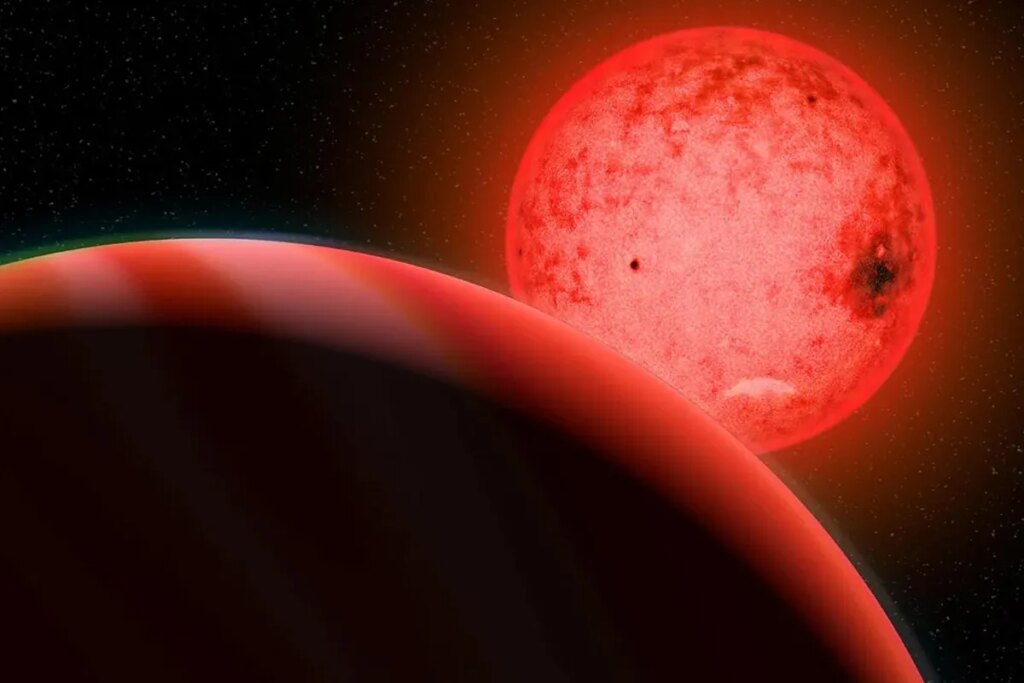
Three years ago, Carnegie University astronomers examining a small star called a red dwarf found something unexpected: a Jupiter-sized gas giant.
In a star system like our own, this would be unremarkable. But at nearly a quarter the size of its host star, the exoplanet, TOI 5205b, was — in the literal sense — impossibly large. It blocked seven percent of the star’s light whenever it passed in front of it, forming one of the largest exoplanet transits on record. It was so physics-defying that the astronomers dubbed it “forbidden”; existing gas planet formation models couldn’t explain how a puny red dwarf, which is only forty percent of the mass of the Sun, could be capable of giving birth to it.
Now, the astronomers got a second look with the James Webb Space Telescope to peer into its atmosphere. And their findings, published in a new study in The Astronomical Journal, reveal even more unusual aspects of the oversized world.
The main curiosity is that its atmosphere has a lower concentration of heavy elements relative to hydrogen than gas giants in our own solar system (Jupiter and Saturn), suggesting something different about its formation.
Compared to its host star, the forbidden world also a lower metallicity, a term that describes the abundance of elements heavier than hydrogen and helium.
“These findings have implications for our understanding of the giant planet formation process that occurs early in a star’s lifespan,” lead author and Carnegie astronomer Anjali Piette said in a statement about the work.
The prevailing theory on planet formation is that they’re conceived in a spinning disk of gas and dust that surrounds a star, which itself forms after the star forms from the collapse of a vast and dense nebula. The disk is the leftover material of its birth, eventually becoming the star’s cosmic companions.
Over time, pockets inside this so-called protoplanetary disk will condense to form rocky planets, or the rocky core that will eventually become an even larger gas giant. Most models suggest that these cores need to be around ten Earth masses to possess the gravity to start rapidly condensing gas around itself. But with a red dwarf like the one TOI 5205b orbits, there shouldn’t have been enough of this material to form the initial core.
The astronomers haven’t found anything to reconcile this discrepancy yet, but the unusually low metallicity is giving them much to chew over. It suggests that the planet’s “heavy elements migrated inward during formation and now its interior and atmosphere are not mixing,” coauthor Shubham Kanodia from Carnegie Science said in the statement. “These results suggest a very carbon-rich, oxygen-poor planet atmosphere.”
More on space: Scientists Spot Two Planets That Collided, Resulting in Carnage That Will Send Prickles Through Your Scalp
The post Astronomers Found Something Strange In Giant “Forbidden” Planet Nearly the Size of Its Star appeared first on Futurism.