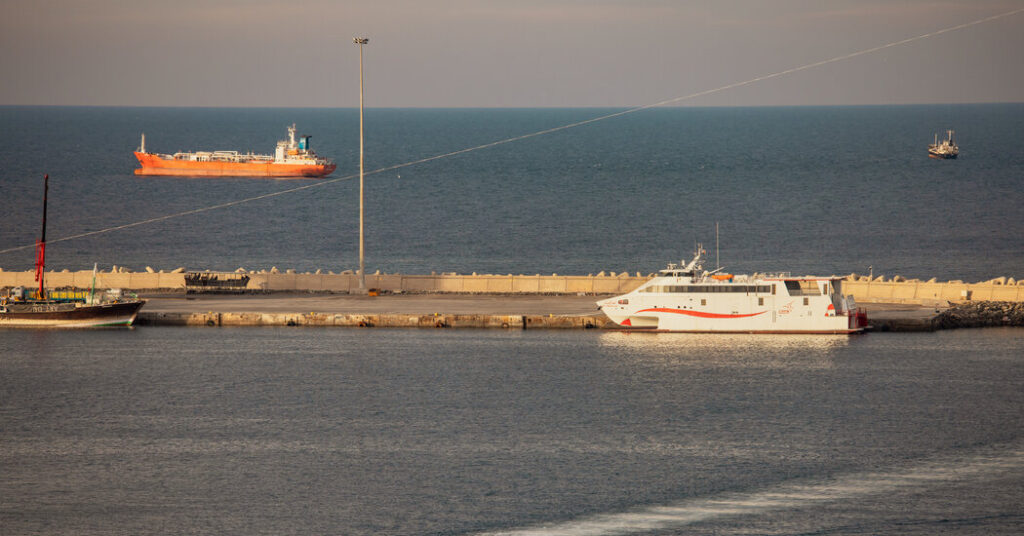
As I write this, President Trump’s ultimatum to Iran to reopen the Strait of Hormuz is set to expire on Tuesday. And his threats are escalating.
Just after announcing the rescue of an American airman whose plane was downed by Iran, Trump said in an expletive-laced social media post that he’d bomb the country’s power plants and that Iran’s leaders would be “living in Hell.” He told a journalist that if Iran didn’t make a deal “I am blowing up everything.”
My colleague Jim Tankersley has been looking at European efforts to find ways to reopen the strait after the fighting stops, whenever that day comes. Military planners from around the world will be meeting in Britain this week to explore that question, and Oman says it has been talking to Iran, too. But as Jim explains, none of the available options, even for those inclined to intervene, look promising.
Four options and zero guarantees
by Jim Tankersley
European leaders say they are eager to find a way to ensure safe passage for oil tankers and other cargo ships sailing through the Strait of Hormuz, where Iran’s scattered attacks have effectively throttled traffic.
It’s easy to see why. They’d like to avoid fuel shortages, prolonged price spikes and the wrath of President Trump. But despite weeks of discussions, including a virtual meeting of more than 40 countries convened on Thursday by Britain, no such plan has emerged.
That reflects, in part, a belief that there is little they can do to safeguard the strait while America, Israel and Iran are still dropping bombs and lobbing missiles in open conflict.
It also reflects the slow gears of diplomacy, and the sheer number of countries, including Persian Gulf nations, that are invested in safeguarding the strait once the war ends.
But more than anything, the struggle reflects how difficult it could be to actually secure the strait, even under a fragile peace — for Europe or for anyone else. None of the options available to Europe, the Gulf nations and other countries look foolproof, even under the assumption that the major fighting will have stopped.
Idea 1: Naval escorts
The plan: President Emmanuel Macron and French officials have repeatedly raised the possibility that French naval vessels could help escort merchant ships through the strait, once the war ends. American officials have pushed for Europeans and other allies, like Japan, to provide escorts for ships sailing under the flag of their own countries. (A French escort for a French ship, for example.)
The catch: Naval escorts are expensive. Their air defense systems alone also might not be sufficient to stop some types of attacks on vessels, like drones, should Iran choose to start firing again. “What does the world expect, what does Donald Trump expect, from let’s say a handful or two handfuls of European frigates there in the Strait of Hormuz,” Boris Pistorius, the German defense minister, asked last month, “to achieve what the powerful American Navy cannot manage there alone?”
Idea 2: Sweep for mines
The plan: German and Belgian officials, among others, say they are prepared to send minesweepers to clear the strait of explosives after the war.
The catch: Western military leaders aren’t convinced that Iran has actually mined the strait, in part because some Iranian ships still pass through it. So minesweepers might be deployed as part of a naval escort, but they might not have much to do.
Idea 3: Help from above
The plan: Send fighter jets and drones to intercept any Iranian air attacks on ships. American officials have pushed Europe to do it.
The catch: Also quite expensive. Still not guaranteed to work. Iran can attack ships with a single soldier in a speedboat, and if even a few attempts succeed, that could be enough to spook insurers and shipowners from attempting passage.
Idea 4: All of those, plus diplomacy
The plan: Pressure Iran with negotiations and economic leverage to refrain from future attacks and deploy a variety of military means to enforce that. On Thursday, the German Foreign Ministry called on China to use its influence on Iran “constructively” to help end hostilities.
The catch: Expensive. Still not guaranteed. Negotiations have seemingly done little to end the war. But this may be Europe’s best bet, for lack of a better one.
What if none of that works?
Continued blockage risks global economic disaster. Countries around the world rely on shipments through the strait to deliver fuel and fertilizer, among other staples. In some regions, shortages are looming. In others, like Europe, high oil, gas and fertilizer prices have raised the specter of spiking inflation and cratering economic growth.
“The big threat right now is stagflation,” said Hanns Koenig, a managing director at Aurora Energy Research, a Berlin consultancy. “You’ve got higher prices, and they strangle the tiny growth we would have seen this year.”
We’ll see what emerges from the meeting of military officials this week — and from Trump’s deadline. But last week, Iranian officials said they planned to continue to control traffic through the strait after hostilities ended. They have already made plans to begin charging tolls for ships to pass through what is meant to be an unfettered waterway under international law. And at the moment, it’s not clear that anyone can stop them.
My colleague Eric Schmitt, our national security correspondent, explains how difficult it would be to take the strait by force. Watch the video.
Other developments:
-
Israel attacked Iran’s largest petrochemical complex in the city of Mahshahr on Saturday.
-
These five maps show the scale of the war in the Middle East.
MORE TOP NEWS
How the downed airman was rescued deep inside Iran
An Air Force officer of an F-15E fighter jet shot down on Friday by Iran spent a day in hostile territory with little more than a pistol for protection. He hiked up a 2,100-meter ridgeline and hid in a mountain crevice, where he was located with help from the C.I.A. and extracted in an operation involving hundreds of special operations troops. Here’s what we know about the rescue mission.
The C.I.A. executed a deception campaign aimed at drawing Iranian forces away from where the officer was hiding. The operation did appear to cause confusion among the Iranian forces hunting for the airman, according to a U.S. official.
OTHER NEWS
-
More than 70 migrants were feared dead after their boat capsized off the coast of Libya.
-
Pope Leo XIV used his first Easter address as pontiff to renew pleas for peace.
-
China sharply tightened rules on drone use and adopted a near-total ban on them in Beijing. Critics say the changes are too restrictive.
-
Dozens were killed by gangs in Haiti just days before a new U.N.-backed multinational force arrived in the country.
-
Jeffrey Epstein presented himself to the Indian tycoon Anil Ambani as a White House insider, according to hundreds of messages exchanged by the men.
WHAT ELSE IS HAPPENING
-
Pepsi dropped its sponsorship of a London festival headlined by Ye, the rapper formerly known as Kanye West.
Top of The World
The most clicked link in your newsletter Friday was about China’s space program.
SPORTS
Cycling: Tadej Pogačar soloed to a third Tour of Flanders victory. He has now won all three races he has taken part in this season.
Football: Seven writers look ahead to the World Cup and make some predictions.
RESCUE TRAINEE OF THE DAY
Baggs, the golden retriever
A 5-month-old puppy, Baggs is training to be an avalanche rescue dog, a rigorous process that takes years. She was chosen for her love of solving puzzles and ability to stay calm around distractions like loud helicopters. During drills in Jackson Hole, Wyoming, she is learning to ride chairlifts and ski, slung across the shoulders of patrollers.
MORNING READ
Nearly four years after OpenAI started the A.I. boom with its ChatGPT chatbot, one industry that is unquestionably being disrupted is the tech industry itself.
Tech workers have been building their own A.I. replacements. Generative A.I. has become particularly good at computer programming. That has given many companies the chance to start cleaning house. Read more about how A.I. is changing Silicon Valley.
AROUND THE WORLD
The cultural tug of war that made Shanghai
Shanghai was an early showcase of modern architecture in China. But over the decades, many of its Art Deco marvels have been covered up, torn down or neglected by Communist Party officials who saw them as signs of Western imperialism.
The buildings still standing today survived the Mao era and widespread demolition in the 1990s, when a frenzy for high-rise development took off. They have been saved by a growing recognition of the value they add to Shanghai’s unique character — and to the role played by Chinese architects and financiers, not just foreigners, in creating them. Read more about Shanghai.
RECOMMENDATIONS
Watch: In the film “DJ Ahmet,” life changes for a young shepherd in North Macedonia after he finds a dance party in the woods.
Discover: Does collagen protein have health benefits?
Savor: Here’s how to determine the right balance between quality and price when buying wine.
RECIPE
This vegetarian pasta is an Afghan Italian mash-up inspired by Italian pasta alla Norma and Afghan borani banjan. Featuring tender eggplant in a spiced tomato sauce, it’s served with yogurt over top.
WHERE IS THIS?
Where is this castle?
TIME TO PLAY
Here are today’s Spelling Bee, Mini Crossword, Wordle and Sudoku. Find all our games here.
That’s it for today. See you tomorrow! — Katrin
Jim Tankersley was our guest writer today.
We welcome your feedback. Send us your suggestions at [email protected].
Katrin Bennhold is the host of The World, the flagship global newsletter of The New York Times.
The post A Looming Deadline appeared first on New York Times.