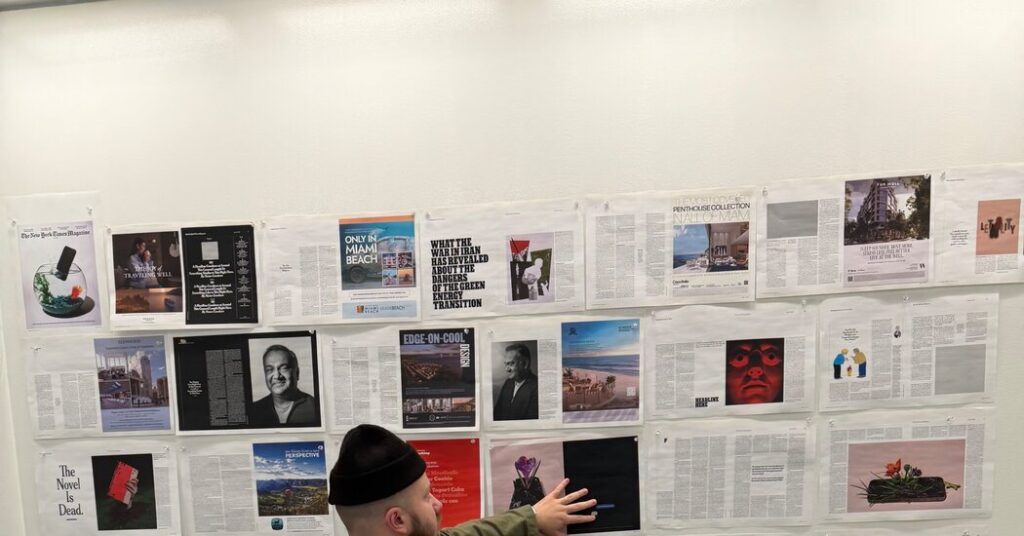
When we set out to redesign The New York Times Magazine last year, we were trying to solve a specific problem: We had more people reading our work online than ever, but much of what we published was still oriented around the demands of our Sunday print magazine, and the particular limitations inherent to assembling, manufacturing and distributing that weekly product.
We knew we needed to break free of these limitations and set ourselves up to deliver stories that feel tailor-made to the digital reader; but we also knew we had to keep making a great print magazine, which is 130 years old.
How to do both?
The story of how we changed the magazine’s lead column offers a good explanation of this problem, and one way we tried to solve it.
The lead column in a magazine’s “FOB,” or “front of book,” is a crucial element. It has to feel fresh and relevant. It sets the tone for your entire reading experience, like the first person you meet at a party.
When we last redesigned the magazine, in 2015, we overhauled the FOB. It’s one of the main things any magazine does when it wants a fresh look. At the time, the lead item in the FOB was called the One-Page Magazine, a single page filled with quirky odds and ends. (Fun fact: The only thing that remains from the One-Page Magazine is the Judge John Hodgman column, which runs alongside The Ethicist every week.) Back then we wanted to replace it with a column, some sort of fresh and incisive bit of commentary to get things started.
But there was a catch: Unlike most magazines, which are sent via postal mail straight from the printing plant to the subscriber, The Times Magazine is bundled into the Saturday or Sunday edition of The New York Times, depending on where you live. The steps required to do that — printing the edition, trucking it to distribution hubs and inserting it into the paper — add about a week to the delivery time. (We sent this weekend’s magazine to the printer on Thursday, March 26.)
So for the 2015 redesign, we set out to come up with a column that would still feel fresh despite the time lag. This meant it couldn’t be directly pegged to the news.
Our solution was First Words, in which writers analyzed recent speeches or other bits of language. That lasted a few years before we replaced it in 2019 with Screenland, a column that similarly analyzes movies, TV and video.
They were both good columns, but the way they avoided being late was by not trying to be timely. They were built to feel broadly relevant when they arrived in print, but over time, as we came to see the digital version of the column as its primary form, they began to feel out of date when we published them online.
For our new lead FOB column, we didn’t try to come up with something that would be shelf-stable for 10 days. And to be honest, we didn’t think primarily about the print FOB section.
Instead we have been experimenting since last fall with a range of different digital columns, searching for things that feel topical at the moment they’re published online. Out of this work, a range of different ideas emerged: among them, a re-imagination of the magazine’s On Language column; a column tracking international opinion about the United States; a visual history of contemporary objects; an oral history of a photograph; columns about genealogy and death; and a weekly piece about current affairs that helps readers understand events by putting them in historical, political or intellectual context. We started publishing this last column, The Context, in January.
Some of these we set aside, some are still in development, and some you’ll find debuting in this weekend’s print magazine. But which to use as the tone-setter, the lead item? We considered several options: The Interview is one of our most popular columns, but it doesn’t run 52 times a year; The Ethicist does, and it’s also a big draw, but it’s not the right way to begin the FOB.
We decided on The Context. As the Magazine’s lead column, it was formulated to solve a different problem than its predecessors: how to be as timely as possible when it appears online on a Friday or Saturday. But by choosing its subjects carefully and pushing the analysis to be as deep and rigorous as possible, we believe we can produce a column that will be valuable to readers even after it’s been printed, trucked, inserted and delivered 10 days later.
For instance, our first column looks at how the green energy transition has created vulnerabilities in the world’s fossil fuel infrastructure that are being weaponized by all sides in the war in Iran.
The Context is just one element of a much larger redesign, but the thinking behind it — for online and as our lead print column — is part of the editorial brainstorming and problem-solving my colleagues and I do as we plan magazine journalism that needs to exist in two forms.
Reorienting our work around the digital reader while ensuring that we still deliver a great print magazine is a constant work in progress. We’ll keep tinkering with it. But in the case of The Context, we think we’ve found the person who you’d want to meet first at the party.
The post The Thinking Behind Our Times Magazine Redesign appeared first on New York Times.