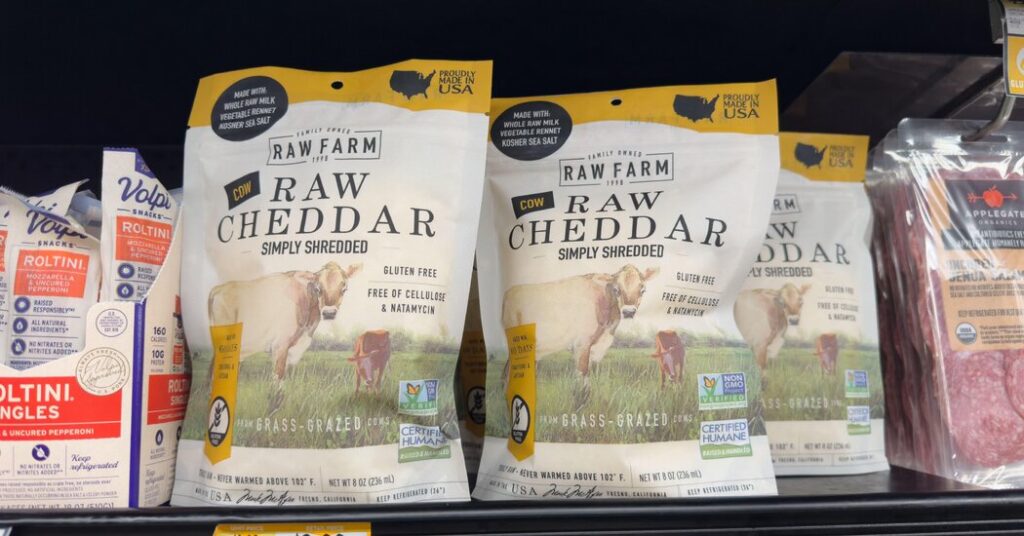
For weeks, the Food and Drug Administration has been asking a raw-dairy farm in California to recall its Cheddar cheese, which the agency has linked to nine E. coli illnesses in California, Texas and Florida.
On Thursday, the dairy farm, Raw Farm LLC, finally complied, though it said it was doing so “under protest” as it continued to deny that its cheese was the cause of the outbreak.
The recalled products, which include original and jalapeño Cheddar sold in blocks and shredded original Cheddar, have expiration dates between May and September. People should check their refrigerators for the recalled cheeses and throw them away, the Centers for Disease Control and Prevention advised in a notice on Friday. The cheeses have been sold nationwide at Sprouts Farmers Market, H-E-B and other grocery stores.
It is rare for a company to refuse to recall products linked to an outbreak of food-borne illness when asked to do so by the F.D.A. In such cases, the agency can issue a mandatory recall, but it had not taken that step with Raw Farm.
“It was a standoff between us and them,” Aaron McAfee, the president of Raw Farm, said in an interview, referring to the F.D.A. He ultimately decided to issue the voluntary recall on the advice of his company’s lawyers, he said, to prevent further damage to the business.
Mr. McAfee estimated that the recall included 170,000 pounds of cheese, valued at approximately $1.5 million.
Federal health officials first announced the outbreak on March 15. On Friday, the F.D.A. reported that nine people had been infected with E. coli O157:H7, a dangerous strain of the bacteria that can cause severe intestinal infections, with illnesses beginning between Sept. 1 and Feb. 20. Three people have been hospitalized, and one person developed hemolytic uremic syndrome, a serious condition that can cause kidney failure. Over half of the illnesses were in children under 5, the F.D.A. said.
Investigators used a type of genetic testing called whole genome sequencing to determine that all of the infections were likely caused by a common source. They also interviewed eight of the infected people (or their caregivers, in the case of young children), and all reported consuming raw dairy products. One person did not know the brand, and the other seven reported consuming Raw Farm products, including raw milk and Cheddar cheese, according to the F.D.A.
Any raw milk that may have caused illnesses should no longer be for sale, according to the F.D.A. The agency said it was not aware of Raw Farm cheese that had tested positive for E. coli., but the investigation is ongoing.
The fact that E. coli has not been found in any of the farm’s cheese has been a sticking point for Raw Farm. On social media, the company has insisted that there was not enough evidence that the illnesses were caused by its cheese.
Darin Detwiler, a professor of food regulatory affairs at Northeastern University, said that the epidemiological and genetic evidence connecting the farm to the outbreak was substantial. It is common, he said, for investigators never to find a positive food sample in outbreaks. By the time people get sick enough to see a doctor, and for public health officials to realize that the illnesses may have been caused by a food-borne pathogen, the foods that may have been a source of an outbreak have often been eaten or thrown away.
“Think of it like a crime scene,” Professor Detwiler said. “Multiple witnesses describe the same suspect. Security footage shows the same person entering each location. But the suspect has already left the building. That’s what’s happening here.”
Prof. Detwiler criticized Raw Farm for waiting for weeks to issue a recall. “Your one job is to have prevented this,” he said. And when there is evidence that a product is unsafe, he added, “your one job is to recall it immediately,” to prevent additional illnesses. Professor Detwiler’s 16-month-old son died in 1993 from an E. coli infection caused by an outbreak linked to ground beef sold by the fast-food chain Jack in the Box.
Previous food-borne outbreaks have been linked to Raw Farm’s products, including a 2024 E. coli outbreak tied to raw Cheddar that sickened 11 people.
Unpasteurized milk sold by the farm was tied to a salmonella outbreak that sickened least 171 people, 22 of whom were hospitalized from September 2023 to March 2024. That outbreak was the largest to be connected to unpasteurized milk in more than two decades, C.D.C. figures showed.
Pasteurization involves heating milk to kill microbes, which can come from dirt, cow feces or the hands of people who milked the cows. In raw milk and dairy products made from it, those microbes can survive and grow.
For decades, public health officials have warned that consuming raw dairy products can cause food-borne illnesses with symptoms that can include nausea, vomiting, stomach pain, fever, headache and body aches.
Severe cases, though rare, can cause kidney failure, stroke or even death. The risk is greatest in children, older adults and people who are pregnant or have weakened immune systems, according to the C.D.C.
Alice Callahan is a Times reporter covering nutrition and health. She has a Ph.D. in nutrition from the University of California, Davis.
The post ‘Under Protest,’ Raw Dairy Farm Recalls Cheddar Linked to 9 E. Coli Cases appeared first on New York Times.