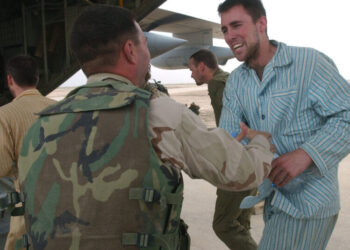
American forces rescued an airman whose warplane was shot down over Iran on Friday, but the uncertain fate of a second crew member prompted a risky search operation on Iranian soil, U.S. and Israeli officials said.
The loss of the warplane, an F-15E Strike Eagle, is the first known instance of an American combat aircraft going down over Iran since the war began more than a month ago.
Iran’s ability to shoot down the fast and agile F-15E came three days after the leaders of the Pentagon claimed “an increase in air superiority” over the skies in Iran. The downing of the jet suggested that Iran, whose military and air defenses have been heavily bombed, still had some command of its airspace. An American helicopter was hit during the search-and-rescue operation but managed to escape safely.
A second U.S. Air Force combat plane crashed near the Strait of Hormuz about the same time the F-15E was shot down over Iran, according to two U.S. officials who spoke on condition of anonymity to discuss operational matters. The lone pilot in the second plane, an A-10 Warthog, was rescued. The officials provided scant details about the A-10 crash, including how and precisely where it happened.
The search for the second airman from the F-15E came as the war reached a new and dangerous phase for the global economy. Iran’s effective throttling of the Strait of Hormuz, the crucial oil and gas gateway, is extracting a severe toll on the countries that rely on Gulf exports. And the United States and Israel have turned to striking infrastructure inside Iran, including a highway bridge near the capital, Tehran, attacked by the U.S. on Thursday.
Those strikes have prompted Tehran to retaliate by launching attacks against key oil facilities and other targets vital to Gulf countries.
The Kuwaiti government said on Friday that Iran had damaged a power and water desalination plant in the country. The Kuwait Petroleum Corporation on Friday said that drones had struck its Mina al-Ahmadi refinery, but did not specify where the attack had originated. In Abu Dhabi, the Emirati capital, the authorities said that falling debris from an air defense interception started a fire at a major gas field, halting operations there.
The attacks across the Middle-East and the downing of the American warplane laid bare Iran’s residual military capabilities after thousands of strikes by Israeli and American forces on its military facilities.
In the hours after the F-15E was shot down, the prospect that an American airman was missing in Iran raised the stakes for President Trump in a war that has proved unpopular in opinion polls from the start. Mr. Trump and his defense secretary, Pete Hegseth, have described the war with swagger, vowing this week to bomb Iran back to the “Stone Ages.”
Iranian officials have responded in kind. The speaker of the country’s Parliament, Mohammad Ghalibaf, mocked the U.S. war effort in a social media post on Friday, writing: “This brilliant no-strategy war they started has now been downgraded from ‘regime change’ to ‘Hey! Can anyone find our pilots? Please?’”
Soon after the warplane went down on Friday, an anchor for a local affiliate of Iran’s state TV broadcaster read a statement on the air calling on residents of a southwestern province to capture the “enemy’s pilot or pilots” alive and turn them over to security forces in return for a reward.
The state broadcaster published images that it said showed wreckage of the downed jet. The photos show the wingtip and top section of a vertical stabilizer from a U.S. Air Force F-15E Strike Eagle, according to Justin Bronk, a senior research fellow who studies air power and technology at the Royal United Services Institute, a defense-focused research institution in London.
U.S. Central Command keeps multiple task forces set up near Iran — including in both Iraq and Syria — for search-and-rescue operations in the event that American warplanes are shot down, according to officials who spoke on the condition of anonymity to share operational details.
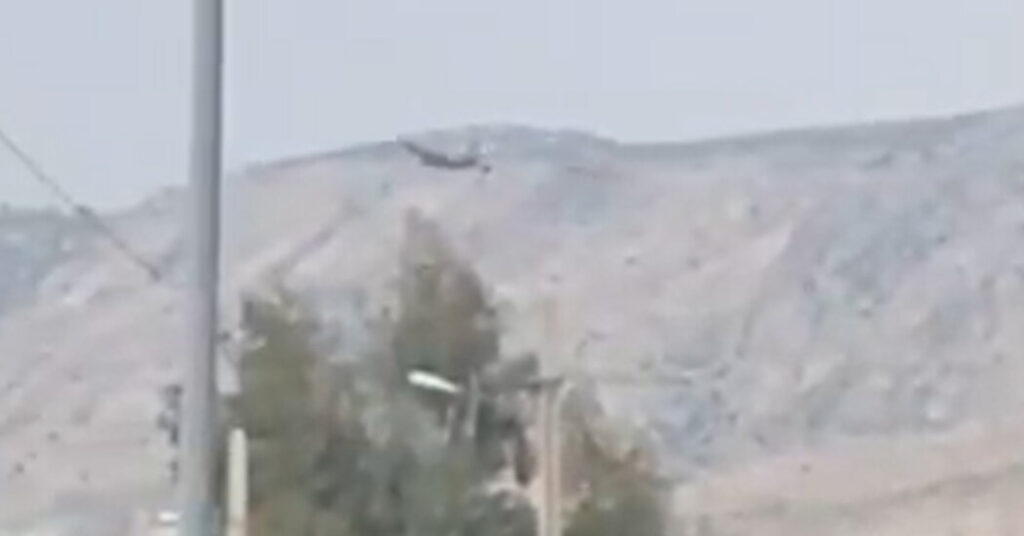
Inside Iran, videos posted to social media and verified by The New York Times show helicopters and a C-130 airplane, American craft that apparently were part of the search-and-rescue effort for the F-15E, flying low over southwestern Iran.
Such an operation is extremely dangerous because Iran still retains antiaircraft weapons. Without the support of U.S. troops on the ground, the loss of recovery aircraft to hostile fire could turn an already difficult situation into a catastrophe. A U.S. Air Force UH-60 Black Hawk helicopter was hit by Iranian ground fire on Friday during the operation to rescue the crew of the F-15E, American and Israeli military officials said. The helicopter crew managed to escape safely and reached Iraq, the officials said.
The fear that airmen could be taken prisoner in the war has always been a highly disturbing scenario for American military planners given the fraught echoes of the past. In announcing the attacks on Iran that began on Feb. 28, Mr. Trump evoked the scores of Americans taken hostage from the U.S. Embassy in 1979. The crisis, along with the disastrous and aborted mission to rescue the hostages, has cast a long shadow over relations with the country in the decades since.
Mr. Trump did not address the specifics of the search-and-rescue operations during a phone interview with NBC News on Friday. But he said the downing of the warplane would not affect negotiations with Iran, which has publicly denied that talks are occurring. “No, not at all,” NBC quoted Mr. Trump as saying. “No, it’s war. We’re in war.”
The F-15E, which was first introduced four decades ago, can reach maximum speeds of 1,875 miles per hour, or two and a half times as fast as the speed of sound. It is capable of flying at low altitudes, including at night and in “any weather conditions,” according to the Air Force. And it can attack ground targets with “a variety of precision-guided and unguided weapons.”
American military pilots shot down over enemy territory are trained in a set of principles called Survival, Evasion, Resistance and Escape, or SERE. The first step is to eject safely from the aircraft via parachute, according to Adm. William J. Fallon, a former commander of U.S. Central Command.
Once on the ground, pilots must find a secure place to evade capture and use radios to share their locations with U.S. forces, he said.
Admiral Fallon said a key factor in this episode was the time of day that the warplane had been shot down on Friday. “It’s probably close to sunset, and that’s good, because we typically have an advantage at night with our search-and-rescue people,” he said.
Iran’s expansive remote territory may improve the odds of pilots’ ability to hide, Admiral Fallon added.
For cases in which individuals are captured or taken hostage by enemy forces, pilots can draw on resistance training to deal with extreme stress, interrogation and possible torture while in captivity.
Iran’s Revolutionary Guards closed off and searched an area on Friday where they believed the American airman who was shot down might be, according to three officials familiar with the operation, who spoke on the condition of anonymity to discuss military matters. The search was carried out by troops and local residents in the Kohgiluyeh and Boyer-Ahmad Province in southwest Iran.
American combat aircraft losses have been relatively light since the war in Iran started.
In addition to the two planes that went down on Friday, three Air Force F-15Es were shot down by friendly fire over Kuwait on March 2. All six crew members ejected safely. A KC-135 tanker crashed in western Iraq over a week later in Iraq, after an apparent midair collision with another tanker, resulting in the deaths of six crew members.
By comparison, the United States lost 42 combat aircraft in the 43-day air campaign of the 1991 Persian Gulf war, according to David A. Deptula, a retired three-star Air Force general who was a main architect of that so-called Desert Storm operation.
Reporting was contributed by Ronen Bergman, Thomas Gibbons-Neff, Aurelien Breeden, Yeganeh Torbati, Adam Rasgon, Tyler Pager, Farnaz Fassihi, Pranav Baskar, Euan Ward, Haley Willis and Leily Nikounazar.
Eric Schmitt is a national security correspondent for The Times. He has reported on U.S. military affairs and counterterrorism for more than three decades.
The post U.S. Searches for Airman After Iran Shoots Down Fighter Jet appeared first on New York Times.