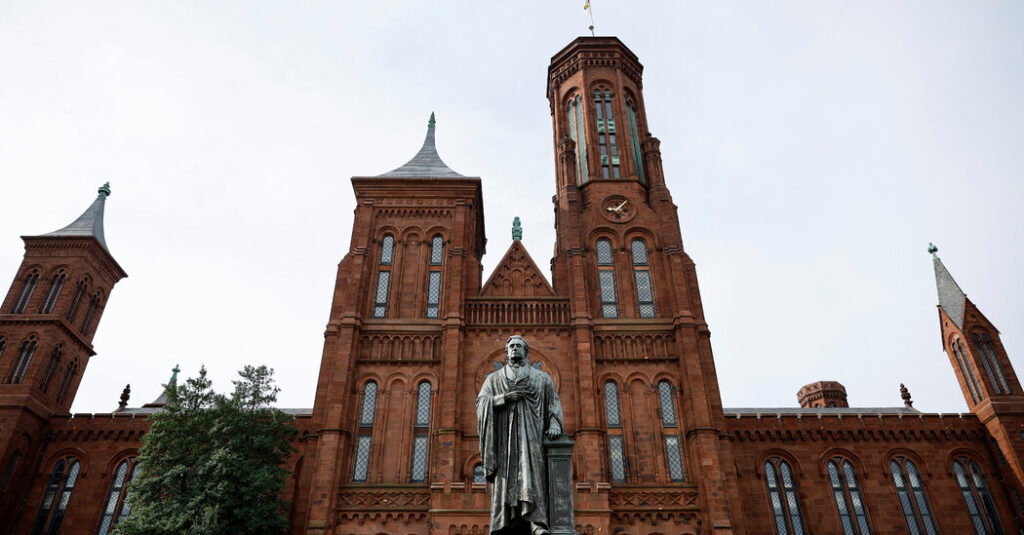
A month after the terms of two Smithsonian trustees ended, their replacements have yet to be named as the traditional process of filling its governing Board of Regents has slowed in the wake of President Trump’s efforts to gain control of the institution.
John Fahey and the board’s chairwoman, Risa J. Lavizzo-Mourey, left the 17-member panel on March 2,
The Regents had agreed on names for their replacements at a meeting last year, according to a person familiar with the deliberations. But the Committee on House Administration, to which such candidates are traditionally forwarded by the board, has yet to receive any names of potential replacements.
Congress must approve the appointments, which then require a sign off by the president. Mr. Trump, however, has indicated that he wants to overhaul the board with his own brand of trustees.
In an executive order issued a year ago, the President called for Vice President JD Vance to work with the House speaker and the Senate majority leader, both Republicans, “to seek the appointment of citizen members to the Smithsonian Board of Regents committed to advancing the policy of this order.”
Executive Order 14253, “Restoring Truth and Sanity to American History,” accused the institution of promoting “narratives that portray American and Western values as inherently harmful and oppressive.”
The board’s composition is one of several areas where the White House is seeking to refashion the Smithsonian into an institution more aligned with Mr. Trump’s agenda. The administration has already pressured the Smithsonian — which has long operated as independent of the executive branch — to turn over internal records regarding content, plans and decision-making at eight of its 21 museums.
Experts said it is highly unusual for the White House to take an interest in the Regents’ nominating process. Since the Smithsonian was established in 1846, its governing members have cycled off after their staggered six-year terms — which can only be renewed once. The transition has generally been uneventful and apolitical.
“It’s a surprising development,” said Samuel J. Redman, a history professor at the University of Massachusetts Amherst who has written about the Smithsonian. “This could be an important delay in terms of getting things done down the line.”
So far the Smithsonian’s secretary, Lonnie G. Bunch III, been able to rely on the backing of the board, which appointed him. But that support could diminish if the White House succeeds in installing its favored candidates on the panel.
And more seats may soon open up.
Though the Regents voted months ago to renominate two members for second terms, neither of those candidates — Denise O’Leary of Colorado and Franklin D. Raines of the District of Columbia — have had their names forwarded to Congress for reasons that remain unclear.
The Board of Regents includes six members of Congress — three from the House of Representatives and three from the Senate; nine citizens; the U.S. Vice President; and the Chief Justice of the United States, John G. Roberts Jr., who serves as the board’s chancellor.
O’Leary’s term expires next week, and, if Congress does not act, the board will be down three members. Raines’s term expires in the fall, when two additional Regents are also set to leave the board.
Smithsonian officials declined to comment on the appointment process, and offered no explanation for the delays. Julissa Marenco, a Smithsonian spokeswoman, said that the appointments are directed by the board, which, through her, also declined comment.
A White House spokesman declined to address the specific issue of appointments but reaffirmed its commitment to seeking changes at the Smithsonian. Davis Ingle, the spokesman, said the administration’s review of museums and exhibitions “aims to ensure alignment with President Trump’s directive to celebrate American exceptionalism in this 250th year of American Independence, and to support a broader vision of excellence that highlights historically accurate, uplifting, and inclusive portrayals of America’s heritage.”
In January, facing a White House ultimatum to turn over Smithsonian records — or face potential budget cuts — Mr. Bunch, in an email to staff members, reasserted the institution’s independence but said that additional materials had been submitted in an effort to be “transparent and open.”
More recently, speaking on a panel at the New York Historical museum last month in which some historians took issue with Mr. Trump’s efforts, Mr. Bunch said: “Because I’m in the middle of it, let me say this in the best diplomatic way I can. You better fight like hell for history.”
The board members who just left — Fahey, chairman emeritus of the National Geographic Society, and Lavizzo-Mourey, a geriatrician and health policy expert, did not respond to requests for comment.
The urgency of the administration’s effort to examine the Smithsonian seems to have eased since the President turned his attention to issues like the war in Iran and gas prices. In addition, Lindsey Halligan, the White House aide tasked with scrutinizing the Smithsonian for “improper ideology,” was rerouted by Mr. Trump to serve as the U.S. attorney for the Eastern District of Virginia — a position she resigned from in January.
Some 62 percent of the Smithsonian’s annual $1 billion budget is derived from federal sources, including funds directly appropriated by Congress. Once the funding is authorized, its disbursement is controlled by the Office of Management and Budget, which has announced that the money must be spent in line with the president’s agenda.
The Trump administration proposed cutting the Smithsonian’s budget by about 12 percent in fiscal year 2026, but Congress has maintained the Institution’s federal funding.
Jennifer Schuessler contributed reporting.
Robin Pogrebin, who has been a reporter for The Times for 30 years, covers arts and culture.
The post Seats Left Empty on Smithsonian Board as Strain With White House Persists appeared first on New York Times.