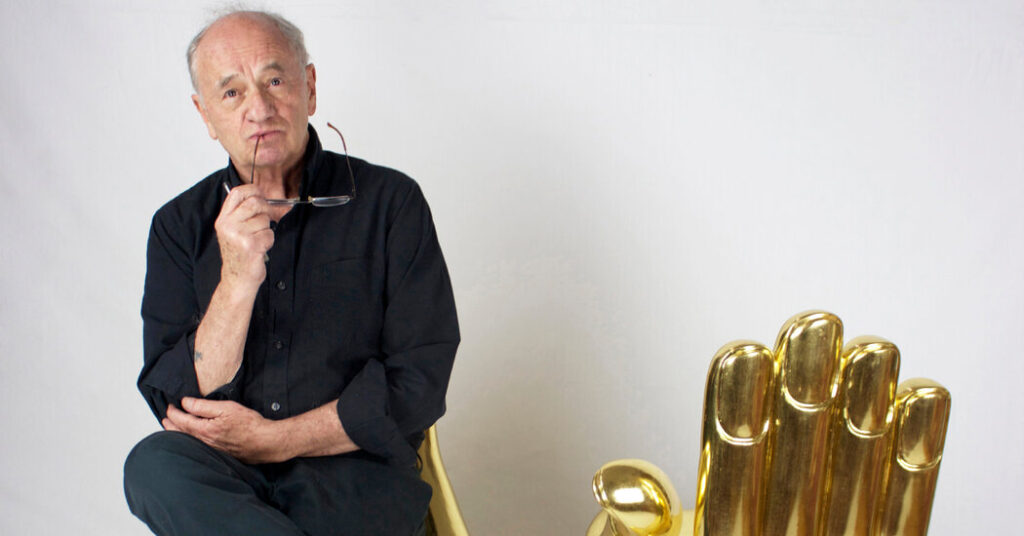
Pedro Friedeberg, a celebrated Mexican artist often called “the last Surrealist,” who was known for his hallucinatory paintings of imaginary cities and buildings, as well as his absurdist furniture designs — particularly his hand-shaped chair, which became a sought-after home-décor item and a pop-culture curio — died on March 5 in San Miguel de Allende, Mexico. He was 90.
His death, at the home of his ex-wife and friend, Carmen Gutiérrez, was caused by colon cancer, according to Déborah Holtz, a friend whose Mexico City-based company, Trilce Ediciones, published several books about Mr. Friedeberg’s life and art.
Born in Italy to German Jewish parents, Mr. Friedeberg moved to Mexico with his family as a young child and was eventually hailed as an artistic force in his adopted country. He worked in various mediums, including sculpture and printmaking, but found fame with paintings and drawings that transcended the literal — and psychic — boundaries of his university architecture studies.
Drawing from Op Art and Pop Art as well as Surrealism, his paintings and lithographs were intricately geometric and dreamlike, conjuring otherworldly skylines, town centers, buildings and temple-like interiors.
His work sometimes called to mind one of his early influences, M.C. Escher, the Dutch printmaker known for trippy (and dorm-friendly) visual enigmas. Many of Mr. Friedeberg’s paintings and sculptures incorporated incongruous images, like dog heads or Mickey Mouse, or symbols drawn from the Aztecs and other cultures, the occult or kabbalah.
Mr. Friedeberg was considered a leading light of the mid-20th-century Mexican Surrealist movement, along with older European émigré artists like Leonora Carrington from Britain and Remedios Varo from Spain, who both moved to Mexico during World War II. The French writer and poet André Breton, widely considered the father of Surrealism, was a champion of his artwork.
Mr. Friedeberg kept working into his 80s, as most of the older generation of Surrealists retired or died. But in later years, he chafed at the designation that continued to follow him. “That’s a terrible mistake,” he was quoted saying in a 2024 profile in W magazine. “I’m neither a Surrealist nor the last of anything.”
Eccentric and at times irascible, he grew equally weary of the outsize attention paid to his most famous creation, the playful Mano Silla (Hand Chair), from 1962 — a large wooden hand that offers its palm as a seat and its fingers as a backrest.
The idea for the chair emerged from a favor to his friend and mentor, Mathias Goeritz, an influential German-born Mexican artist, architect and theorist who, like Mr. Friedeberg, opposed the stark minimalism so prevalent in midcentury art and architecture.
As Mr. Friedeberg recounted in a 2015 interview with Pin-Up, a New York-based architecture and design publication, Mr. Goeritz was leaving for a six-month honeymoon in Europe and told him, “I have this wonderful woodcarver and I don’t want to lose him. Why don’t you give him a job so that he’s busy while I’m gone?”
Mr. Friedeberg reached out to the woodcarver. “I told him to make a hand,” he recalled in a 2017 interview with Architectural Digest. “Then I said, ‘Why don’t you make it big enough to sit on.’ I thought that would be funny.”
He thought little about the results of this request until Mr. Goeritz returned from Europe and dropped by Mr. Friedeberg’s house with a gallerist and art collector friend. “These are fantastic,” the gallerist said upon seeing the chairs. “I want four. No, I want six!”
The chair went into production and, over the years, became a status symbol with international tastemakers — at least those with a sense of whimsy, including the actors Yul Brynner and Jeanne Moreau, the film director Roman Polanski, the fashion designer Arnold Scaasi and the celebrity interior designer Kelly Wearstler.
It was a design that had started as a joke, but now Mr. Friedeberg had to explain why he had decided on a hand. “So I’ve made a list of all the things a hand means,” he told Pin-Up. “There are like 60 meanings of a hand: loyalty, goodness, generosity, power, talent, work.”
Pietro Enrico Hoffman was born on Jan. 11, 1936, in Florence, Italy, to Julius Hoffman and Gerda (Landsberg) Hoffman.
His mother later married Erwin Friedeberg, who helped her and Pietro flee the rising tide of fascism and antisemitism in Europe. They settled in Mexico in 1940, and Pietro adopted the Spanish version of his first name.
He graduated from the American School in Mexico City in 1952 and eventually enrolled at the prestigious Universidad Iberoamericana to study architecture. There, he began rebelling against the minimalism espoused by architects like Mies van der Rohe.
Mr. Friedeberg preferred more ornamental styles like the Baroque, and was particularly fond of the exuberant Art Nouveau work of the Catalan master Antonio Gaudí. With the encouragement of Mr. Goeritz, a professor at the university, he began to design increasingly unbuildable buildings. After three years, he left college to pursue art.
His first exhibition was at a Mexico City gallery in 1960. Around that time, he also helped found an iconoclastic circle of artists known as Los Hartos (the Fed-Ups), whose members included Ms. Carrington, Alice Rahon, José Luis Cuevas and other artists who opposed what they considered the pretentiousness of much contemporary art.
Mr. Friedeberg went on to have exhibitions around the world. His work is part of the permanent collections of more than 50 major museums, including the Louvre in Paris, the Museum of Modern Art in New York, the Los Angeles County Museum of Art and the Smithsonian American Art Museum in Washington.
His marriages to Nancy Lane, Wanda Sevilla and Ms. Gutierrez ended in divorce. His survivors include two children from his second marriage, Diana Friedeberg Gutiérrez and David Friedeberg Gutiérrez; four grandchildren; and a sister, Vera Bopp.
For all his other accomplishments, Mr. Friedeberg is best remembered for his hand chairs. More than 5,000 have been produced in a variety of materials — mahogany, oak, bronze, plastic — and finishes, including gold and silver leaf.
Some rare, original midcentury versions can fetch tens of thousands of dollars at auction. As Architectural Digest noted, “the design world still gives them a round of applause, setting them in Louis XV interiors as well as groovy midcentury ones.” In the 2000s, the hand chair became a running gag on the sitcom “Arrested Development.”
Mr. Friedeberg did not bask in the attention. “I hate them,” he told W. “They’ve become like an icon or something.”
Alex Williams is a Times reporter on the Obituaries desk.
The post Pedro Friedeberg, Whose Hand Chair Drew Outsize Attention, Dies at 90 appeared first on New York Times.