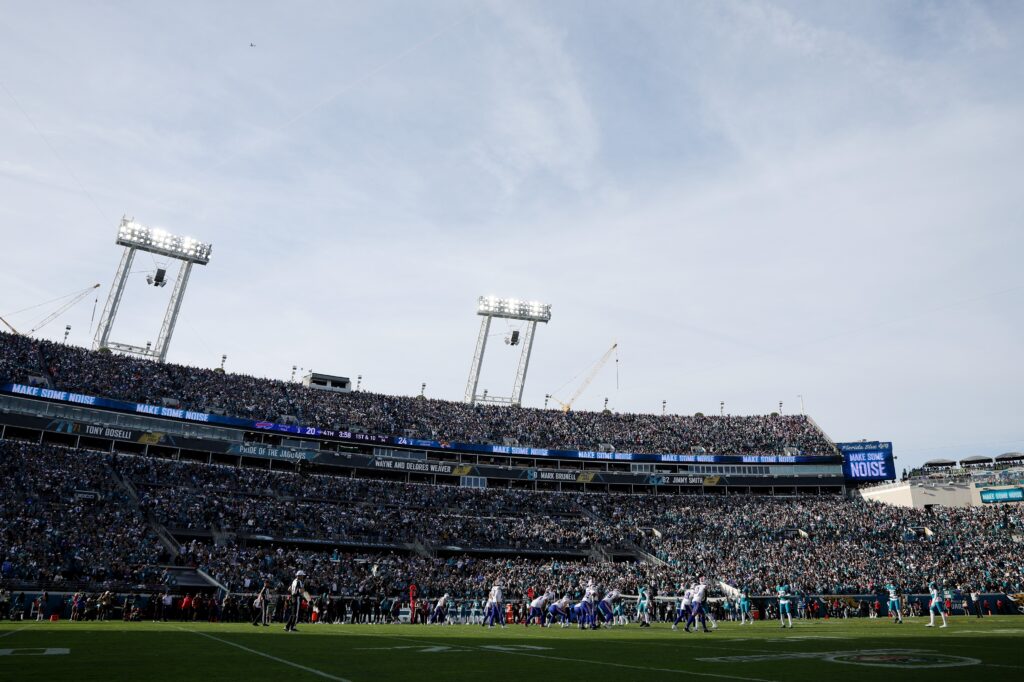
The NFL made it official Tuesday that the Jacksonville Jaguars are “going to Disney World” — that is, playing their 2027 home schedule in Orlando while their stadium gets renovated. The city of Jacksonville is footing half of the bill. This is the latest stage in the ongoing shakedown of its taxpayers.
The usual argument for stadium subsidies is that they bring new economic activity to cities and help create jobs and revitalize neighborhoods. This argument is usually specious; football stadiums are empty most days of the year, and the money people spend at stadiums probably would have been spent at other businesses anyway. Economic research consistently finds that stadium subsidies are terrible public investments.
The Jacksonville example stands out because the usual (bad) arguments don’t even apply. Taxpayers are shelling out a massive amount of money to get slightly less football in the same place.
EverBank Stadium in Jacksonville opened in 1995 and cost $121 million. That’s about $263 million in today’s money. The project to renovate it was forecast in 2024 to cost over five times more — $1.4 billion — than the cost to build it in the first place. And now it’s projected to be $100 million over budget.
Taxpayers are on the hook for $775 million. That’s the largest expenditure in the city’s history. As is often the case with stadium subsidies, the cause was bipartisan, passed by a Republican city council and championed by a Democratic mayor.
The project will overhaul the stadium, adding a canopy over the seating bowl, wider concourses and new (expensive) seating options. It’ll be an impressive venue when it’s done. But the purpose of government isn’t to build fancy stadiums.
The Jaguars are one of the poorest NFL teams, but in an industry with massive profits, the franchise is still worth $5.6 billion. And team owner Shahid Khan is worth about $14.5 billion. The Jaguars have the money to renovate their stadium, but they probably wouldn’t have been as extravagant if half of the project wasn’t paid with other people’s money.
After the renovation is complete, the stadium’s seating capacity for Jaguars games will be slightly smaller, falling from 67,814 to 63,000. This season, the capacity will be only 42,507 as the construction eliminates some seating. And in 2027, capacity in Jacksonville will be zero as the team plays in Orlando, more than two hours away.
On top of playing the 2027 season in a different city, the 2024 stadium renovation agreement also said that the Jaguars will play one of their home games in London every year. At least when other cities give taxpayer money to a team, they play all their home games at home.
Other than temporary construction jobs, renovating the same stadium has little impact on employment growth for the city. Politicians won’t be able to take credit for poaching a team from somewhere else. They aren’t even keeping the team entirely in Jacksonville. And now the mayor of Orlando is bragging about the “pretty serious economic impact” in his city that Jacksonville’s taxpayers are subsidizing.
The post Never subsidize a sports stadium. And definitely not like this. appeared first on Washington Post.