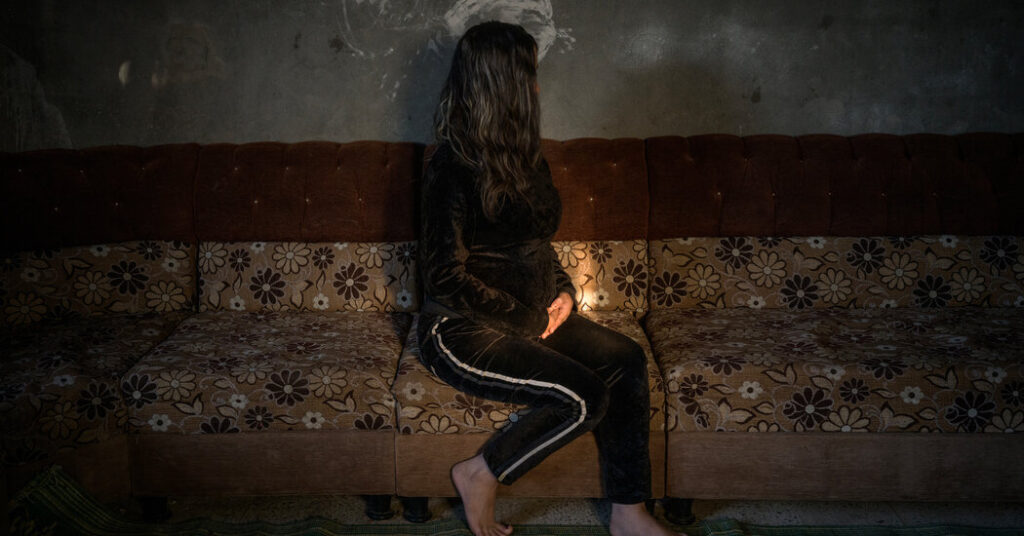
A 16-year-old girl left her home in northwest Syria last May to visit a shop and disappeared.
Weeks later, an anonymous stranger phoned her distraught family and said that he had the teenager and would let her go if they paid thousands of dollars in ransom, according to four people involved in her case.
The family paid the ransom and the girl returned in August, more than 100 days after she had been kidnapped. She told confidants that she had been held in a dank basement and was regularly drugged and raped by strangers, the four people said.
A medical exam turned up yet another shock: She came home pregnant.
Since rebels ousted the dictator Bashar al-Assad in late 2024, panicked families and activists trying to help have regularly sounded the alarm on social media that women and girls from Syria’s Alawite minority have mysteriously disappeared or been kidnapped. Many fear that their sect is being targeted as retribution for the brutality of Mr. al-Assad, who also belongs to the Alawite sect, an offshoot of Shiite Islam.
The government has denied that Alawite women and girls are being targeted by kidnappers, saying that it has confirmed only one such case.
But a New York Times investigation based on dozens of interviews with Alawites who say they were kidnapped, their relatives and others involved in their cases found that these abductions have been common and often brutal.
The Times verified the kidnappings of 13 Alawite women and girls, in addition to one man and one boy. Five said they had been raped. Two came home pregnant.
The family of one woman said it sent $17,000 to kidnappers who never released her, and provided screenshots of ransom demands and the money transfers. A 24-year-old said she had been held for three weeks in a filthy room where men raped her, beat her, shaved her head and eyebrows and cut her with razor blades. Her relatives also paid the kidnappers and in this case secured her release, according to four people involved in her case.
Syrian activists say they know of scores of such kidnappings but details are difficult to confirm because victims and their families are too scared to talk.
Most people who spoke with the Times did so on condition of anonymity for fear of reprisals from the government or the kidnappers. The Times is not identifying most of those who were kidnapped for the same reason.
The Times corroborated accounts from people who had been kidnapped and their relatives, as well as through social media posts announcing when they were taken and returned, ransom messages sent by kidnappers and interviews with medical and aid workers who spoke with the abductees after their release.
The kidnappings took place against a backdrop of deep distrust between the Alawites, who make up about one-tenth of Syria’s population, and the new government. Mr. al-Assad relied heavily on his sect in his military and security services while in power.
That led many of the Sunni Muslim former rebels who now run Syria to associate the Alawites with the ousted regime.
Last March, that anger fueled days of sectarian violence in northwestern Syria that left about 1,400 people dead, according to a U.N. investigation. The inquiry found that some government security forces had participated in the killing, leaving many Alawites afraid of them.
Many of the kidnapped women and girls, along with their relatives, said the government had failed to take their cases seriously.
Nour al-Din Baba, the Interior Ministry spokesman, said in an interview that he could not respond to The Times’ findings unless it provided the names for the cases it had verified, which The Times declined to do. He said that pregnancies did not prove kidnappings and that ransom messages could be fabricated.
“For all of those ransoms, where is the proof?” he said.
He added that he stood by a government investigation released in November that examined 42 reported kidnappings and found that only one of them was “real.”
In the other cases, he said, the women were involved in prostitution or other crimes, ran away with lovers or fled domestic troubles. They and their families, he said, then claimed they had been kidnapped to avoid social stigma.
The kidnap victims and their relatives painted a very different picture, one of women and girls grabbed off the street by armed men near their homes or while running errands.
They reported being taken by fellow Syrians or by foreign jihadists who had come to Syria during the country’s 13-year civil war, hoping to establish an Islamic state. Many women and girls reported that their captors had insulted Alawites, saying they deemed them permissible to rob and rape — a view propagated by Islamist extremists.
One 33-year-old was kidnapped by four armed men last summer, according to the woman and two others involved in her case said. Like other abductees, she recalled her captors asking whether she was Alawite. She said yes and they replied that they were “‘going to have a good time,’” she recalled.
“They wanted to humiliate the Alawites,” she said.
Rima Flihan, the executive director of the Syrian Feminist Lobby, a nonprofit organization that has tracked kidnapping cases, said sectarian revenge drove the abductions.
“It is systematic and it is targeting this community,” she said. “They are trying to make the community vulnerable.”
The Times also documented five cases of Alawite women who had disappeared and remain missing, although it was not possible to determine whether they had been abducted.
One of them, Etab Jadid, 41, disappeared in May after buying ice cream near Syria’s Mediterranean coast, according to her mother, Rabiha Shabbah. The family had reported her disappearance to the police but had received no updates and have not been contacted by any kidnappers.
The Times could not independently confirm all the details of the cases. But they overlapped with or bore striking similarities to others documented by rights groups. Amnesty International said in July that it had credible reports of 36 similar kidnappings and had documented eight cases.
In August, a U.N. commission said it had documented six such cases and received “credible reports” of dozens more that it was still investigating.
The Syrian Feminist Lobby has counted 80 Alawite women and girls who have disappeared since early 2025, Ms. Flihan said. Twenty-six of the cases were confirmed kidnappings, including of women who suffered physical or psychological abuse, she said.
Ten have returned home, three are still missing and the status of the other 13 remains unclear, she said, adding that the government had not supported those who had returned.
“They are more shaming the women than seeing them as survivors,” she said.
All of the families that spoke to The Times said they had reported their cases to the security forces. While some dealt with sympathetic officers, many said the security personnel had been dismissive or accused the missing women and girls, without evidence, of using drugs or running away with their boyfriends.
Some security officers told the families of those who had returned to lie about what had happened.
Walaa Ismael, 24, said she was abducted near the university where she was studying in the central city of Homs in May. Her captors demanded a ransom of $15,000 but let her go after activists spread news of her disappearance online and her widowed mother told her captors that she could not pay.
Ms. Ismael described her kidnappers as criminals motivated by money, not sectarianism. After she returned, she said, security officers told her family to say that she had been visiting a friend.
“I said no,” her mother, Iktimal Salameh, recalled. “I put out a video to tell everyone what happened.”
In an interview, a police investigator who spoke on condition of anonymity because he was not authorized to talk to journalists, said he had worked on 10 reported kidnappings and that nine of them had been “fake.” One was real, and the woman had come home pregnant.
“It destroyed her life,” he said.
Many of the women and girls who have returned said they suffer from trauma that has disrupted their educations, careers and sleep. Some have separated from their husbands and a few have fled Syria, fearing their kidnappers could come for them again.
One 19-year-old was held for a few days last summer by a foreign jihadist, she and three others with knowledge of her case said. Since then, she said, she had been depressed, lost her love of sports and abandoned her plans to go to university.
“I used to go out with my friends, but now I don’t want to leave the room,” she said. “I’m scared of the people around me.”
The pregnant 16-year-old told confidants that her captors had given her sleeping pills and allowed strangers to rape her. She was released for a ransom of about $2,500 and returned to her family, poor farm laborers.
Abortion is illegal in Syria, even in cases of rape. She wanted to keep the baby anyway.
“It is my child,” she said. “What did it do wrong?”
In February, she gave birth to a healthy baby girl.
Ben Hubbard is the Istanbul bureau chief, covering Turkey and the surrounding region.
The post In Syria, Kidnappings of Women and Girls Fuel a Minority Group’s Fears appeared first on New York Times.