Before the sun rose over Manila, Eve Castino-Quilas squeezed with her husband, two children and another couple into one of 30 cars traveling from their local church to a province 45 miles south of the Philippine capital. Their aim was to pray in seven churches in one day.
The Visita Iglesia, as the journey is called, is a Holy Week tradition across the Philippines and parts of Latin America: Catholics visit seven churches for prayer to commemorate the seven stops that Jesus Christ made on the way to his crucifixion.
But the Quilas family were forced to make their trip nearly a month early, setting off a day before a national fuel price hike. A sharp jolt in fuel prices, brought on by the war in the Middle East, has become an additional burden for Filipino Catholics making the journey.
In the Philippines, fuel prices have roughly doubled since the United States and Israel began striking Iran on Feb. 28, and the Iranian government choked off oil and gas supplies from the Persian Gulf. And supplies are running low.
Asia buys massive amounts of crude oil from the Middle East, but the Philippines is particularly vulnerable, typically importing 90 percent of its oil from the region. Since the war started, it has turned to Russia and China, as well as other Southeast Asian countries, for fuel.
In late March, President Ferdinand R. Marcos Jr. declared a national energy emergency. Among other measures, government offices have switched to a four-day workweek, and Mr. Marcos has called on the public to car pool.
The pilgrimage is usually performed on the Thursday or Friday before Easter Sunday. Holy Week is one of the busiest travel periods of the year in the Philippines, a predominantly Catholic country.
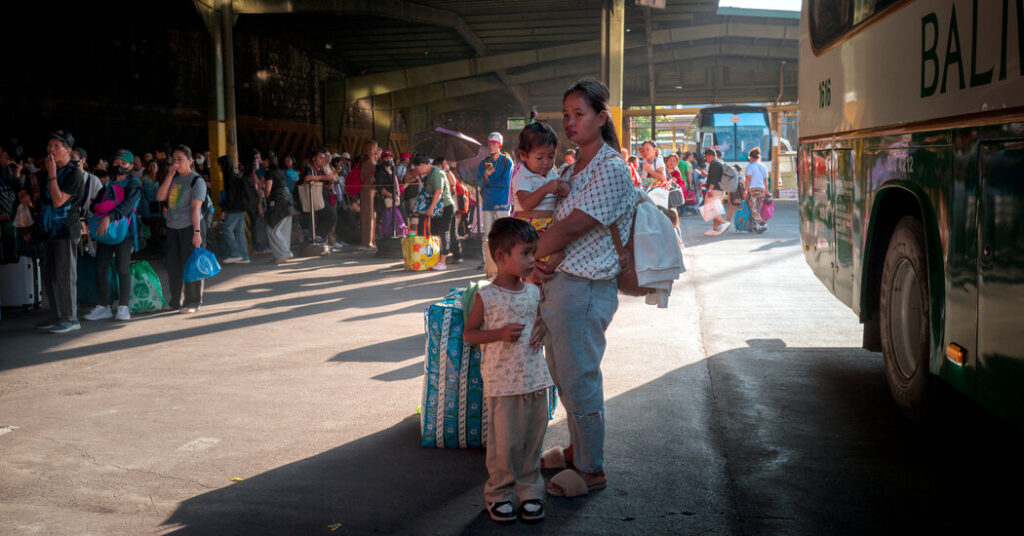
Each spring, millions of Filipinos return to their home provinces or take a vacation over the four-day holiday. This year is no exception: The Transportation Department has said it expects five million people to travel by land, air and sea during Holy Week.
But there are signs people are not making the journey this year.
Through the week, the operator of the North Luzon Expressway reported light traffic on major toll roads that would normally be jammed with cars heading out of the city.
In the city of Baguio, a popular Holy Week destination in the mountains north of Manila, weak demand has prompted business at Waya Araos-Wijangco’s restaurant to fall by about 80 percent compared with last year.
As customers tighten their budgets, she said, restaurants were no longer competing against each other.
“Now they’re competing against the gas stations,” she said.
As many Filipinos choose to stay home for Holy Week, some municipalities and parishes across the Philippines have created guides on social media for Catholics to perform the Visita Iglesia close to home by walking, cycling or taking public transportation.
Jayvee Recio, a schoolteacher in Batangas Province, produced a video showcasing lesser-known churches in his hometown. He did the Visita Iglesia by motorbike, filling up his tank at 94 pesos a liter, or more than $5 a gallon.
“Usually, for Visita Iglesia, people like to travel far, but the church you visit doesn’t have to be far or grand,” Mr. Recio, 34, said in a phone interview. “The essence of prayer is more important.”
For those who don’t want to travel, the Catholic Bishops’ Conference of the Philippines revived a virtual church visit app that was created during the coronavirus pandemic. Many parishes plan to livestream their Holy Week masses on YouTube or Facebook.
At a church in Quezon City, Rev. Jerome Secillano said he would advise Catholics to look to the suffering and resurrection of Christ, which are central to Easter, as they coped with the high cost of gasoline and other consumer goods.
“We can bear our crosses daily with hope and confidence that it won’t be for life,” he said. “This will pass.”
Ms. Quilas, 44, who lives in Quezon City, said she was awed by the centuries-old churches she saw on her family’s Visita Iglesia pilgrimage in early March.
“You feel divine intervention as soon as you enter,” she said.
It also made financial sense. Today the same journey would cost at least $60 to fill up a tank, instead of $25 in a typical year.
But the Quilases are not making their usual three-hour drive to Nueva Ecija province to visit relatives on Easter weekend. Gasoline is too expensive, she said, and they worry that there won’t be any left to buy for the trip home.
Francesca Regalado is a Times reporter covering breaking news.
The post How the Fuel Crisis Crimped an Easter Pilgrimage appeared first on New York Times.