There are more cows than people on the island of São Miguel, and at least one of them was about to become a star.
For 11 days in January, Werner Herzog, the German filmmaker, hosted a workshop on the island, the largest in the Azores archipelago in the North Atlantic, and among the 50 attendees, several were considering featuring a cow in their short films.
One idea was pitched by Sabri Benalycherif, 48, a photographer from Lisbon, and Jill Mulleady, 47, a filmmaker from Argentina. Their vision for a short involved a cow entering a church.
“How will you get a cow up the steps and into the church?” Mr. Herzog, 83, asked the duo, sternly. “You may be doomed, because the cow may be obstinate and never make a single step up there. It may go wild.”
“But you moved a boat over a mountain,” Ms. Mulleady politely reminded him, referring to the scene in his 1982 epic “Fitzcarraldo,” in which the crew hauled a 320-ton steamship over a steep hill in the Peruvian Amazon.
Mr. Herzog shook his head. “People think I do the impossible things, but no. I do the doable,” he said. “I knew that it was possible to move a ship over a mountain.”
He explained that he had three months to tease out the problem. These filmmakers didn’t have that time. “You have to do the doable, and within the two days of shooting you have here, it doesn’t seem to be doable,” Mr. Herzog said.
This was the crux of his workshop: Take your camera, get the shot, forgo storyboards, don’t overdo it and, above all else, do the doable. For many this advice was, if not groundbreaking, then certainly liberating.
The participants had traveled from as far as Hawaii, Australia and India. They were paired up based on shared cinematic styles and language and, in some instances, compatible star signs. By the end of the 11-day workshop, they had to film, edit and screen a five- to 10-minute-long film, in any style, be it narrative, tone poem or documentary.
They would take inspiration from Mr. Herzog and the island’s terrain — its lush green hillsides, black sandy beaches, mist-shrouded tea fields, famous hot sulfur springs and, of course, cows. As the filmmakers brainstormed ideas, Mr. Herzog was transfixed by the idea of the cow in the church.
“You need somebody who transports the cow in a trailer. You might have to anesthetize the cow and then, later, reanimate it,” he said. “And what will the local priest think?”
The Master
The name Werner Herzog has become a kind of shorthand for maverick filmmaking — the man himself is an icon. And yet, his conceptually dense movies are hardly box office friendly. Many would describe them as inaccessible, best appreciated by students of film, cinephiles and other filmmakers, as they tackle complicated themes on such matters as life on death row and families for hire in Japan. He is as much of a character, with his German accent, deadpan voice and irreverent philosophizing, as the lore that surrounds his approach to making movies — even for those who’ve never seen them.
And Mr. Herzog has become a subject of intrigue for a new generation discovering his work — especially after the “nihilistic penguin” meme, drawn from his 2007 documentary “Encounters at the End of the World,” went viral in January, which happened to coincide with his workshop.
Mr. Herzog began his Rogue Film School in 2009, in Los Angeles, where he has lived since the late 1990s. The densely scheduled four-day course cost participants $1,500. The purpose was not to learn how to make films, but to listen to Mr. Herzog, who makes clear that he doesn’t teach filmmaking — that belongs in film schools, of which he has long been a vocal critic. Filmmaking, he said, is about managing chaos or “wrangling.”
According to the Rogue Film School website, the workshop was “about poetry, films, music, images, literature.” “Censorship will be enforced,” it warned. “There will be no talk of shamans, of yoga classes, nutritional values, herbal teas, discovering your boundaries and inner growth.”
The workshop sessions were so popular, Mr. Herzog made them longer and more elaborate. He started working with the Barcelona-based production company Extática Cine, which held them in Cuba, the Peruvian rainforest and Las Palmas in the Canary Islands. They chose São Miguel for 2026, because its moody, mythic winter landscape was ideal for cinema.
Mr. Herzog announced this year’s workshop via his new Instagram account, which Simon, his youngest son, had set up for him. Also new was the high price tag — 8,800 euros (about $10,200) — which shocked a lot of his Instagram followers, who left comments about privilege and trust funds.
“Love you dude, but 8,000 euros totally bars working-class people from taking the course. Not a fan,” wrote one.
“I’ll attend the way 70s Werner would approve of (forging documents, stealing my way in for free, taking your equipment, going insane in nature),” read another.
In December, applicants had only six days between being accepted into the program and depositing the money to secure their places. They crowd-funded, dipped into their savings and applied for artist grants and loans. One person was rumored to have sold their car. “The time span between getting the invitation and wiring the money felt like a shotgun wedding,” said Lucas Ackermann, 28, a writer-director from Berlin.
There was an overwhelming feeling among those accepted into the workshop that they had earned a prestigious prize, or were being anointed by the master himself. It was a once-in-a-lifetime opportunity for these filmmakers, who swallowed the price tag for what they were receiving in return: a close mentorship with Werner Herzog, contacts with other filmmakers and an impressive addition to their CVs.
Participants like Aleksandra Szczepanowska, 46, who lives in New York City, were prepared for the cost. “To make a short, no-budget music video in New York is $20,000. So this is almost too cheap,” she said.
Extática Cine explained that the price covers, among other things, room and board, transportation on the island, translators, a database of local actors and locations, a chance for distribution and, of course, time with Werner Herzog. After paying the organizing team and expenses, about a third of the earnings goes to Werner Herzog Foundation in Munich, which oversees the preservation and conservation of his works.
The Process
Mr. Herzog captivated his 50 attendees as he recounted stories he had told hundreds of times, many of which appear in his 2023 memoir “Each Man for Himself and God Against All.” He talked about growing up in rural Bavaria, his often tempestuous working relationship with the actor Klaus Kinski and how he hypnotized the cast of his 1976 film “Heart of Glass.”
After a couple of days, barriers had come down, at least for some. It wasn’t that Mr. Herzog’s star power had dimmed; they more so had come to learn from him and get to work. Even so, one-on-one time proved tricky. Often Mr. Herzog would advise one filmmaker when an eager crowd would form around him, as if pulled by a magnetic force. Some professed being a little put out by the experience.
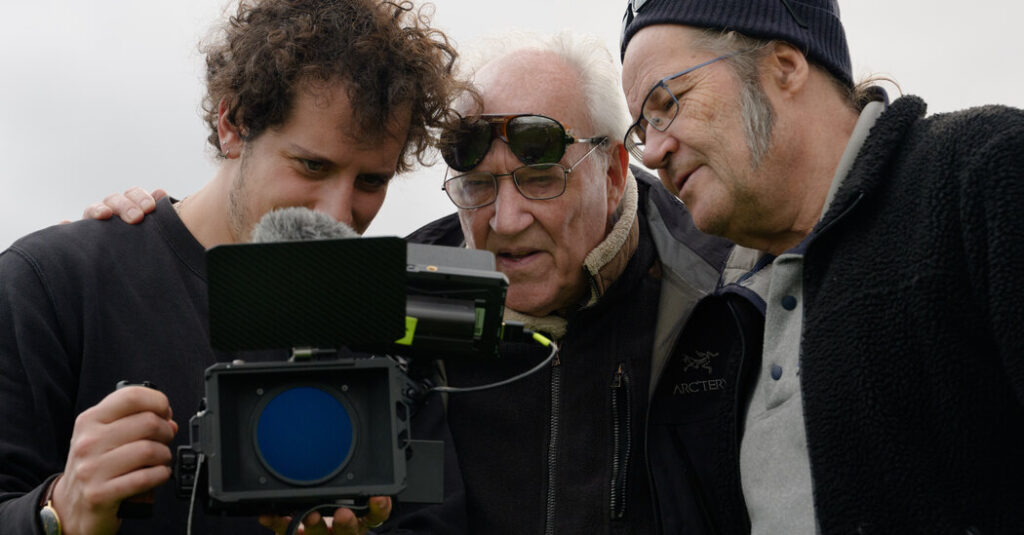
Before shooting began, Mr. Herzog and Peter Zeitlinger, his longtime cinematographer, inspected the group’s “arsenal,” as they termed the camera equipment. Some participants unpacked state-of-the-art cinema lenses and D.S.L.R. cameras, while another brought a simple 1990s Sony camcorder. Mr. Herzog said the most important thing was not the camera, pleading, “Please, pretty please, give me a good story.”
Mr. Herzog instructed them to jump right in. “No time for meditation, no time to wait for inspiration,” he said. “And it’s a good thing. You have to function like this on a real set.”
These rules forced a welcomed change for the filmmakers, like Ms. Szczepanowska. “I’ve never shot without a screenplay, without a shot list, without a storyboard,” she said. “It’s sort of like you don’t realize how much you know, or what you’re capable of, until you do it.”
A few months before the workshop, the Extática Cine team engaged a local casting director to create an island-wide casting call.
“It’s really hard, because usually when filmmakers come here, they bring their actors or they only want the people from Azores to do background work,” said Ana Lopes, 42, an actress from São Miguel who also runs a casting agency. She was in Lisbon when she was called in for a role by one of the participants and immediately booked a flight home. “This is so important for me, but also for the local nonactors, because you have 50 filmmakers working here. When do you get that in an island like this?” Ms. Lopes said.
Another actress, Teresa Carreiro Andrade Raposo, a 20-year-old sociology student from São Miguel, was cast in four different films. “I honestly had never heard of Werner Herzog,” she said. “Apparently, he’s a really important person, so I’m happy to be a part of this project.”
The Legacy
Halfway through the workshop, Simon Herzog, 36, traveled from Vienna to teach the cohort how to pick locks — a common feature of the elder Herzog’s course and useful for locations that were off-limits. “I learned half from my dad and half from the internet,” Simon said. “I can open most locks in Romania.”
Though Simon had attended a couple of his father’s Rogue Film School weekends, this was his first workshop. It was a Christmas gift from his father. But Simon’s presence also benefited his father’s protégés, as Mr. Herzog became more accessible once he arrived, occasionally prompting his father to be more direct.
And Simon started his father’s Instagram account. “We had talked for some time about having some kind of a medium to be more proactive about sharing his work,” he said.
The first video, “I am Werner Herzog. This shall be my Instagram,” was filmed in the garden of their 16th-century cottage in southern Austria, posted on August 2025 and had garnered almost nine million views. Mr. Herzog does not own a cellphone, so Simon shoots videos when they are together and uploads them later. They made several during the workshop.
Simon, who accompanied his father to the Amazon jungle when he shot the 1998 documentary “Wings of Hope,” believes his father’s interest in doing these workshops reflects his love for the craft as well as a desire to establish his legacy. “He has a lot of knowledge and wisdom to pass on,” he said. “I don’t think he’s particularly precious about it.”
The Adulation
Mr. Herzog would hold court during meal times and continue after dinner, when he would screen clips from his extensive catalog, like “Aguirre, the Wrath of God,” “Grizzly Man” and “Cobra Verde,” hitting pause to draw attention to particular details. Sometimes he would offer insights or snippets from his personal life that would elicit laughter and awe.
“Any primate can produce a film today,” Mr. Herzog said at one point. “Incidentally, I have seen a film made by a sheep.”
“You never see me in the tabloids, because I have never been at red carpet events — unless it was for my own film,” he also mused.
Many of the filmmakers hung onto his every word.
“He’s my father in cinema,” said Hao Wang, 33, a director from Chengdu, China, who had previously completed Mr. Herzog’s course on the online platform MasterClass. During the workshop, he taught Ms. Wang how to whistle, a skill he believes is important in directing a crew.
The adulation proved jarring to Francisca Manuel, 41, a filmmaker from Lisbon. “I was not expecting that these 49 people around me would show so much devotion to him,” she said. “Some of them, particularly the dudes, see him like a god.”
And this can be a problem for Mr. Herzog. “It’s very hard for him to find people who are not sucking up to him, and so appreciates a person who is authentic to him,” said Mr. Zeitlinger, who has worked with Mr. Herzog on more than 20 projects.
“Most directors are living in a false reality, where everybody is lying to them,” he added. “It’s like people in power: They never get constructive feedback. But Werner is not that way.”
The Shoot
By the time the shooting started, six of the 25 pairs had consciously uncoupled to work alone. “Some find it hard to adapt to each other,” Mr. Herzog said.
The group scattered across the island. Mr. Herzog paid each of them a visit, shuttling between locations in a chauffeured minivan. At the port, there was a shoot where a duo was filming a fisherman fixing one of his nets, talking about his life.
“Since he is talking on-camera all the time, you need silent moments,” Mr. Herzog said. “It has to be material where he can think aloud. You also have to record the sea gulls separately as a sound. You have to collect.”
Mr. Herzog watched as Jordan McAfee-Hahn and Matúš Ďuraňa were filming a cow by the side of a cliff, the gray ocean shimmering silver on the horizon on a windy afternoon. Their film, which they called “Lola Dreams of the Sea,” featured a young farmer running after Lola the cow, who was inexplicably drawn to the body of water.
The cow playing Lola did not want to sit down. She complained loudly, until finally she complied and crouched on the grass.
“Shouldn’t we have her looking out towards the ocean?” Mr. McAfee-Hahn called over the wind.
“No, no. It’s good with the ocean as a backdrop,” said Mr. Herzog, suggesting the duo shoot a close-up of the cow’s face to capture Lola’s emotional responses. “Leave her there.”
The cows were very difficult to work with, as Asreen Zangana, 28, discovered.
“The cows were really moody. They didn’t want to interact with my actor,” said the Iraqi American film director, who uses they/them pronouns. “Originally my protagonist was going to be really affectionate with the cows. He was going to hug and kiss them, but they weren’t having it. They just stormed off.”
To become “good soldiers of cinema,” Mr. Herzog told participants they must learn to roll with the punches. “All of a sudden something goes terribly wrong, your second lead character has to go to hospital and you know he will not come back within the next three months, so you have 60 seconds to change your screenplay and make it plausible that the person is not there, even make it an advantage to the story,” Mr. Herzog said. “It happens all the time on a set, and you have to be able to respond instantly. There’s no time. No time left for anything.”
That’s exactly what Mx. Zangana did. “I had to quickly change the story to be that the man is lonely, and really needs the affection of his cow but isn’t getting any,” they said. “He was super adaptable, as nonactors usually are.”
The Farewell
After 11 intense days in São Miguel, Mr. Herzog was off to begin promoting his latest film, “Bucking Fastard,” starring the sisters Rooney Mara and Kate Mara as identical twins. He was also finishing a book of his film stills to be released by the German art book publisher Taschen and doing voice-over work on Bong Joon Ho’s upcoming animated movie, “Ally,” about deep-sea creatures. There would be little, if any time to rest in between.
When it came time to bid his protégés farewell, following a screening of their finished works, Mr. Herzog surveyed the group with his piercing gaze.
“The world as filmmakers is yours now,” he told them. “The world is yours. You will go out, but you should remain rogue. My advice is to form rogue cells everywhere.”
Many grabbed every opportunity to sit next to Mr. Herzog and ask questions or pontificate, while a few chose to quietly absorb the filmmaker’s wisdom from a distance, like Dean Wei, a filmmaker from Beijing.
“I just wanted to listen to him.”
Erin Schaff is a photojournalist for The Times, covering stories across the country.
The post How Far Would You Go to Learn From Werner Herzog? appeared first on New York Times.