Georgia’s election system is flirting with disarray, experts say, after the state legislature failed overnight to push back a deadline that requires Georgia to get rid of its current voting system, which uses QR codes, before the November midterm elections.
A bill that would have extended the deadline for eliminating the QR codes to 2028 died in the State Senate early on Friday after having passed the state House of Representatives just hours earlier on Thursday night.
The speaker of the House, Jon Burns, a Republican, said it was “a little troubling” that the State Senate did not address the looming deadline by taking up the bill.
“We think we had a reasonable plan that would allow us to move forward with our elections, and have transparency and bring credibility to our elections,” Mr. Burns said. “You can’t change horses in the middle of the stream.”
Mr. Burns said he would contemplate the possibility of the legislature reconvening to address the issue. Gov. Brian Kemp of Georgia, a Republican, could call a special session of the legislature, a rarity in the state.
“I’m tired,” said Mr. Burns. “It’s been a long day, a long morning, a long afternoon, a long night. So we’ll sit down with the governor and take his temperature on where we need to be. But, certainly, election reform is something we were committed to.”
A staff member in Mr. Kemp’s office declined to comment early Friday morning.
Vasu Abhiraman, vice chair of the election board in DeKalb County, said in an interview earlier this week that “we do not want a major transition in the summertime, in the middle of this election cycle.”
“It’s going to be total chaos,” he said.
The potential trouble in Georgia stems from the conspiratorial thinking that has consumed many Republicans since late 2020, when President Trump claimed, without proof, that the presidential election had been stolen from him. Mr. Trump has also made unfounded accusations that Georgia’s voting machines were part of a conspiracy to flip votes.
Mr. Trump’s allies in the Republican-dominated state legislature then got behind a 2024 law to eliminate QR codes that are used to tabulate votes, by July 1 of this year.
Electoral chaos could cast doubts on election outcomes, particularly in this year’s midterms, when Mr. Trump’s party could be dragged down by his sagging poll numbers. Georgia is hosting one of the most closely watched midterm elections, in which Senator Jon Ossoff, a Democrat, will face re-election, squaring off against the winner of an upcoming Republican primary.
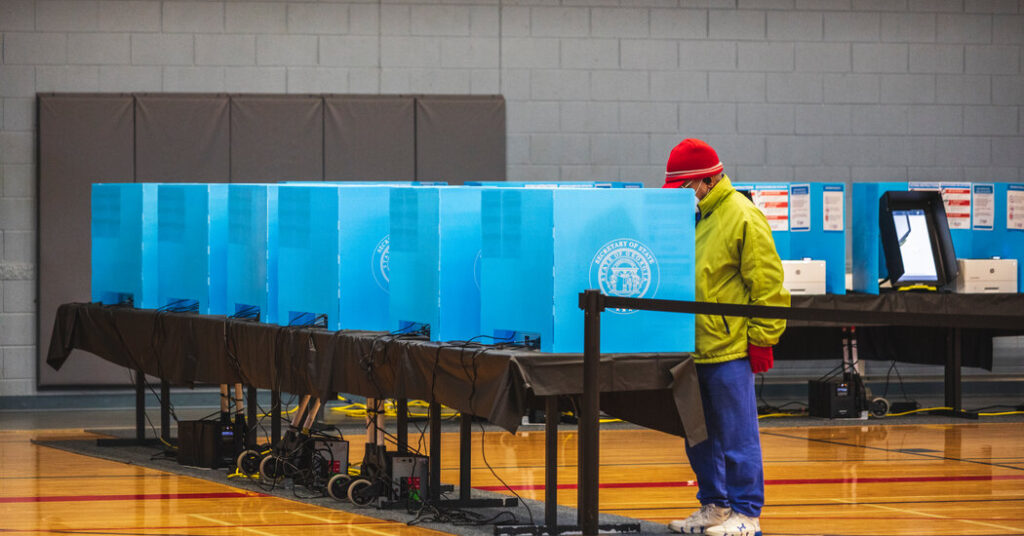
The dispute centers on touch-screen voting machines, which voters use to make their ballot choices. Each person’s choices are then printed out on a sheet of paper, along with a QR code — which includes the same information in a form unreadable to humans, but readable by computers. Voters review their choices on the sheet of paper, then take it to a scanner, which uses the QR code as the basis for tabulating the votes. Critics say that the QR codes do not allow voters to verify their choices when they review their ballots.
Secretary of State Brad Raffensperger, a Republican, has said the cost of moving to a new system without QR codes would be millions of dollars. But the state legislature has not provided the funding to make the switch.
The July deadline weighed heavily on state lawmakers on Thursday, the last day of their yearly legislative session. Last week, in an effort to buy more time, the state House passed an earlier version of the bill to push the deadline for eliminating the QR codes to 2028. The updated version passed on Thursday night would create a path for voters to make their selections in the next presidential contest using hand-marked paper ballots.
“Changing our election system is not easy,” said State Representative Victor Anderson, a Republican, on Thursday night. “Honestly, we should have started long before now.”
The bill was supported by Georgia’s local election officials. It would also make changes to election rules ahead of the 2026 midterms, adjusting the threshold for recounts from a half-percentage-point margin, to a one percentage point margin. Under the bill, Georgia’s state election board, which is controlled by Mr. Trump’s allies, would be tasked with creating a pilot program for auditing paper ballot images.
“I think it is a very reasonable and responsible solution to a situation that we absolutely must address,” said State Representative Saira Draper, a Democrat, on Thursday.
But the Senate did not pass the bill before the session ended.
As it stands, elections officials in the state’s 159 counties will be able to use the old, QR code-based system for the midterm primaries in May, as well as for the primary runoff in June.
But they will be hard pressed to make the needed changes by the November midterms.
The state already has an established system that allows voters to use hand-marked paper ballots in the event of an emergency. But these are typically isolated cases — for instance, when a polling place experiences a power outage. Mr. Abhiraman said that using that system statewide to address the removal of the QR codes might not be legally permissible.
Another headache: Georgians are allowed to vote before Election Day at early voting sites anywhere in their county of residence. The current touch-screen system shows voters their customized electronic ballots, which includes the specific races that they are allowed to vote in. A move to hand-marked ballots, Mr. Abhiraman said, would mean that every early voting site would have to print up every permutation of the ballots.
In DeKalb alone, he said, those permutations number in the hundreds.
A second possible solution, Mr. Abhiraman said, would be to distribute optical character recognition software to the counties, which could make text on the ballots readable by computers, and thus subject to a machine count. Under this scenario, Mr. Abhiraman said, the QR codes would still be used for a preliminary tabulation of the votes, with the optical recognition software would then be used to tabulate the official, certified vote.
But Mr. Abhiraman said that this system might also be vulnerable to potential legal challenges. And, he added, someone would have to pay for the software, and election workers would have to be trained, in a hurry, on how to use it.
Richard Fausset, a Times reporter based in Atlanta, writes about the American South, focusing on politics, culture, race, poverty and criminal justice.
The post Georgia Lawmakers End Session Without Fixing a Threat to Its Midterm Elections appeared first on New York Times.