Not so long ago, the future was female. That expectation was most memorably expressed a few weeks before the presidential election in 2016, when Hillary Clinton posted a picture of her young self on Twitter with the caption “Happy birthday to this future president.” Though Donald Trump’s victory dashed her presidential hopes, it did not end her faith in the direction of history. “I remain convinced that, yes, the future is female,” she later said.
Joe Biden agreed. In the 2020 presidential campaign, he described himself as a “transition candidate” who would serve as a “bridge” to a more diverse and feminine future. He promised to pick a woman as vice president and to nominate a Black woman for the Supreme Court, and he did. The sense of growing empowerment was reinforced by the prominence of politicians such as Kamala Harris and Alexandria Ocasio-Cortez.
But if Democratic Party politics are any indication, the future is no longer female. Stung by the losses of Mrs. Clinton and Ms. Harris, many in the party, according to multiple reports, are looking for a presidential candidate in 2028 who is straight, white and male. Representative Jasmine Crockett of Texas summed up the prevailing attitude as “Let’s go find the safest white boy we can.”
The vogue for white masculinity is apparent in the enthusiasm for Graham Platner, a hard-bitten oysterman and war vet who is seeking the Democratic nomination for Senate in Maine. It is evident in the rise of James Talarico, the Democratic nominee for Senate in Texas who looks like a member of the Moral Majority. It can even be seen in the makeover of Pete Buttigieg, who has acquired a beard, a splitting maul and a taste for flannel shirts.
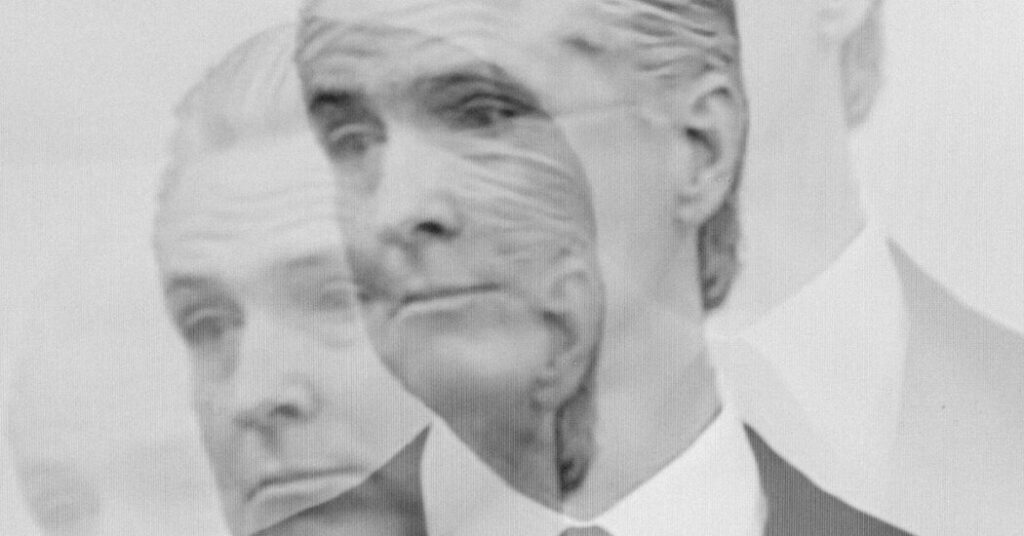
But nowhere is this trend clearer than in the messaging of Gavin Newsom, the California governor and presidential hopeful. More than any other Democrat, he has embraced an unapologetic, some might say toxic, form of masculinity. Suddenly aggressive, thick-skinned and partial to the macho lingo of the online right, he seems to have concluded that progressive models of manliness — the deferential white male ally, the “girl dad” concerned about reproductive rights — are passé.
His instincts may unsettle progressives, but Mr. Newsom has accurately identified a Democratic weakness. His attempts to address the problem, though often misguided, nonetheless point his party in the direction it must travel to beat back the right.
Mr. Newsom began his masculinist push by starting a podcast in March of last year. His first episode was a sympathetic interview with Charlie Kirk, in which Mr. Newsom described transgender athletes’ competing in women’s sports as “deeply unfair.” An overwhelming majority of his guests, which also include Steve Bannon, have been men. He has countered progressive criticisms by denouncing cancel culture.
On social media, Mr. Newsom has shown a willingness to push the boundaries of acceptable speech. In November, his press office responded, “Quiet, piggy,” to the conservative activist Chaya Raichik, echoing President Trump’s use of that phrase earlier that month to dismiss a female reporter. Mr. Newsom’s staff members have also repeatedly suggested that his conservative opponents are gay, leading a writer for one L.G.B.T. publication to lament his “frankly homophobic” rhetoric.
Most striking, Mr. Newsom has drawn on the idiom of the manosphere and online right, communities noted for their unembarrassed racism and misogyny. In July, he called Mr. Trump’s adviser Stephen Miller a “fascist cuck,” the latter being a term used to fault men for lacking sexual power and racial pride. In March, his press account shared a video of Mr. Newsom with the caption “mog or get mogged.” This term describes a man who shows himself to be physically superior to other men and thus the “alpha male of the group,” or AMOG, who “mogs” lesser men.
The most startling example of Mr. Newsom’s strategy came last week when he posted an image on social media comparing his looks to those of the immaculately groomed fictional villain Patrick Bateman, as played by Christian Bale in the 2000 film “American Psycho.” The Bateman character, a serial killer whose hatred of women is rivaled only by his contempt for Black people, has become an object of fascination for the manosphere and online right, with memes coursing across X and TikTok. The edginess of these memes depends on a winking acknowledgment of Bateman’s bigotries.
The point is not that Mr. Newsom secretly desires the subjugation of women or minorities. On the contrary, he is committed to a system of diversity, equity and inclusion measures that offer advantages to women, racial minorities and L.G.B.T. people — that is, to everyone but straight white men. The point is that he is responding to a political and cultural energy that has shifted away from the celebration of feminism and diversity and toward the concerns of alienated, and especially white, men.
This is not just a matter of two election defeats. Progressives tend to see themselves at the cutting edge of social change, challenging power structures and overcoming oppressive cultural conventions. But as feminism, diversity and gay rights have become official dogmas — enshrined in law and promoted by cultural authorities — those causes have lost their rebellious charge. That countercultural quality is now possessed by expressions of traditional white masculinity that seem out of step with the diversity regime.
Mr. Newsom’s social media team seems to understand this. But memes alone are unlikely to dispel the sense that Democrats are no longer at the political vanguard. Despite his heresy on transgender athletes, Mr. Newsom continues to support diversity initiatives whose costs fall especially hard on white men. This commitment limits his appeal to the male vote and may make it hard for him to run as an alternative to the status quo.
Rather than imitate far-right provocateurs, Mr. Newsom should ask why voters in his home state rejected affirmative action in 2020. Democrats are convinced that they need to nominate a white male. What they really need is someone who is willing to challenge the party’s orthodoxies.
Matthew Schmitz is the editor of the magazine Compact.
The Times is committed to publishing a diversity of letters to the editor. We’d like to hear what you think about this or any of our articles. Here are some tips. And here’s our email: [email protected].
Follow the New York Times Opinion section on Facebook, Instagram, TikTok, Bluesky, WhatsApp and Threads.
The post Gavin Newsom Is No Longer Your Deferential White Male Ally appeared first on New York Times.