You’re reading Awakenings, a newsletter on religion. Click here to get the full edition in your inbox.
Robert Barron is the bishop of the Diocese of Winona-Rochester and the founder of Word on Fire Catholic Ministries.
C.S. Lewis once suggested that those who think the Christian Gospel is a myth just haven’t read many myths. If they had, they would know that “not one of them” is like the Biblical accounts of Jesus. Precisely because they trade in archetypal truths and not historical facts, myths typically start with “once upon a time” or “a long time ago, in a galaxy far, far away.” No serious person wonders when Hercules lived or whether Wotan was related to Leif Erikson.
But the accounts of the resurrection of Jesus do not begin with “once upon a time.” They open with specific historical and geographic references. A speech given by St. Peter in the Acts of the Apostles is typical. He reminds his listeners that Jesus began teaching in Galilee, “after the baptism that John announced.” He goes on to say that he witnessed the good works that Jesus performed “both in Judea and Jerusalem.” Then comes a sobering account of Jesus’ brutal death at the hands of the authorities. Finally, without changing tone or register, Peter adds: “God raised him on the third day and allowed him to appear … to us who were chosen by God as witnesses.”
This succinct narrative closes with a line that I have always found breathtaking. Peter describes himself as one of the followers of Jesus “who ate and drank with him after he rose from the dead.” That’s not someone trading in “once upon a time”; that’s someone baldly stating what happened.
Peter spent the rest of his life spreading the news of the resurrection and, along with all but one of his fellow apostles, went to his death for doing so. There is no such record of the missionaries and martyrs of Hercules. People appreciate the truths contained in myths, but they don’t give their lives for them.
Now why does the resurrection matter today? Every human life is conditioned by the apparent finality of death. The seeming fact that every person will die and remain dead places a pall over every political, cultural, scientific and aesthetic achievement. When death is seen as inescapable, it is natural to wonder whether anything really matters. And tyrants, from time immemorial, have used the fear of death as a means of coercing, manipulating and dominating people.
The resurrection challenges the power of death on which every system of oppression relies. In the Gospel of Matthew, it is accompanied by an earthquake. It’s a fitting detail, because across history, the resurrection has proved to be profoundly destabilizing. By overthrowing the reign of death, it transformed the world.
As British historian Tom Holland has argued, many of the values taken for granted in the West, including respect for the dignity of the individual, concern for the victim and reverence for human rights have come from Christianity — more specifically, from the Easter story. In the resurrection, a beaten, pierced and bloodied body rose from the dead. Weak and suffering flesh — once regarded with contempt — was shown to have an eternal destiny.
In the light of Easter, it is possible to see that all human pain, and all human achievement, is situated in a higher register. Far from being futile, it matters eternally. Given this fact, it should not be surprising that people who believed in the resurrection — including Martin Luther King Jr., Desmond Tutu, John Paul II and Dorothy Day — have been so committed to making this world better. King couldn’t possibly have asserted that the arc of the moral universe bends toward justice unless he believed that the last word belonged to life, not death.
Tyrants have reason to tremble at the good news of the resurrection. By destroying the power of death, it shatters the fear on which they rely. Of course, as long as the rising of Jesus is explained away as a harmless myth or symbol, no oppressor need concern himself with it. But once people start believing that it really happened, despots begin to lose their grip.
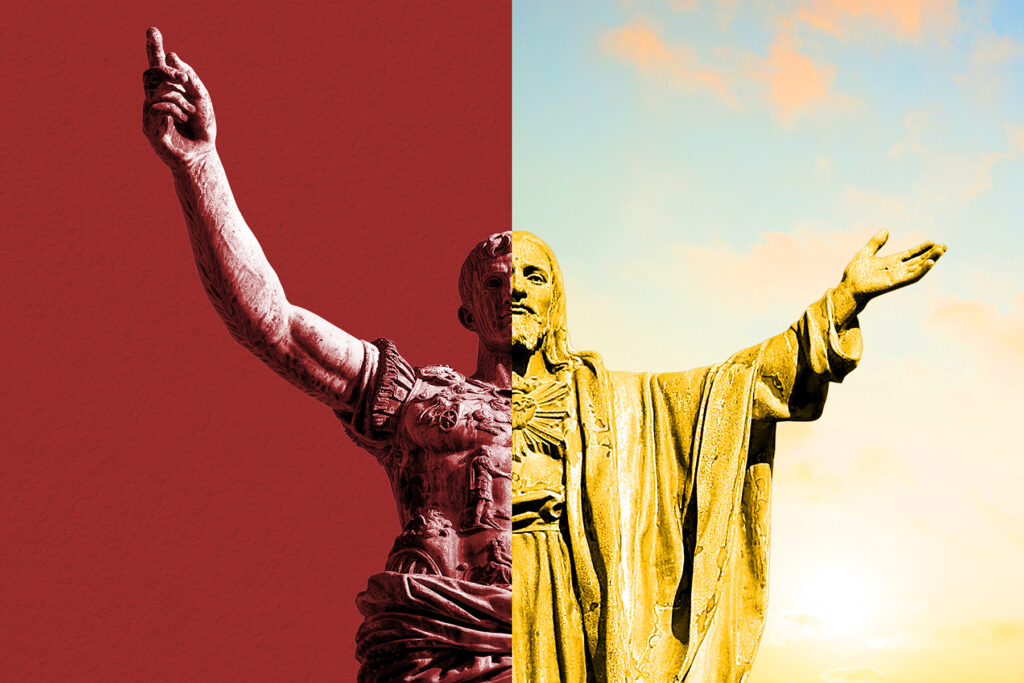
The radical nature of the Easter story was evident in the early days of Christianity. When the witnesses to the resurrection declared that Jesus is Lord, they were not trading in blandly spiritual talk. On the contrary, they were challenging the common view that Caesar, backed up by his massive army, was Lord — which is precisely why so many of the first evangelists ended up in Roman prisons.
Easter cannot be domesticated. It does not tell the story of what happened once upon a time, or in a galaxy far, far away. It is an earthquake. It shakes the foundations of the world by proclaiming that death does not have the final say.
The post Easter is a challenge to tyranny appeared first on Washington Post.