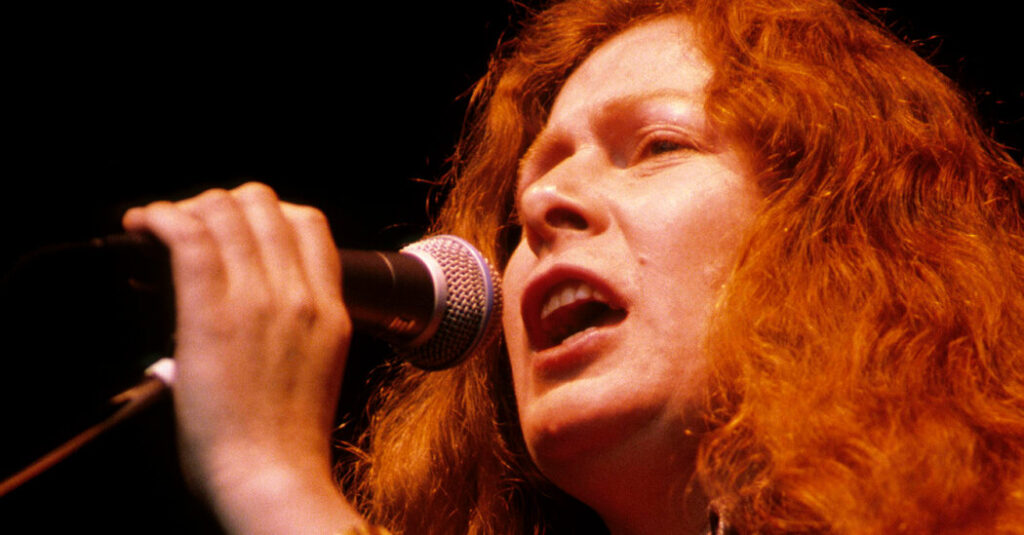
Dolores Keane, a singer whose rich voice, deep roots in Ireland’s County Galway and collaborations with American artists like John Prine, Nanci Griffith and Emmylou Harris earned her legions of fans and a reputation as “the soul of Ireland,” died on March 16 at her home in Caherlistrane, in western Ireland. She was 72.
Her brother Seán Keane, also a renowned singer, announced the death on Facebook. He did not provide a cause.
Ms. Keane emerged in the 1970s as part of a renaissance in traditional Irish music. A wave of artists was attracting a new generation of fans through skillful updates of classic songs as well as clever reinterpretations of Americana, blues and even pop music.
After several years as a solo singer in Galway, in the country’s rural west, she joined a new folk group, De Dannan, in 1975. That year, De Dannan scored a hit with “The Rambling Irishman,” a song that contained many of the themes that Ms. Keane would return to throughout her career, among them rootlessness, homesickness and lost love. Its lyrics included these lines:
I am a rambling Irishman,
in Ulster I was born.
And many’s the happy hours I spent
on the banks of sweet Lough Erne.
But to live poor I could not endure,
as others of my station.
To America I sailed away
and left this Irish nation.
De Dannan went on to a long career as a cornerstone of modern Irish folk music, though Ms. Keane’s time with the group was brief.
She began a solo career in 1976 and, over the next 30 years, established herself as one of her country’s leading interpreters of traditional music. She released her debut album, “There Was a Maid,” in 1978.
Though she popularized a long list of Irish classics, Ms. Keane also sang Celtic-inflected arrangements of pop and country songs by American musicians like Steve Winwood and Guy Clark; on “The Essential Dolores Keane Collection” (2007), she included a rendition of “Lili Marlene,” a love song popularized by Marlene Dietrich during World War II.
Ms. Keane frequently toured the United States, often in partnership with like-minded Americana singers. In a 1998 interview with The Irish Times, her friend and frequent collaborator Ms. Griffith called her “the soul of Ireland,” a sobriquet that stuck.
Ms. Keane reached the peak of her popularity in the 1990s, following her appearance on “A Woman’s Heart” (1992), a compilation album featuring her and five other female Irish singers. It became the best-selling album ever in Ireland.
She was beloved in her country in part because she was so quintessentially of the place: Her glittering wit, warm personality and lilting burr of an accent all marked her as a child of County Galway.
“A voice like hers does not leave us,” Catherine Connolly, the president of Ireland, said in a statement after her death. “It moves into the air and lives forever.”
Dolores Keane was born on Sept. 26, 1953, in Sylane, a small town not far from Caherlistrane, where she lived for most of her life and where her parents had both been born and raised. Her father, Matt, worked at a brewery and her mother, Bridie (Comer) Keane, worked in a shop.
After her 8-year-old sister Marian died of tuberculosis when Dolores was 4, their mother grew so depressed that Dolores was sent across the road to live with her aunts Rita and Sarah Keane.
Her aunts were well-known singers of traditional Irish music, and Dolores took quickly to their lessons, not just in music but also in the history and culture from which it grew. She began singing with them, and her first appearance on a recording came when she was just 5.
The rest of her family was musical, too. Her parents played in a band that performed at local social events. Her uncle Paddy taught her to play the fiddle.
In 1975, Ms. Keane met John Faulkner, an Irish musician, who was visiting Galway as part of filming a documentary about Irish music. They married in 1977 and moved to London.
She later accompanied him as a consultant on a tour of eastern Canada for a documentary on the Irish influences on the region. They divorced in 1988.
In addition to her brother Seán, her survivors include a son, Joseph, from her marriage to Mr. Faulkner; a daughter, Tara, from her relationship with Barry Farmer; another brother, Matt; a sister, Teresa; and two grandchildren.
Ms. Keane stepped back from performing in 2000. She was struggling with depression, alcoholism and, soon after, recurrent bouts of breast cancer. She finally went into a rehabilitation clinic and got sober, an experience she spoke about in interviews.
During a 2023 television interview, she described her addiction and depression. “I hope that your troubles are few,” she told the audience, “and that whatever you’re going through, you’ll be better. Believe me. You’ll be better.”
Clay Risen is a Times reporter on the Obituaries desk.
The post Dolores Keane, Singer Known as the ‘Soul of Ireland,’ Dies at 72 appeared first on New York Times.