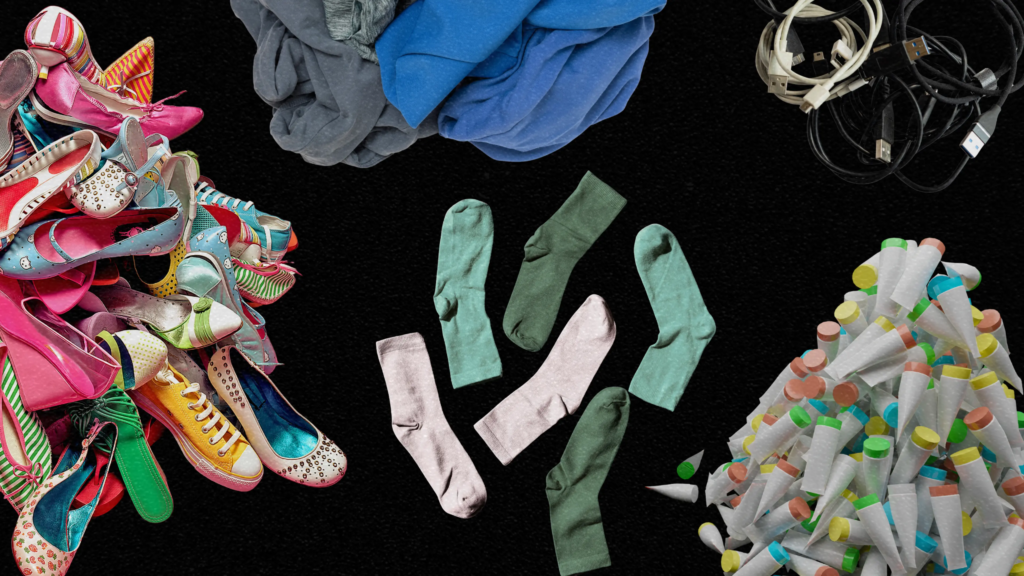
Here’s a humbling exercise: Gather every pair of socks you own in one place. Now try not to freak out.
That slightly horrifying moment—where did they all come from?! Why are there so many holes?—is exactly why some experts swear by decluttering by category instead of by room.
“Everybody’s surprised,” says Rachael Fahncke, an organizer who owns Dayton Designer Closets in Ohio. “It’s shocking the amount of things you collect, especially the obscure things like charging cords. You’re like, ‘Why do I have 75?’”
The premise behind this approach is simple: Instead of tackling your bedroom, kitchen, or closet one at a time, pick a single type of item—shoes, cleaning supplies, workout clothes—and track down every version across your home. That includes the pairs by the front door, the backups shoved in a hall closet, the out-of-season ones stashed under your bed, and the random extras hiding in gym bags, cars, or that one drawer you never fully emptied. Gather them in one place, and once you can see the full volume, start making clearer, more intentional decisions about what you actually need.
Why it works
Most of us don’t actually know how much we own. Your belongings are probably scattered around your home, so each individual pile feels manageable. Together, though, they tell a different story.
“It’s so easy to forget something,” says Tyler Moore, a content creator known online as Tidy Dad and author of Tidy Up Your Life: Rethinking How to Organize, Declutter, and Make Space for What Matters Most. “Until you pull it all together, how do you actually know what you have vs. what you don’t?”
That’s the psychological shift at the core of this method: It replaces fragmented decision-making with a full-picture view. Instead of asking if you have room for 10 different white T-shirts in your wardrobe, you’re asking: “Do I need all of these?” And once everything is in front of you, the answer often becomes obvious.
Read More: Clutter Can Overwhelm Your Brain. Here’s the Easy Way to Tackle It
Decluttering by category forces a kind of clarity that tackling an entire room at once rarely delivers, and often reveals that what feels like a storage problem is actually an over-accumulation problem. “People think, ‘I need a bigger house or more storage,’” Fahncke says. “But you’re making room for the wrong things.”
It also helps explain a common cycle: When you can’t see what you have, you’re more likely to buy duplicates—another phone charger, another pair of black leggings, another bottle of sunscreen—only to add to the clutter.
By contrast, seeing everything at once creates a kind of built-in accountability. It’s harder to justify keeping five nearly identical items when they’re sitting in a single pile in front of you.
Start with micro-categories
If you decide to declutter by category, experts advise going smaller than you might originally plan. In fact, the narrower the category, the more effective—and less overwhelming—the process tends to be.
“I like to start with micro-categories that have an impact on my own life,” Moore says, especially ones that don’t require input from anyone else. That’s part of what makes them so manageable: You can make decisions quickly, without negotiating with a partner or family member, and see immediate progress. The same goes for shared categories that don’t carry much emotional weight, like cleaning supplies.
“I don’t think there are many people who are getting in disagreements with the people they live with if someone were to organize the cleaning supplies and set up all these systems,” he says. “I think anyone would be like, ‘Hey, great, thank you,’ as opposed to, “I went through all the sentimental stuff that you were passed down from your grandma and decided we’re going to put it into this one box.’”
Micro-categories aren’t just easier—they’re strategic. “Those decisions, especially items that are low stakes, help you make much higher-stakes decisions,” Moore says. In other words, building the muscle of letting go of things makes it easier to eventually tackle bigger, more complicated categories.
They also make the process feel doable in the first place. “Think about something that can take 10 to 15 minutes,” Moore says. “Set that timer, do it, and then move on.”
What it looks like in practice
Once you start thinking in categories instead of rooms, everyday clutter starts to look different—and easier to tackle. Here are some examples for inspiration:
Shoes
Shoes are a classic problem category because they tend to live everywhere: by the front door, in closets, under beds, and tucked into seasonal storage. Instead of dragging every pair into one overwhelming pile right away, start where they already exist.
“I would start where I have my zones of shoes already,” Fahncke says. From there, you can quickly spot duplicates—like multiple pairs of worn-out sneakers—and choose your favorites.
Read More: You Should Be Washing Your Shoes. Experts Explain How
Once you’ve edited those smaller zones, bring everything together for a second pass. “You’ll be shocked,” Fahncke says. “Like, ‘Why do I still have these?’”
That’s also when it becomes easier to set boundaries going forward. After narrowing down your collection, she recommends adopting a simple rule: If a new everyday pair comes in, an old one should go out.
Workout clothes
Break this category down further. Fahncke likes separating pieces she wears for lounging, strength training, running errands, or specific workouts like Pilates.
It may sound excessive, but the goal is function: When each type of item has a defined “zone,” getting dressed becomes easier and faster. “If I’m getting ready in the morning and my lights are off, I know where to go,” she says.
This kind of micro-sorting also makes it obvious which items you actually reach for, and which are just taking up space.
Sunscreen
Some of the most useful categories are the least obvious. Sunscreen, for example, tends to be scattered across bags, bathrooms, cars, and travel kits—and often goes unchecked for years. “It’s not until you get fried at the beach that you look at it and you’re like, ‘Oh, this expired two years ago,’” Moore says.
Once everything is gathered, the task is straightforward: Toss anything that’s out of date, keep what you’ll realistically use, and store it where it aligns with your routine—whether that’s near the door, in a beach bag, or with daily skincare.
Socks
Socks are one of the easiest categories to lose control of—especially when unmatched pairs start piling up.
Fahncke recommends creating a system that keeps them from multiplying. “If it doesn’t have a mate coming out of the laundry, it does not get put away,” she says. Instead, designate a separate bin for single socks and revisit it regularly.
“Once a month, I go through there to see, ‘Can I find the mate?’” she says. “If I haven’t found the mate in a month, I don’t need to have it anyway.”
That approach keeps drawers from filling with “just in case” items, and makes it easier to maintain a streamlined rotation of socks you actually wear.
Cords and chargers
Few categories spiral out of control faster than cords and chargers. They’re small, easy to stash, and often kept long after the devices they belong to are gone.
That’s what makes this category so satisfying to declutter: Once everything is gathered into one place, duplicates and outdated items become immediately obvious, Fahncke says.
As you sort, focus on what you actually use. If you don’t recognize a cord or no longer own the device it belongs to, it’s likely safe to let it go. From there, create a simple system, she advises—whether that’s a labeled bin or small organizer—so cords don’t end up scattered again.
Cleaning supplies
Cleaning products are often spread throughout the house—under sinks, in closets, and in garages—making it easy to overbuy or forget what you already have.
Pulling them all together allows you to rethink your system. Instead of keeping multiples in every room, you might decide to streamline. As he puts it: “Do you want to have lots of different types of cleaners spread out throughout your house, or is it better to have one cleaning bin you take with you from room to room?”
How it helps you stay organized long-term
As you sort through a single category at a time, decision-making becomes more straightforward. Instead of evaluating items in isolation—does this fit here?—you’re comparing like with like and choosing what truly earns its place. You can also start to rethink where things belong, moving them closer to where you actually use them rather than where you’ve always stored them.
For one, it reduces daily friction. When everything has a clear category and place, you spend less time searching and second-guessing. “You don’t have that decision fatigue,” Fahncke says. “You know exactly where it is.”
Read More: What’s the ‘Chaos Zone’ Decluttering Method—And Does It Work?
It also naturally creates limits. Once you’ve gathered all your items and chosen your favorites, you become more aware of how much you actually need—and more intentional about what comes in next.
Just as important, the process helps you design your home around your real routines—not aspirational ones. “The things that we have in our home should actually serve a purpose and be of value,” Moore says. That might mean moving a favorite lotion to your bedside so you’ll actually use it, consolidating cleaning supplies into one portable bin, or rotating seasonal items so what you need is always accessible. When you see everything together, he adds, you can rethink not just what you own, but how you use it.
And that’s ultimately the goal: not just a tidier home, but a more functional one. “When you have a system in place for how to actually deal with this stuff,” Moore says, “it just makes it that much easier.”
The post Why You Should Declutter By Category, Not Room appeared first on TIME.