C. Jarrett Dieterle is a legal policy fellow at the Manhattan Institute.
Organized labor has allegedly been on life support for years, with many in the press going so far as to prepare obituaries. One writer bid “farewell to America’s middle class,” noting that “unions are basically dead.” Others observed that membership was shrinking and that the movement had lost its political punch.
But after more than a decade of setbacks, labor unions appear to be on the mend with a string of recent victories. While the political left — and, increasingly, elements of the right — welcome this development, everyday Americans will pay the price.
The storyline of declining union power is compelling. In the 1950s, one-third of American workers were members of a labor union. Last year, the number sat at 10 percent. While the country’s shift from a manufacturing to a service-based economy drove much of this decline, labor law also played a role.
Right-to-work statutes, which allow employees to opt out of unions and avoid paying dues, were officially born with the passage of the Taft-Hartley Act in 1947. More than 20 statespassed such provisions by 1985, and another six joined their ranks between 2012 and 2017. That was accompanied by at least two watershed developments. In 2011, Wisconsin passed Act 10, curtailing collective bargaining rights among public-sector unions, which in turn triggered numerous other states to follow suit. Seven years later, the U.S. Supreme Court ruled in Janus v. AFSCME that public employees who refuse to join a union can’t be forced to pay “fair share fees.”
Yet despite those changes, it appears reports of organized labor’s death were greatly exaggerated.
Consider Utah, which in February 2025 passed a comprehensive ban on public-sector collective bargaining. That seemed like another arrow in the side of unions and a boon to the taxpayers. One estimate found that Wisconsin’s limit on such bargaining has saved the Badger State over $35 billion since 2011. Similar benefits would have accrued out West — if the law had survived. Ten months after the bill’s enactment, Utah’s Republican legislature and governor repealed it in the face of public pressure. Wisconsin’s Act 10, meanwhile, is held up in litigation and may be struck down by the liberal majority on the state’s supreme court.
The same dynamic is playing out elsewhere across the country. Virginia banned collective bargaining for public employees in 1977 but has let localities allow it since 2021. The Democratic-controlled government under Gov. Abigail Spanberger is now expected to mandate it for state and local government employees. Lawmakers in Richmond are also pressuring Spanberger to repeal the commonwealth’s right-to-work statute. Missouri and Michigan have rescinded theirs in recent years.
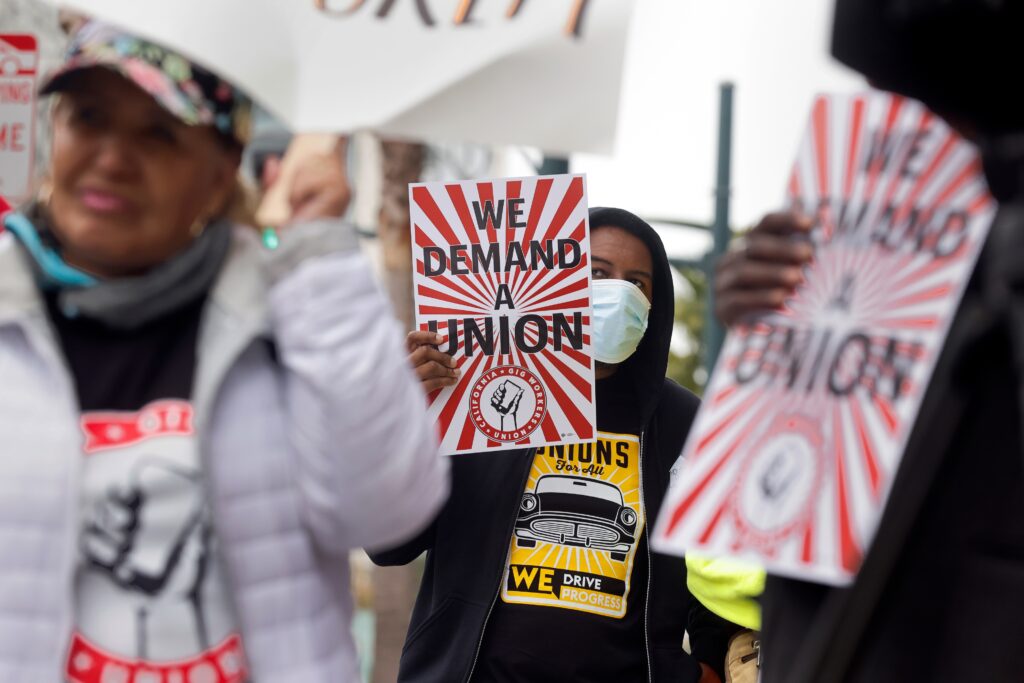
Union power is also spreading to new sectors of the economy. In 2024, Massachusetts voters passed a ballot measure allowing gig workers to unionize, a longtime goal of organized labor. California did the same in October 2025, and other capitals are expected to consider similar measures in the coming years.
So far, the union comeback has mostly been confined to courthouses and state legislatures. Membership hardly budged last year, rising from 9.9 percent of U.S. workers in 2024 to 10 percent in 2025. Yet if more states continue to mandate collective bargaining for public-sector workers — or decide to repeal right-to-work statutes for the private sector — rates can be expected to rise in those jurisdictions. If workers at a unionized shop are forced to pay dues regardless of their membership status, more will opt in as the financial incentive to remain unorganized slips away.
At the same time, while maintaining its long-standing association with the Democratic Party, organized labor has started to attract allies on the right. President Donald Trump courted unionized workers during his 2024 campaign, and Teamsters President Sean O’Brien spoke at the 2024 GOP convention. Vice President JD Vance and Sen. Josh Hawley (R-Missouri) have also become strong pro-labor voices within the party. Both have publicly criticized right-to-work laws, something that would have been anathema within the GOP a few years ago.
Yet while many may celebrate the reemergence of organized labor, research shows that American taxpayers, consumers and even workers themselves are better off in right-to-work states. Manhattan Institute research has found that right-to-work laws generate stronger labor markets and sharply raise a state’s manufacturing share of employment. Those locales also feature lower unemployment and child poverty rates.
The cost of public-sector unionization is even starker. The Heritage Foundation has found that mandatory collective bargaining for public employees increases annual state spending by up to $750 per person. As ever, the way to accommodate that increase is by raising taxes. For a family of four, this could amount to an increased tax burden of several thousand dollars a year.
As Virginia pursues mandated collective bargaining for government workers, local governments are already calculating that it could cost them anywhere between $50,000 and $403 million over a two-year period. The annual estimate for the commonwealth runs to $50 million. The taxpayer will end up footing the bill through higher taxes and other revenue-generating fees as localities and the state scramble to cover the cost of increased salaries and staffing. A local Democratic official in Northern Virginia said the bill would be the “largest tax increase in Virginia history” and could “bankrupt local governments and bankrupt school divisions.”
The left and populist right think they’re helping workers by championing unions. It’s a nice thought — but while the politics may have changed, the economic reality remains the same. Resuscitating organized labor won’t enhance our shared prosperity; it’ll just stick Americans with weaker job markets and higher taxes.
The post Unions are on a comeback. Americans are paying the price. appeared first on Washington Post.