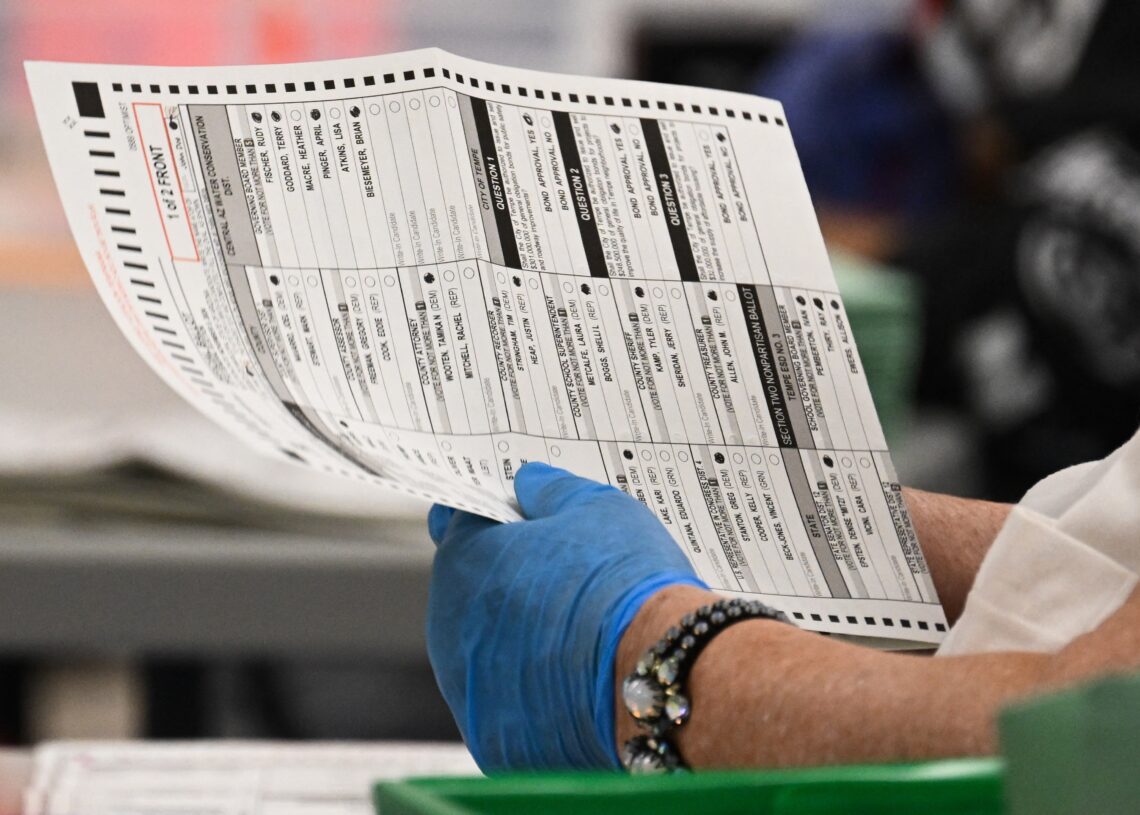
In October 2000, while stationed in San Diego, my home state absentee ballot arrived from North Carolina a few weeks before the presidential election. However, for my vote to count, I had to find two witnesses to watch me complete the ballot and sign their names to verify it. Uninterested in bringing politics into my unit, I waited. Days later, terrorists attacked the USS Cole off the coast of Yemen. The week of the election, my ship deployed to the Persian Gulf.
By Thanksgiving, with the election results still trapped in a Florida recount, we were steaming toward conflict without knowing whose orders we’d follow once there — and my only voice in the matter was an empty ballot left in my car’s glove compartment, stateside.
Last month, President Donald Trump submitted his Florida absentee ballot by mail from his Palm Beach resort. Trump began last week telling law enforcement officials that “Mail-in voting means mail-in cheating.”
But the next day, his mail-in ballot was counted in a special election for a seat in the state legislature. When a reporter pressed him on the contradiction, Trump responded, “You know what, because I’m president of the United States.” Looking to further explain his use of an absentee ballot, Trump said his proposed policy — outlined in the Save America Act that now sits before the Senate — allows a few exceptions for mailing in ballots, such as for those voters who are disabled, in the military or away long-term on business; none of these applied to Trump in this election. As The Post has reported, the president was in Palm Beach in March during early voting. He claimed the exception, though, citing he was too busy, so he mailed it in.
He is also commander in chief — and he goes to war the same way he votes: at his convenience, from Mar-a-Lago and without fully explaining himself. Trump announced the start of combat operations in Iran during a prerecorded video from his private club, the first time much of Congress, the American people and most of the military learned of the matter. Afterward, he hosted a fundraising dinner while families across the country wondered what war would mean for them. This is what happens when the people making policy — for war or democracy — can exempt themselves from the consequences of their decisions.
The easy use of the military and democracy for political expedience reduces faith in both, casting them as tools for partisan goals rather than civic institutions that strengthen the nation. Political and economic elites are mostly insulated from the repercussions, while the public feels the democratic strain more than the sacrifices of war. But service members are left to pay dues twice — once in war and once at the ballot box, with only an avoidant Congress to protect their interests and a patchwork of state voting laws to voice their preferences back home.
The result is a system where war is cheap for the people who don’t fight it and democracy is costly for the people who do.
This is not specific to Trump, and it didn’t happen on its own. In “Bend but Do Not Break,” a book examining the all-volunteer armed forces, scholars of civil-military relations argue that the end of the draft, advances in technology and the intrusion of partisanship have increased the distance between the military, the people and elected officials. Civilian leaders’ use of the military for political gain disrupts democratic norms of apolitical armed forces beholden to laws rather than to politicians. Partisan animus infects democracy and contributes to declining confidence and public trust in the military. And precision missions by Special Operations forces and the ability to wage war from a distance lower the bar for using force, which can encourage adventurism — in places such as Venezuela and Iran.
Amid the politics are service members and their families caught in the middle, trying to navigate life in the military. It remains one of the nation’s most politically, racially and geographically diverse institutions. But fewer Americans today have connections to someone serving in the military, and in 2024, the secretary of the Army noted that more than 80 percent of recruits come from military families. That separateness between service members and the public creates a warrior caste, where the military essentially becomes a family business.
While their right to vote is no more sacred than anyone else’s, their service is a distinct claim to that right. And casting a ballot should be easier for them than it is for the commander in chief.
In October 2008, stateside but stationed 700 miles away from my home state after a few years overseas, I received an absentee ballot. The two-witness requirement was still in place, and ballots had to be received back home no later than Election Day, no excuses. It was a hassle, but I finally voted, for the first time.
Trump seems intent on making absentee voting a hassle for everyone. The Save America Act’s restrictive requirements, a Supreme Court skeptical of laws allowing late-arriving ballots and ever-changing state rules mean voting will never be as convenient in uniform as it is for politicians claiming special privilege. And on Tuesday, Trump issued an executive order directing the U.S. Postal Service not to deliver mail-in ballots to anyone not listed in a new registry for citizens.
The military and democracy are all-volunteer. The nation’s well-being depends on people opting in to both — an outcome more likely when these institutions have the public’s trust and engagement, principled leaders who lead by example, and a commitment to the ideals that make service and sacrifice worth choosing.
The post Trump’s hypocrisy on voting is hard to stomach as a military man appeared first on Washington Post.