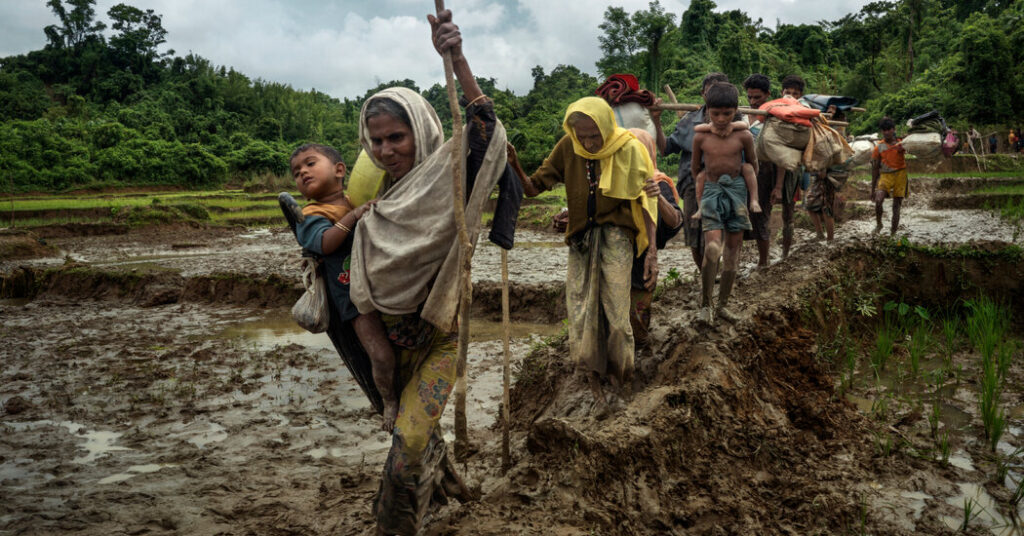
A U.S. government initiative to help island nations in the Pacific counter China lost $92 million, more than half of its budget. Funding aimed at preventing and responding to atrocities committed by Burma’s military junta was cut entirely.
When President Trump moved to claw back vast sums of foreign aid funding last year — first by winning party-line approval from the G.O.P.-controlled Congress to cancel the spending, then by unilaterally doing so without giving lawmakers time to object — his administration did not say which programs it planned to defund.
New data reviewed by The New York Times presents the clearest picture yet of where the administration chose to make the spending cuts. It was mostly by taking a meat ax to programs that once enjoyed bipartisan backing on Capitol Hill, as well as slashing almost 90 percent of U.S. economic aid to Africa, by far the hardest hit by Mr. Trump of any region across the globe.
The Trump administration has framed the cuts as a pillar of its efforts to raze what it calls wasteful spending antithetical to U.S. interests abroad. Russell T. Vought, the White House budget director, testified before the Senate Appropriations Committee last year that the rescissions package he was asking Congress to approve targeted “many foreign aid programs” that “use benevolent-sounding titles to hide truly appalling activity that is not in line with American interests.”
Economic and development-assistance funding was severely affected: $4.2 billion of the $7.8 billion lawmakers approved was ultimately canceled. And out of the 104 directives lawmakers had written into the spending bill to fund the State Department and other foreign aid programs, only two survived.
About half of the funding that was preserved and will be spent — a total of $2.4 billion — is going to Jordan, after Republican senators fought to exempt programs aiding the Middle East ally.
In the package Mr. Vought sent to Capitol Hill, he described economic assistance funds as having broadly “been used to fund radical gender and climate projects,” rather than to meet economic development needs.
A senior administration official pointed to grant funding for Burma that had gone to Freedom House, the pro-democracy nonprofit, and Internews Network, a nonprofit news organization, calling them “radical leftist NGOS.” Internews Network had been scrutinized by conservative media in part for a guide it published for Spanish-language journalists encouraging them to “adopt practices endorsed by transgender activists” in their coverage.
Terminated funding meant to help island nations in the Pacific counter the Chinese government, the official said, had been used to finance “radical climate” projects, rather than to counter Beijing’s influence.
Opponents of the rescissions package in both parties had called on the Trump administration to redirect funding away from recipients it viewed as radical, and to not terminate the money altogether.
Trump Administration: Live Updates
Updated
- Judge blocks deportation of man who was detained by ICE after exoneration.
- A commission led by Trump allies approves his ballroom, but legal roadblocks remain.
- Bondi’s firing ends a turbulent 14-month term atop the Justice Department.
“I certainly agree that the taxpayers of the United States should not be paying for things like promoting vegan food in Zambia,” Senator Susan Collins, Republican of Maine and the chairwoman of the Appropriations Committee, said at a hearing examining the cuts.
She added: “However, these and other controversial and questionable projects were the product of the misguided priorities of the Biden administration. Unless the current administration plans to continue these controversial projects that it has identified, which I very much doubt, those projects alone cannot be used to justify the proposed rescissions.”
Instead, Mr. Trump took aim at programs that had long enjoyed bipartisan constituencies, including those aimed at violence against children and combating infectious diseases. The programs to support the Burmese, especially the Rohingya people fleeing ethnic cleansing, had been championed by Senator Mitch McConnell of Kentucky during his long tenure as Republican leader.
While writing the foreign aid funding bill, Mr. McConnell pressed to reinsert $121 million for Burma, including for atrocities prevention and accountability programs. In doing so, he turned the funding faucet back on, but did not restore the money that Mr. Trump had already canceled.
“The Chinese are in there just operating effectively, and we — because of not honoring contracts and some of the other things we were doing to try to be helpful — are completely getting outmaneuvered,” Mr. McConnell told Secretary of State Marco Rubio at a hearing last May.
Aid to Venezuela and Cuba — two nations with strong G.O.P. allies on Capitol Hill — was largely preserved, while Africa fared the worst. Lawmakers had approved $1.5 billion for economic and development aid programs in Africa, but only $186 million was ultimately spent.
Funding for programs in Eastern Europe and Central Asia fared far better, with $712 million of the $770 million lawmakers allocated going out the door. That funding was protected in part by the determination of a few key Republican members to preserve funding for Ukraine.
Senator Thom Tillis, Republican of North Carolina, had given a long speech warning that he and other lawmakers had “no earthly idea what specific cuts would occur” once they had approved the package. He said he had sought to shield the aid to Ukraine.
“This happens to be a program that some believe, if it’s cut, could harm some of the nonmilitary aid that we’re providing Ukraine,” Mr. Tillis said last summer, when the Senate was considering approving Mr. Trump’s requested spending cuts.
“I’ve been told,” he said at the time, “that that will not be one of the cuts, and so I’m willing to move forward and vote on this bill on the assumption that that comes to pass.”
With those programs protected, administration officials had to cut more deeply into other areas in order to reach the top-line number they wanted to slash.
Senator Patty Murray of Washington, the top Democrat on the Appropriations Committee, had warned about that dynamic as Republicans pushed the rescissions package through the House and Senate on party-line votes last summer.
Republicans “preserve funding for Jordan, Egypt and a few university partnerships. What about our allies in the Indo-Pacific?” Ms. Murray said in a floor speech. “I’m sure my colleagues were told their priorities won’t be impacted, but Director Vought cannot keep that promise given the scale of these cuts. The math simply does not add up.”
Ms. Murray argued that if lawmakers put together their own package of spending reductions rather than approve one written by the administration, “we actually know what is being cut.”
“Doesn’t that sound a lot better than just passing this Pandora’s box and finding out later what got cut?” she asked.
Catie Edmondson covers Congress for The Times.
The post Trump’s Cuts Have Eviscerated Once-Bipartisan Foreign Aid Programs appeared first on New York Times.