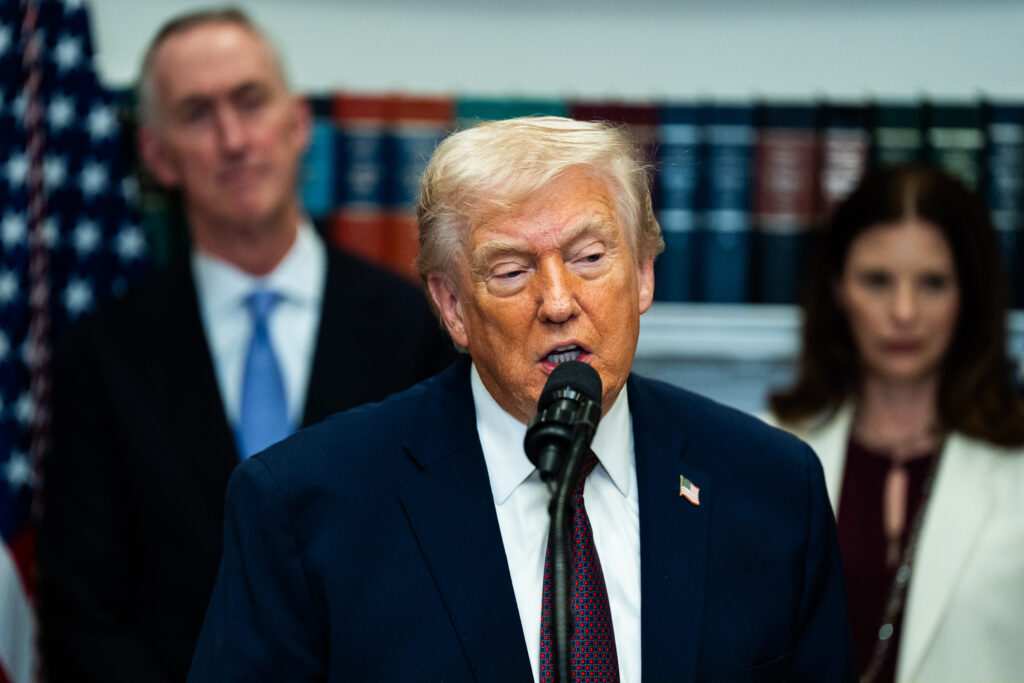
President Donald Trump on Thursday ordered a new 100 percent tariff on imported drugs made by companies that have not agreed to lower their retail prices, the latest move in his evolving campaign to reshape global trade and promote domestic manufacturing.
Makers of patented pharmaceuticals can escape the import tax by agreeing to join the president’s “most favored nation” program to reduce U.S. drug prices or by establishing new factories to serve the American market, according to a senior administration official, who briefed reporters on the condition of anonymity.
Companies that agree to build new U.S. plants will face 20 percent tariffs during construction, which must be completed before Trump leaves office. The administration expects “the lion’s share” of patented drugs consumed by Americans to be produced in the United States, the official said.
“We need to make sure our drug supply is protected, secure and domestic,” the official said.
Some imported drugs will face much lower tariffs under trade deals Trump negotiated with five U.S. trading partners. Goods from the European Union, Japan, South Korea and Switzerland will face 15 percent levies while drugs from the United Kingdom, which was the first to sign a deal with Trump, will be hit with a 10 percent tariff.
The White House has reached agreements with 13 drugmakers and expects to soon conclude an additional four, the official said. Companies already have pledged to invest $400 billion in new U.S. plants, the official said.
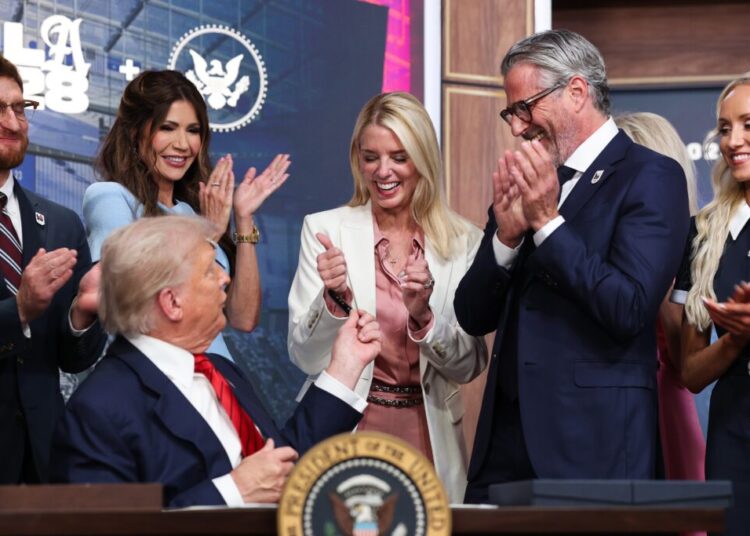
On Thursday, the president signed an executive order formalizing the new tariff regime, which is designed to incentivize other drugmakers to lower prices. Separately, Trump ordered changes to simplify current tariffs on industrial metals.
Both actions show that the White House is unbowed by Americans’ concerns over the high cost of living even as the war in Iran is expected to aggravate inflation as November’s midterm elections draw closer. The president also continues to fine-tune his tariff regime in the wake of the Supreme Court ruling that invalidated most of the import taxes he imposed on an emergency basis last year.
The tariffs at issue in Thursday’s announcement were imposed pursuant to a different law, Section 232 of the Trade Expansion Act of 1962, and are unaffected by the high court’s decision.
The administration insists that foreign companies bear the brunt of U.S. tariffs, a claim disputed by mainstream economists. Roughly 90 percent of tariff costs have been absorbed by U.S. importers, according to a study released last month by economists with Yale University and the University of California at Los Angeles.
The administration has decided to tweak its 50 percent tariffs on steel, aluminum and copper to take account of what it described as gamesmanship by foreign exporters that underreported the value of their shipments to lower their customs bill. From now on, a tariff of 50 percent will be assessed on the “full value” of the imported metals paid by U.S. importers rather than on the exporter’s reported cost, the official said.
The administration also is changing how tariffs are applied to “derivative” products that contain some steel, aluminum or copper. Products containing a minor amount of metal — such as a perfume bottle with a metal cap — would face no tariff. Those containing a significant amount will be hit with a 25 percent levy.
The United States did not receive as much tariff revenue as it expected under the original approach, which prompted the change. But the official dismissed suggestions that the revision would result in higher prices.
“These will not have an impact on the price of the good on the shelf,” the official said.
Consumers have much at stake in the administration’s handling of imported drugs.
Trump has insisted that lowering drug costs should be a political priority, an opinion shared by his advisers who have encouraged Republicans to focus on the issue ahead of November’s elections.
The administration last year launched its most favored nation initiative to reduce U.S. drug prices by linking them to those of other countries with lower costs. Officials pressured some of the world’s largest drug companies to voluntarily lower their prices in exchange for benefits such as tariff exemptions. The White House also launched a new government website, TrumpRx, aimed at helping Americans purchase medications at discounted prices.
Pfizer, the first company to publicly announce drug-price cuts in September, said the terms of its deal with the administration included a three-year grace period when the company’s products would escape tariffs.
Trump’s tariff threats were a “powerful tool” in compelling price cuts, Pfizer CEO Albert Bourla said at a White House news conference in September. Officials touted several Pfizer medications that they said would be newly discounted, such as an eczema treatment that would be available at an 80 percent discount.
“Nobody’s ever seen anything like it. I got other countries to do it with the threat of tariffs,” Trump said in a speech last week, touting his administration’s drug-price cuts. “We gotta talk about [it], that alone should win the midterms.”
Democrats have criticized Trump’s claims as hyperbolic, saying that his deals have not always resulted in the cheapest prices available and called on the White House to instead work on bipartisan drug-price legislation.
The pharmaceutical industry has also criticized Trump’s tariff threats.
“Imposing new tariffs on medicines would undermine new U.S. investments because every dollar spent on a tariff is a dollar not available to build in America or discover cures,” PhRMA, the industry’s chief lobbying group, said last year.
About 6 in 10 adults say they are worried about affording prescription drugs for themselves or for their families, according to a poll released by KFF last month — the highest level of worry since KFF, a health policy polling organization, began polling on the question in 2018.
The post Trump sets 100% drug tariffs on companies that haven’t lowered prices appeared first on Washington Post.