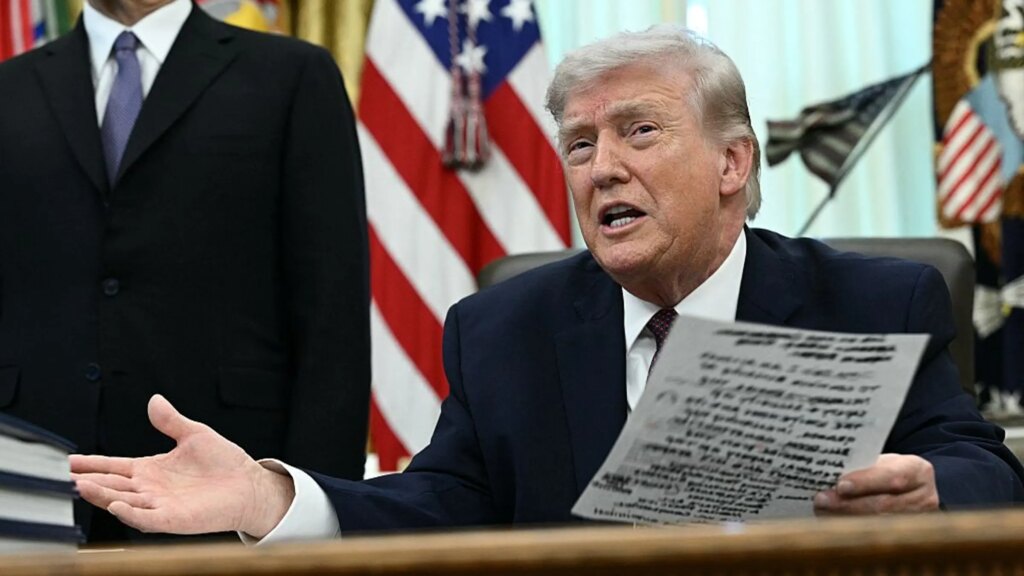
When President Donald Trump declared that Republicans should “nationalize” or “take over” the 2026 midterm elections, it wasn’t just a flippant remark. It was an unconstitutional red flag and part of a decade-long pattern in which Trump has undermined confidence in American elections.
Tuesday’s executive order targeting mail voting was just the latest example. The order aims to dictate how local officials run elections in their own communities and would fundamentally alter the voting process nationwide, potentially disenfranchising millions of voters. It directs the Department of Homeland Security to create a purported “State Citizenship List.” It also bars the U.S. Postal Service from delivering ballots to any voters not on a federal list, and even encourages the Department of Justice to investigate and prosecute local election officials who break from the White House.
Each and every part of the order attempts to seize power from the states and hand it over to a single man. That’s not how American elections work—not now, not ever.
Let’s be clear: states run elections. Period. Our system of voting is intentionally decentralized, a cornerstone of America’s tradition of checks and balances. This ensures elections and are run by state and local officials who know what works best for their communities.
The president has no constitutional authority over state-run elections, yet President Trump has not hesitated to test the bounds of his authority.
With 2026 primaries already underway and the president pushing his legislative power grab—the SAVE America Act—alongside a sweeping executive order to nationalize our elections, the threat to free, fair, and secure elections in this country is playing out in real time.
Since Trump returned to office, his administration has tried to militarize our communities, intimidate political enemies, and punish peaceful protestors and the free press. The brutal actions we’ve seen from federal agents in Minnesota and around the country scared Americans and sought to consolidate federal powers. However, such actions are also a sign of weakness from a president becoming increasingly desperate in his tactics. Trump and his policies are deeply unpopular.
Against this backdrop, Trump is becoming more brazen in his attempts to assert executive power over the states. He has been lying about elections since his first campaign in 2016, and it isn’t hard to imagine why. By undermining trust in our elections, Trump makes it easier to cast doubt on results he doesn’t like.
Last year, the White House tried to overhaul our election system through another unconstitutional executive order. Several states sued to stop it, and the courts agreed with them. Trump can’t legally change the voting process all by himself.
At the same time, Trump’s Justice Department has been seeking access to individual voter data—first through letters, then through a flurry of lawsuits. These efforts are not normal; there is no precedent for such sweeping actions under previous Republican or Democratic presidents. Trump’s Department of Justice has demanded that election officials violate state laws and hand over private and sensitive data for no clear reason. To date, the court rulings in these cases have sided with the states, unequivocally affirming their authority to conduct elections.
When Attorney General Pam Bondi sent Minnesota Governor Tim Walz a letter demanding voter data just hours after federal agents shot and killed Alex Pretti, she attempted to leverage ICE operations as a coercive weapon. The FBI seizure of Fulton County’s 2020 ballots and the subpoena for Maricopa County’s election records (based on discredited conspiracy theories) was another escalation. By continuing a false narrative about the 2020 election, Trump may destabilize the 2026 election.
Here’s the good news: State and local officials are holding the line against federal overreach. From Democrat Joceyln Benson in Michigan to Republican Brad Raffensperger in Georgia, secretaries of state from both parties have refused to comply with Trump’s demands. State legislatures, even in deep-red states, have refused to carry out Trump’s agenda: Indiana blocked mid-decade redistricting, for example, and Texas failed to pass a restrictive proof-of-citizenship voter mandate. Idaho recently denied the DOJ access to their voter rolls, reaffirming states’ authority to govern their own elections. Meanwhile, our federal and state courts are consistently standing up for the Constitution and the rule of law.
Our system of checks and balances is working.
Americans aren’t buying what Trump is selling. They want to move on from Trump’s 2020 loss and election denial. They don’t want the Trump administration to be more involved in our elections. They trust local election officials to run elections well and want every vote counted more than they want their preferred candidate to win. Americans can and should go to the polls with confidence. When people trust elections, they are more likely to vote.
As the midterms approach, voters should look to state and county election officials for trustworthy, accurate information on how they are keeping elections safe and secure. These officials work year-round in our communities to prepare for elections, from routine maintenance to training election workers and testing voting machines. They will be prepared to defend our elections against federal interference and uphold the right of every eligible voter to have their voice heard.
The Trump administration is trying to “take over” elections, but that doesn’t mean they will succeed. It’s up to the states to ensure they don’t.
The post Trump Is Trying to Nationalize Elections. States Won’t Let Him appeared first on TIME.