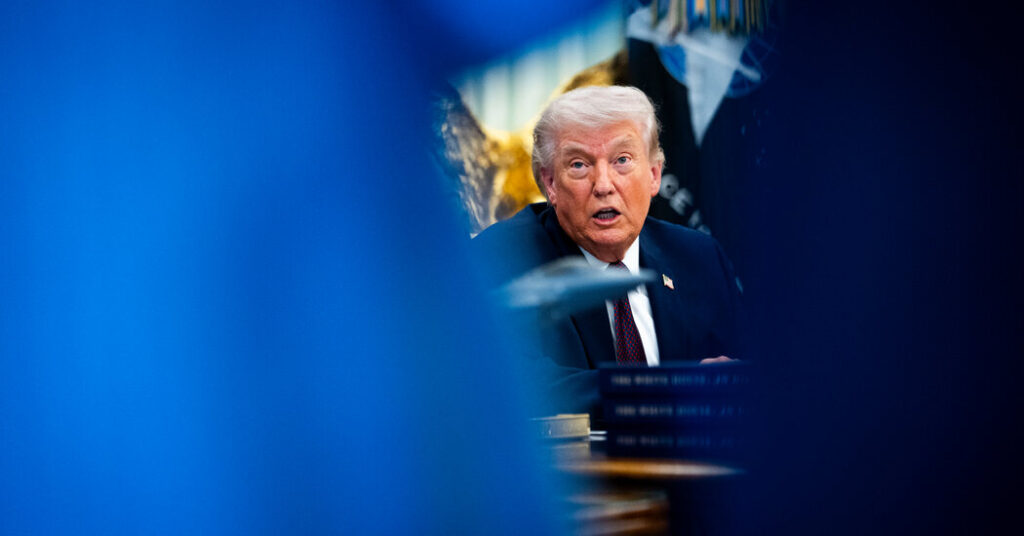
President Trump celebrated the destruction of a bridge near Tehran on Thursday, warning on social media that there was “much more to follow.”
The attack on the B1 bridge between Tehran and the nearby city of Karaj killed eight people and wounded 95, according to Fars, a semiofficial Iranian news agency. IRIB reported that two strikes had hit the bridge around an hour apart, the second while emergency responders were assisting the wounded. A U.S. military official said that American forces struck the bridge, eliminating what the official called a planned military supply route for Iran’s missile and drone forces. Mehr, a semiofficial Iranian news agency, said this was a “false claim,” because the “Bridge B1 has not yet been inaugurated.” The U.S. military official spoke on condition of anonymity to share operational details.
It is unclear if the bridge, in the mountains, was open to the public or if the casualties were among people on the bridge or nearby. The strike occurred on the last day of Nowruz, the Iranian new year, which is traditionally a day when Iranians celebrate by spending time outdoors.
Mr. Trump’s post on Truth Social was accompanied by a video of an explosion on or near the bridge and a large plume of smoke rising into the sky. With the U.S.-Israeli war on Iran now in its fifth week and showing little sign of abating despite Washington’s diplomatic overtures to Tehran, Mr. Trump in his social media post urged Iran’s government to “MAKE A DEAL BEFORE IT IS TOO LATE, AND THERE IS NOTHING LEFT OF WHAT STILL COULD BECOME A GREAT COUNTRY!”
The Israeli military said in a briefing to reporters on Thursday that it was not responsible, and that the bridge had been a U.S. target. U.S. Central Command, which oversees American military operations in the Middle East, did not reply to a request for comment.
Mr. Trump has threatened to destroy all power plants and other infrastructure in Iran if its leaders did not agree to a peace deal and end their military’s de facto blockade of the Strait of Hormuz.
Some experts in the law of armed conflict say that a country’s infrastructure could be considered a legal and legitimate target if that infrastructure is used by its military or plays a role in military operations. The legality would vary on a case-by-case basis.
“Whether the bridge was a lawful military objective would depend on the facts,” said Brian Finucane, a former State Department lawyer who specialized in the law of armed conflict and who now works at the International Crisis Group. “My read is that bridge was targeted not to provide any military advantage but in the hopes of coercing Tehran and generating content.”
Johnatan Reiss and Eric Schmitt contributed reporting.
Euan Ward is a Times reporter covering Lebanon and Syria. He is based in Beirut.
The post Trump Hails Destruction of Iranian Bridge, Warning ‘More to Follow’ appeared first on New York Times.