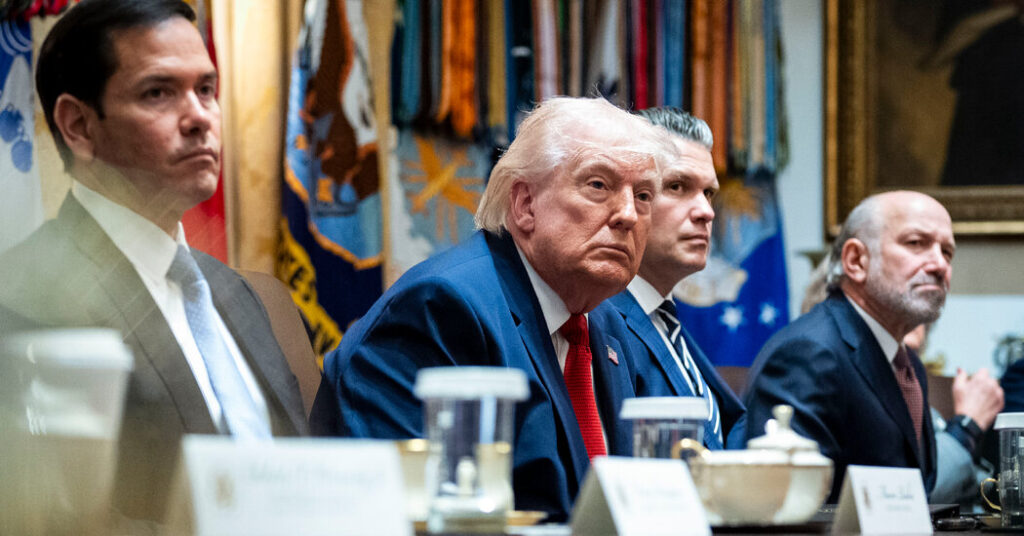
In the first budget of his second term, President Trump asked Congress to adopt some of the deepest spending cuts in the modern era, seeking to curtail or eliminate entire federal programs in education, health, housing and more.
But Mr. Trump did not succeed in bringing much of that blueprint to life. Instead, he wrangled with lawmakers for months only to relearn a timeworn truth in Washington: A president’s budget is merely a suggestion, one that Democrats and Republicans frequently disregard.
For the White House, that lesson looms large as it prepares to release its latest federal spending plan on Friday. It was never going to be easy for Mr. Trump to increase funding for the military, as he has pledged, while slashing some of the services on which millions of Americans rely. But his task has only become harder against the backdrop of war with Iran, gridlock on Capitol Hill and the looming midterm elections.
By Thursday, the White House had said little publicly about its exact budget plans. But Mr. Trump has hinted at some of his political objectives ahead of the 2027 fiscal year, which begins on Oct. 1.
For months, the president has steadily ramped up a campaign to crack down on what he describes as rampant fraud in federal programs — a move that may foreshadow another round of proposed cuts to domestic agencies that Mr. Trump has long disfavored. At a cabinet meeting last week, the president even predicted that his actions could reverse the nation’s debt and eventually generate a “surplus,” though budget experts vigorously dispute the claim.
Mr. Trump has also said that he would seek $1.5 trillion for national security and defense in the next fiscal year, which would be a roughly 50 percent increase from current levels. But he announced that total on social media weeks before the United States and Israel began bombing Iran in February, and it is unclear whether the White House has since recalibrated its approach.
Taken together, the requests could form the backbone of a 2027 budget that is spiritually similar to Mr. Trump’s last submission to Congress. Much of that budget, finalized in May, went largely unheeded, as Republicans joined with Democrats in a series of deals to fund the government that omitted the president’s most aggressive changes to federal spending.
While Mr. Trump would win some victories — including an increase to border enforcement — the final result was a significant departure from the roughly $163 billion in cuts that he had initially proposed. If anything, it was a remarkable outcome primarily because it was so ordinary: Even in Mr. Trump’s Washington, where the Republican-led House and Senate have frequently ceded legislative power to the executive branch, lawmakers reasserted quiet but unmistakable control over the nation’s purse.
Jessica Riedl, a budget and tax fellow at the Brookings Institution, said she expected the White House to reprise some of its past ideas in its new budget. But the politics had not changed, she said, and such a proposal would be “dead on arrival on Capitol Hill.”
Mr. Trump’s budget may offer only a partial picture of the government’s ledger. Much like last year, the administration may detail only the agencies and programs that must be funded annually — a universe of so-called discretionary funding that excludes the likes of Social Security, Medicare and Medicaid, which represent most federal expenditures in a given year.
The White House also initially omitted a holistic accounting of the nation’s fiscal health in its previous budget, including the money collected in tariffs and taxes. In the months to follow, Republicans adopted a sprawling set of tax cuts in a package that is expected to add trillions to the nation’s roughly $39 trillion debt, which Mr. Trump has pledged to reduce.
To close the gap, the president originally proposed a series of spending cuts that were as wide-ranging as they were deep. For the 2026 fiscal year, Mr. Trump asked Congress to eliminate significant aid for low-income housing; roughly halve spending at research agencies, including the Centers for Disease Control and Prevention; jettison some money to police tax fraud; and codify his attempts to end many federal education programs.
The president’s budget chief, Russell T. Vought, described those targets last May as “contrary to the needs of ordinary working Americans and tilted toward funding niche” political interests. Congressional Republicans appeared to agree, at least at first, and lauded the White House for identifying possible savings that might offset their sweeping yet pricey tax cuts.
But the early G.O.P. enthusiasm for austerity did not translate into votes to significantly reduce the federal balance sheet, according to an analysis earlier this year by The New York Times. Even after a series of high-stakes showdowns that closed the government repeatedly, federal spending stayed largely flat this fiscal year, and agencies like the Department of Housing and Urban Development and the C.D.C. emerged mostly unscathed.
“Most of the stuff did not go through Congress,” said Kent Smetters, the faculty director of the Penn Wharton Budget Model, a nonpartisan think tank.
Mr. Trump was not totally unsuccessful last year, administration officials maintain. The White House managed to essentially level out domestic spending overall, even while raising funding for the military. And the president clinched some of his politically minded cuts, including the elimination of billions of dollars for foreign aid and public broadcasting.
Formalizing work that began with the so-called Department of Government Efficiency, the administration also closed entire offices and ousted thousands of federal workers using more legally dubious means. Frequently, the White House looked to achieve that agenda by stretching the limits of its own power, circumventing lawmakers, even though the Constitution bestows Congress with the power of the purse. Each of the moves prompted states and others to sue, and judges have often ruled against the administration, which has defended the legality of its actions as it continues to halt billions in funding.
For Mr. Smetters, the dynamic still affirmed the reality that presidents’ budgets frequently serve only as a “political statement.” He predicted that Mr. Trump, like his predecessors, would double down anyway, “knowing perfectly well you can say later, ‘Congress didn’t agree with me’” in his pitch to voters.
Entering the new budget season, there appears to be even less appetite for compromise on Capitol Hill, where a dispute around funding for immigration enforcement at the Department of Homeland Security has left the agency closed for more than six weeks. Add the looming midterms, and lawmakers from both parties may be more inclined to resist any changes to spending that might anger voters, fiscal experts say.
“Across-the-board cuts are hard sells, particularly during the midterms,” said Dominik Lett, a budget policy analyst at the Cato Institute, a libertarian-leaning think tank. “Politicians want to signal they’re increasing spending and delivering for their constituents, even if in reality, the cuts in the future will be much more significant and draconian if we don’t take responsible action today.”
The tough politics could also compel Republicans to try to forge ahead on their own, using a legislative tactic known as reconciliation that could help them override Democratic opposition. G.O.P. leaders last invoked the process in 2026 to clinch their tax cuts, which they offset only in small part by scaling back federal safety-net programs, including Medicaid and food stamps.
That package also provisioned about $170 billion to help implement Mr. Trump’s immigration policies, including deportations, on top of about $150 billion in additional military funds, which the Pentagon has raced to use in 2026. Republicans have openly discussed a similar increase in the coming months, which could secure more money for immigration enforcement as well as the war with Iran. In a document shared with Congress this week, the Trump administration signaled it was seeking to clinch such a package by June 1.
But it is not clear whether Mr. Trump can corral warring, divided Republicans to approve those increases under tight time constraints. Some Republicans have reacted skeptically, if not with outright opposition, to the idea that the administration could seek $200 billion in supplemental war funding.
The White House has not transmitted that request to Congress. But Rachel Snyderman, the managing director of the economic policy program at the Bipartisan Policy Center, said that any attempt to increase military spending to the level that Mr. Trump seeks will create “significant pressure” on the White House find a “fiscally palatable” way to do so without adding to the debt.
“It’s a very delicate scale they are working with right now,” she said about the budget process. “While we don’t know yet what’s going to be included in this budget, I think, at this point, the administration has been very consistent about their priorities.”
Carl Hulse contributed reporting.
Tony Romm is a reporter covering economic policy and the Trump administration for The Times, based in Washington.
The post Trump Faces a Tough Fight With His New Budget appeared first on New York Times.