President Trump had seen enough.
He spent about an hour listening to the government make its case against birthright citizenship at the Supreme Court on Wednesday, making him the first sitting president to attend oral arguments at the high court.
His presence, which put him face-to-face with justices whom he has tried to bully and intimidate, only raised the stakes of an already closely watched case about what it means to be an American, an issue that was key to his political rise.
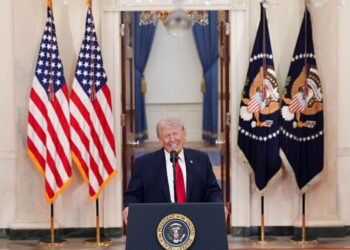
But about 13 minutes into the opposing argument by the American Civil Liberties Union, Mr. Trump abruptly got up and walked out, trailed by two escorts.
Mr. Trump has made little room for dissent during his second stint in the White House, and it was no different on Wednesday at the court. Mr. Trump observed the proceedings from the courtroom’s public gallery, listening as the justices across the ideological spectrum questioned his efforts to strictly limit birthright citizenship.
During oral arguments, spectators are generally expected to remain seated and silent.
Mr. Trump has long attacked judges who defy him, but the president’s relationship with the Supreme Court justices became even more strained after the court’s decision in February to invalidate his tariffs plan, which like immigration is at the heart of his administration’s agenda.
A hush came over the courtroom as Mr. Trump entered the room. He arrived about 10 minutes before the oral arguments began, accompanied by his attorney general, Pam Bondi, as well as the White House counsel, David Warrington.
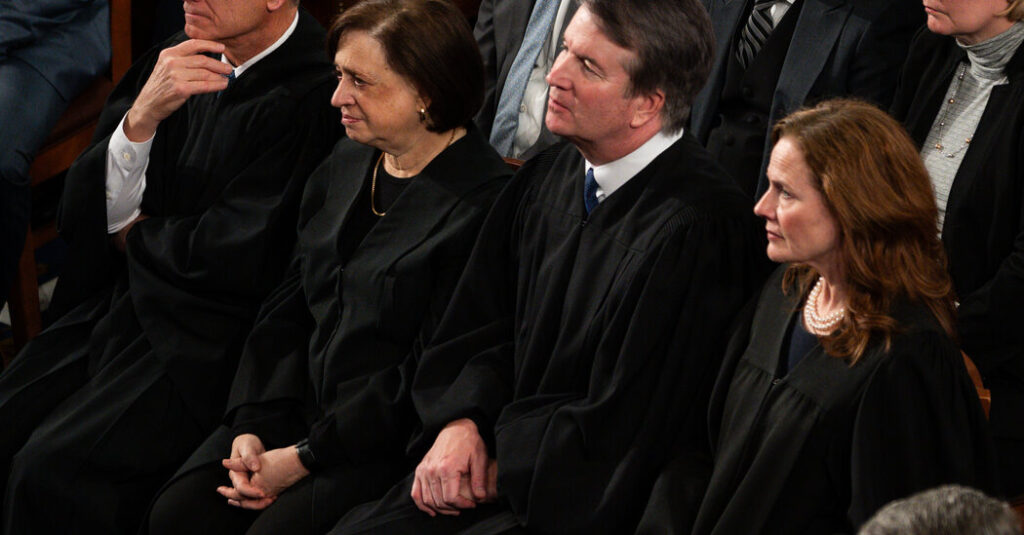
Wearing a red tie, Mr. Trump sat with his hands clasped in his lap as the arguments delved quickly into a history lesson about the 19th century debate surrounding the 14th Amendment. The president’s seat was at least half a dozen rows behind the lectern, where his solicitor general, D. John Sauer, stands. Mr. Sauer previously worked as Mr. Trump’s personal lawyer. The justices did not appear to acknowledge Mr. Trump’s presence, instead focusing their attention on the two lawyers presenting the case.
Mr. Trump departed the Supreme Court just as Cecillia Wang, the A.C.L.U. lawyer, and the justices went back and forth on questions central to the case, including whether undocumented immigrants or temporary visitors, such as students or workers on visas, should receive automatic U.S. citizenship.
Upon his return to the White House, Mr. Trump issued a public reaction to the arguments on social media, falsely claiming the United States was “the only Country in the World STUPID enough to allow ‘Birthright’ Citizenship!” The United States is among at least 30 countries that automatically grant citizenship to anyone born within its borders.
Mr. Trump, who has appointed three justices to the Supreme Court, has often talked about the justices not as independent checks on his power appointed for their expertise, but as loyalists who should support his agenda. Last month, he suggested that Justices Neil M. Gorsuch and Amy Coney Barrett, whom he nominated during his first term, were “an embarrassment to their families” because they had joined the majority in voting against his tariffs plan.
Legal experts said that Mr. Trump’s presence at the court on Wednesday was a show of power.
“Is there any question? It’s an attempt to intimidate the justices,” said Steven Lubet, an emeritus professor at Northwestern University’s School of Law who focuses on legal ethics. “It’s a challenge to the Supreme Court’s independence.”
Mr. Trump has taken steps throughout his time in office to erode checks on his power and encroach on traditionally independent agencies. He has ousted inspectors general, installed loyalists at the Justice Department and delivered broadsides against judges defying his executive power.
Mr. Trump had mused about attending the Supreme Court’s arguments about tariffs, but did not make an appearance.
Many people outside the court expressed strong opposition to the president’s presence on Wednesday.
“I think it’s basically kind of a strong-arming tactic, wanting to be there, intimidate them with his presence,” said Michelle McKeithen, one of the people who gathered outside the court during the arguments. “And kind of a statement of: ‘Make a decision while I’m here, looking you dead in your eye — and don’t make the wrong decision.’”
Earlier this week, Mr. Trump continued to express displeasure with the Supreme Court — insisting the justices must prove their intelligence by siding with him on the birthright citizenship issue, which he sees as key to his administration’s efforts to crack down on illegal immigration.
The president and his top advisers have long contended that foreigners have incentives to travel to the United States to have babies, and that so-called birth tourism is a national security threat.
“Birthright Citizenship is not about rich people from China, and the rest of the World, who want their children, and hundreds of thousands more, FOR PAY, to ridiculously become citizens of the United States of America. It is about the BABIES OF SLAVES!” he posted on social media earlier this week.
The president appeared to be referring to his argument that the 14th Amendment was intended only to grant citizenship to freed slaves after the Civil War and not to broadly guarantee it to everyone born in the United States, a claim with which even many conservative scholars disagree.
Many other presidents, including John Quincy Adams, Abraham Lincoln and Richard Nixon, have made appearances in the courtroom. But they all did so as lawyers arguing cases, before or after serving in the White House, according to Clare Cushman, a historian with the Supreme Court Historical Society.
Weeks after Mr. Trump responded to the Supreme Court’s tariff decision by calling the court’s majority a “disgrace to our nation,” Chief Justice John G. Roberts Jr. appeared to warn about the increasingly harsh rhetoric aimed at justices, calling it “dangerous.”
“It’s got to stop,” he said during an appearance at Rice University.
Kate Shaw, a law professor at the University of Pennsylvania, said that it was fine “in theory” for Mr. Trump to attend the Supreme Court arguments.
But given his previous insults about the justices who voted against him, Ms. Shaw said that “this seems like a way to send the message that justices who vote against his birthright citizenship order are in for more such attacks.”
Aishvarya Kavi and Zach Montague contributed reporting.
Ann E. Marimow covers the Supreme Court for The Times from Washington.
The post Trump Attends Supreme Court Oral Arguments, Then Leaves an Hour In appeared first on New York Times.