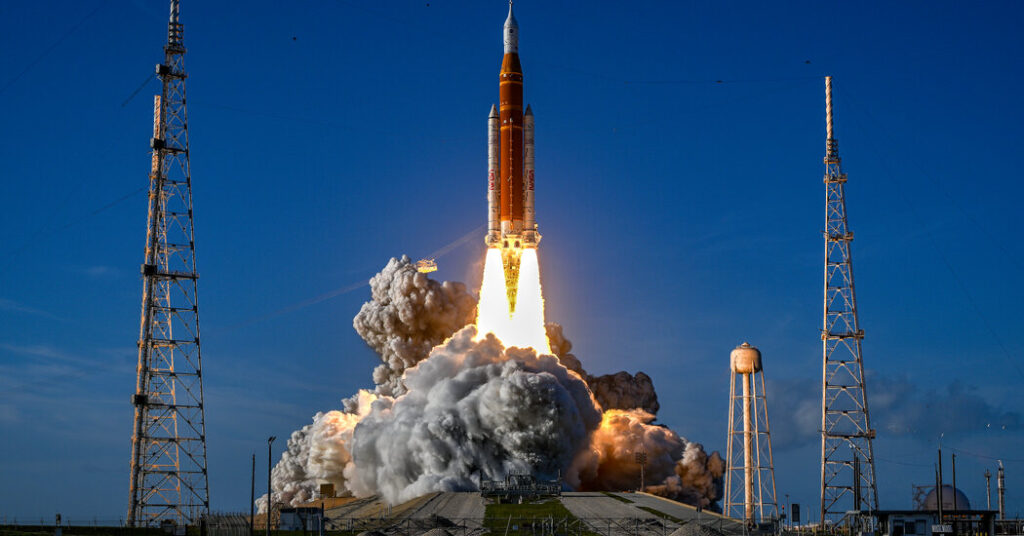
A big space mission like Artemis II can sometimes feel like a unifying moment for humanity. After all, what better than a cold, indifferent cosmos to remind us of our shared status as earthlings?
But humanity’s endeavors in space have always been entangled with humanity’s politics back on Earth. Today, my colleague Selam Gebrekidan, an investigative reporter focused on China’s space program, is writing with a reminder about Artemis II: As awe inspiring as it might be, it’s not a mission to bring humanity together. In fact, it’s part of a high-stakes space race between the U.S. and China. — Alicia P.Q. Wittmeyer
A new space race
Like many around the globe, I watched the Artemis II launch this week with the giddy excitement of a child.
It’s the first time humans have headed toward the moon in more than 50 years. The four astronauts will not land on the moon, but they will get to see its far side, the hemisphere that is always turned away from us. If all goes well, they will go farther than any human has ever gone from Earth. And if all goes really well, American astronauts will land on the moon again by 2028. From that point, NASA plans to launch missions every six months and sustain a presence there.
This is an important moment for NASA. The agency got to show off its newish rocket, the Space Launch System, which propelled the astronauts into space without a hitch. NASA will continue to test its spacecraft Orion, which has performed well so far — minus a small issue with its toilet.
It’s also a flex for the space agency at a crucial juncture, because the United States is in the middle of another space race. This one is with China, not the Soviet Union.
And “this time the goal is not flags and footprints,” Jared Isaacman, the NASA administrator, said last week. “This time the goal is to stay.”
Chinese astronauts are aiming for a first moon landing in 2030 — in theory, many months after the U.S. But the Artemis program has been proceeding in fits and starts, while China’s space program has been driving forward with formidable focus. And even NASA acknowledges that it may lose this round.
“They may be early,” Isaacman said. “And recent history suggests we might be late.”
A new frontier
The U.S. vision for the moon is much grander than it was in the Apollo years. So is China’s.
Each country wants to build a base near the southern pole, where it can extract resources like frozen water, hydrogen and helium. Each wants to build nuclear reactors to power its lunar bases. Each wants to launch missions from the moon and go deeper into space.
Whoever is first to establish a lunar base will most likely have a greater say over what others can do on the moon, which, at the moment, is a frontier with few laws or rules.
Take the question of long-term power sources, for example. Last year, NASA put out a directive to fast-track its plans for nuclear reactors on the moon, in part because if China, along with Russia, builds a reactor first it could “potentially declare a keep-out zone,” Sean Duffy, the secretary of transportation who temporarily led NASA, said.
China’s space program is still young. But it has accomplished a lot in a short time. Its robotic missions have gone to the far side of the moon and brought back samples, feats only the Chinese have pulled off.
Experts I spoke to said that China’s advantage when it comes to space lies in its centralized control. It can set goals years in advance, fund its projects and hit milestones on time. NASA’s budgets and goals are shaped by U.S. domestic politics. The cadence of China’s work will be the same no matter what NASA does with Artemis, one scientist who works on the lunar program told me.
A human concern, not just a political one
The U.S.’s near-term goals for the moon are ambitious: Because the U.S. has already sent people to the moon, Artemis is hoping to send astronauts to the south pole, where no humans have gone before. China’s immediate goals are more attainable. The country’s first landing will be on the near side of the moon, the region where Neil Armstrong took “one giant leap for mankind” in 1969.
Even if NASA loses this round, it won’t determine the final outcome of this new space race. It will be a while before the U.S. or China can establish a prolonged presence on the moon; a few crewed missions are unlikely to execute on either country’s grand ambitions.
But they will set the tone for who seems to be heading for dominance. And this is a race that the rest of the world has a stake in.
Most other countries, realistically, won’t be active participants. Some dream of the moon — India has landed a rover near the southern pole, and Russia has its Luna program — but it is likely to be the U.S. or China who shapes its future.
Other countries won’t just be passive observers, though: Canada has an astronaut on board the Artemis II mission. Others are sending scientific instruments, on both the Chinese and American missions. The relationships that shape geopolitics on Earth could wind up shaping science in space.
But beyond that, this is a race for who claims control of Earth’s natural satellite. That makes it a human concern, not just a geopolitical one. We all have a stake in the future of the moon. (Read my story about China’s lunar ambitions.)
For more:
-
Look back on the first human spaceflight to reach the moon, 58 years ago, and the picture that would forever be known as “Earthrise.”
MORE TOP NEWS
Trump fired his attorney general
President Trump had been souring on Attorney General Pam Bondi for months, especially because of her handling of the Epstein files, which have become a political liability for Trump.
Bondi’s dismissal yesterday ended a turbulent 14-month tenure in which she desperately tried to appease a boss who demanded control of the Justice Department to pursue politically motivated investigations.
‘Maybe one shouldn’t speak every day’
President Emmanuel Macron of France yesterday bluntly criticized Trump for repeatedly shifting his goals for the Iran war. He also said Trump’s anger at NATO was unhelpful.
“When we’re serious, we don’t say the opposite of what we said the day before every day, and maybe one shouldn’t speak every day,” Macron told reporters in South Korea during a trip through Asia. “We just need to calm things down and build lasting peace.”
During a televised address on Wednesday, Trump threatened to bomb Iran “back to the Stone Ages” and repeated his warning that he would hit the country’s infrastructure, unless a deal was struck. But he failed to offer a clear exit strategy. Here are the takeaways.
Markets: The price of oil jumped and stocks wavered after Trump’s address.
Reaction: Iran’s commanders and officials issued defiant statements.
OTHER NEWS
-
Russia is sending a second tanker of crude oil to Cuba. The White House declined to say whether it would allow the second tanker to dock.
-
Officials are examining whether an air traffic controller stepped away to use an emergency telephone just before the fatal crash of an Air Canada jet at a New York airport.
-
Pope Leo XIV returned to tradition and washed the feet of priests during Holy Thursday.
WHAT ELSE IS HAPPENING
-
The rapper formerly known as Kanye West performed his first full U.S. live show since 2021, after years of antisemitic behavior.
TOP OF THE WORLD
The most clicked link in your newsletter yesterday was about a letter from Iran’s president addressed to Americans.
SPORTS
World Cup: The president of the Italian Football Federation resigned after the country failed to qualify for the 2026 tournament.
Kylian Mbappé: Can the team captain take France to World Cup glory?
TECH TIP OF THE DAY
Get rid of cringe email handles.
Google just announced that people now have the option to change old Gmail usernames without losing access to their inboxes. The company’s chief executive, Sundar Pichai, invited users to “say goodbye to [email protected].”
MORNING VIDEO
There are 11 shows running both on Broadway in New York City and in the West End in London. Nearly everything about them is the same — except for the ticket price. My colleagues Michael Paulson and Alex Marshall went to shows on both sides of the Atlantic to compare experiences. See who got the most bang for their buck in the video above.
AROUND THE WORLD
Skipping rocks on the Strait of Hormuz
Musandam Province in Oman is sometimes compared to Norway because of its rocky fjords. The region is defined by a peculiar duality: rugged isolation and a sometimes dangerous proximity to global trade.
The sleepy fishing town of Khasab, the provincial capital, sits on the Strait of Hormuz, where boys can sometimes be seen skipping stones on a quiet stretch of the coast. For residents, life has always required navigating the precarious balance between the serene seclusion of their lives and the global crosshairs on their shores. Read more.
RECOMMENDATIONS
Watch: “Living the Land” follows a boy left in the care of relatives in rural China when his parents move to the city in search of jobs.
Read: Here are 23 great chapter books for beginning readers.
Travel: Spend 36 hours in Queenstown, New Zealand, the birthplace of commercial bungee jumping.
Listen: Our critic called Harry Styles’s new album the sound of spring.
RECIPE
These chocolate nest cakes are Britain’s favorite Easter dessert and the perfect no-fuss baking activity for the whole family. Just stir, portion into muffin cups, fill with as many candy eggs as you can, and chill.
WHERE IS THIS?
Which river is this?
TIME TO PLAY
Here are today’s Spelling Bee, Mini Crossword, Wordle and Sudoku. Find all our games here.
That’s it for today. Enjoy your weekend! — Alicia
We welcome your feedback. Send us your suggestions at [email protected].
Selam Gebrekidan is an investigative reporter for The Times based in Hong Kong.
The post The Race for the Future of the Moon appeared first on New York Times.