The first time human beings flew to the moon, it came at the end of a rotten year. War, political violence, racial strife, protesters in the streets — it felt like everything was coming unraveled. Yet when Apollo 8 splashed down, it proved so inspiring that one American summed up the feeling with a telegram thanking the astronauts: “You saved 1968.”
Fifty-eight years later, another American spacecraft hurtled toward the heavens this week to begin a journey back to the moon amid deep divisions at home. For a brief moment, the talk was again about courage, exploration, national ambition and common purpose. But it was no fault of the four astronauts of Artemis II that the planet they left behind remains riven by war, strife and violence or that 2026 has not, as yet, been saved.
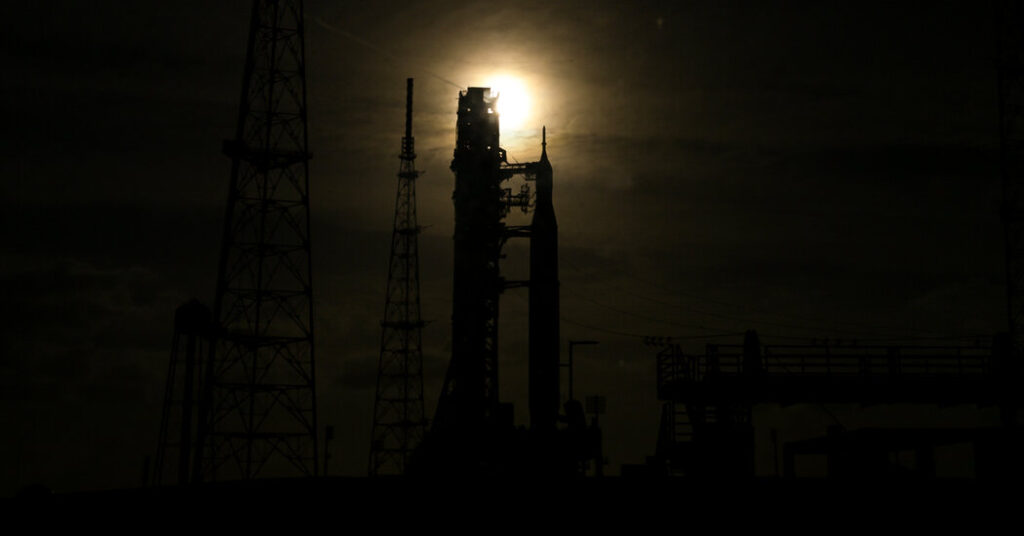
The launch of Artemis II on Wednesday evening captured the tenor of the times in a country that can still do big things but seems forever mired in big problems. The roar of the rocket managed to hold the spotlight for less than two and a half hours before President Trump came on the screen to change the subject. While he congratulated the astronauts at the top, he quickly turned the nation’s attention back to the latest war dividing Americans and the economic turmoil it has wrought here and around the world.
This is, it seems, a country impervious to unity these days, led by a president with little interest in pursuing it. Rather than take advantage of the moment to try to bring Americans together behind a fresh leap back into the next frontier, Mr. Trump focused on what has torn Americans apart. He did not have to give that speech just after the launch. It did not say anything new. He chose that particular moment to draw the cameras back to himself so that he could “tell everybody how great I am,” as he described his goal beforehand.
“Had he said more about it last night in the speech, that would have been a unifying factor,” said Roger D. Launius, a retired NASA chief historian. “Everybody likes this stuff. You might question the cost, but generally we all sort of like it. There’s not a lot of NASA haters out there. It’s nonpartisan.”
Still, Mr. Launius said, the Artemis II launch did remind him of that brief moment of shared endeavor in 1968. “I think there were a lot of people who paused to see that,” he said. “Now, they immediately got back to other things. Within a half-hour, it was over. But I do think there was a similar camaraderie.”
To be sure, Artemis is not Apollo and going back to the moon does not fire the imagination like going there in the first place. For many Americans, it seems like a rerun, even if most were not old enough to remember the last time humans ventured beyond Earth’s orbit. Like Apollo 8, which paved the way for Apollo 11 to actually land on the moon, Artemis II will circle the satellite without actually touching down, leaving that to a successor craft in the coming years.
Moreover, for all the wonder of those iconic launches in the 1960s and early 1970s, the sense of coming together did not last long. Apollo did not end the turmoil over the Vietnam War or civil rights or the assassinations of the era. And once Neil Armstrong and Buzz Aldrin took that great leap for mankind and beat the Russians — which, after all, was John F. Kennedy’s real goal — the magic ended for many ready to move on.
Yet there was still something awe-inspiring about reaching out again after so long, as enthusiastic crowds gathered in Florida and online around the world concluded this week. It is no small feat to travel 250,000 miles from the Earth. Only 24 humans have ever visited our nearest neighbor, 12 of whom actually landed on the moon, and none in more than half a century.
Under its commander, Reid Wiseman, Artemis II is bringing the first woman (Christina Koch), the first Black man (Victor Glover) and the first non-American (Jeremy Hansen of Canada) to another world.
And this time, NASA says, humans are traveling to the moon to stay. Artemis IV and Artemis V are supposed to land on the dusty surface in 2028, and future expeditions are meant to serve as a springboard toward the even more ambitious mission of sending humans for the first time to Mars.
“We need this,” Senator Mark Kelly, Democrat of Arizona, said in an interview on Thursday, a day after attending the launch with his twin brother and fellow former astronaut Scott Kelly. “Right now, with the division in our country, just everything seems to be one side or the other and politicized and just like the chaos in the world right now. On top of it, we’ve got a war in Europe, people can’t afford their lives, election coming up. It’s just a crazy time. It’s moments like this that I think give people hope.”
There are so few things that bring Americans together these days. Public faith in the presidency, Congress, the Supreme Court, business, the police and the media has fallen. Establishments and endeavors that were once widely respected are now seen through partisan or ideological lenses. Even institutions like Harvard University, the F.B.I. and the Centers for Disease Control and Prevention are now distrusted by wide swaths of Americans on one side of the aisle or the other.
While Americans used to rally around the president at the start of a war, Mr. Trump’s attack on Iran was the first major conflict in the history of polling not to have public support from the beginning. Mr. Trump is a historically unpopular president but, according to Gallup polling, every president over the past two decades has governed without the support of a majority of Americans for most of their tenures.
NASA has been an outlier. While many Americans question whether the moon should be a high priority, the space program has high ratings. Of 16 federal agencies tested by the Pew Research Center in 2024, NASA was seen favorably by more Americans than all but two others (the National Park Service and the U.S. Postal Service), with 67 percent positive versus just 12 percent negative.
To listen to the astronauts themselves describe their hopes for their mission in the months before the launch was to hear the palpable desire not just to depart the Earth but to heal it. In a series of interviews with The New York Times in January, the space-farers gave voice to distinctly terrestrial aspirations.
Ms. Koch talked about how the moon mission would be “celebrating the fact that we recognize that we can go farther when we go together.” Mr. Glover compared it to 1968 when “it was a tough time in the country” and said that he hoped “that we can create a touch point for our generation that’s equal to or maybe even, maybe there’s a path to be even greater” than Apollo 8.
Mr. Wiseman, the commander, acknowledged that even amid all the technological tests and flight simulations, he had been mulling over the state of society. “I’ve been thinking — in the world that it is today, what are the things that we can best do to lift up our friends on planet Earth?” he said. “I hope we have a great impact on bringing the world together even just for a minute.”
That is perhaps an even heavier lift than the Space Launch System achieved above Florida this week. Even more than in 1968, America is a country splintered into tribal factions. Americans who watched Apollo 8 take off mainly did so on one of three major broadcast networks or one public network. An estimated one billion people around the world watched or listened as Frank Borman, James Lovell and William Anders read from the Book of Genesis on Christmas Eve.
This week, followers of the launch could watch on far more television networks or, as many did, online, either on NASA’s own channel or elsewhere. As Andrew Egger wrote on The Bulwark, a political website, watching on the internet meant that he was treated to a comments feed filled with conspiracy theories about whether the launch was faked and even whether the Earth is flat. Mr. Kelly said so many Americans live in their own social media bubble that millions may not have even known about the launch.
The revival of the space exploration program has been a priority of Mr. Trump’s since his first term, the kind of grand project that fits his vision of making America great again. Yet with the war on Iran disrupting markets and economies, he devoted just 35 seconds to the launch at the start of his nationally televised address shortly after takeoff. “It’s amazing,” he said, praising NASA and the astronauts. “They are on the way and God bless them. These are brave people.”
Some were surprised that Mr. Trump did not go to Florida to witness the launch himself, as he did in 2020 for a landmark SpaceX flight. Jared Isaacman, the NASA administrator, had said in a January interview that he expected Mr. Trump to show up at key moments. “I have no doubt that he will,” Mr. Isaacman said then. “He specifically told me to make sure I get the invites for the signature space events.” The White House did not say on Thursday whether Mr. Trump will personally welcome the astronauts home when they return.
Mr. Kelly lamented Mr. Trump’s decision not to go. “The president last night, instead of being down there at the Kennedy Space Center, which I thought could have been a really good moment for him, instead he’s giving this nonexplanation about Iran,” he said.
But Mr. Kelly said he hoped the spirit of Artemis II would invigorate Americans for more than a day. “It’s a way they all get to see some of the great things that our country can do,” he said. “So it definitely is a unifying event. We’ll see how unifying it is and how long it lasts.”
Peter Baker is the chief White House correspondent for The Times. He is covering his sixth presidency and sometimes writes analytical pieces that place presidents and their administrations in a larger context and historical framework.
The post The Awe of a Moon Launch in an Age of Trump, Turmoil and Tribal Divisions appeared first on New York Times.