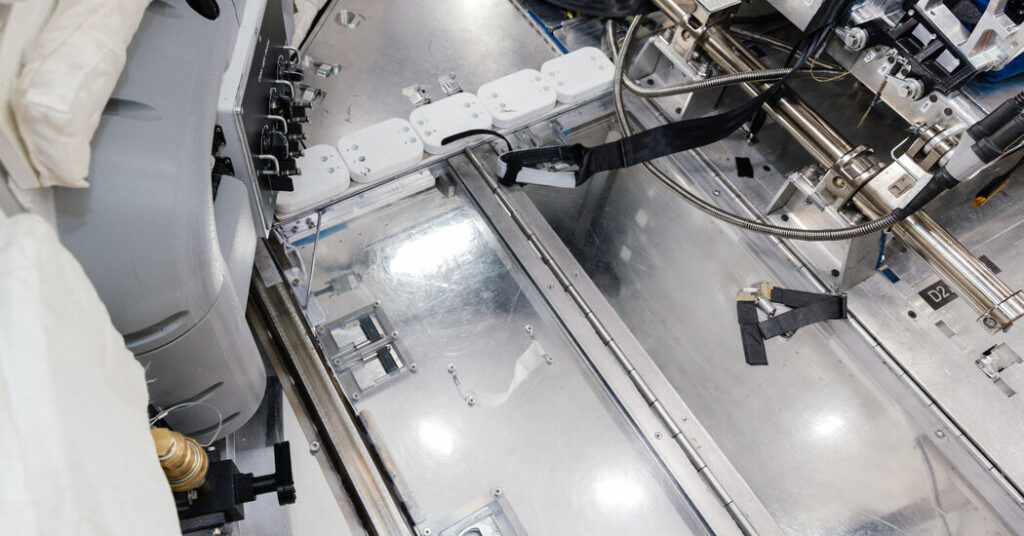
While in orbit around Earth, the Artemis II crew called down to the mission team on the ground to report a problem with their toilet.
They noticed a blinking fault light that NASA’s associate administrator Amit Kshatriya called a “controller issue” in a news conference, one that would take some hours to troubleshoot.
This is the first time a real toilet has been installed on a mission into deep space. The Apollo missions that carried astronauts to the moon in the 1960s and 70s did not have a toilet, nor a designated bathroom area on board. Those crews used waste collection bags on their way to the moon. They left those bags on the lunar surface to reduce mass and contamination risk during their journey back to Earth.
The setup for Artemis was planned to be a bit more dignified.
Aboard the Orion capsule is a specialized toilet called the Universal Waste Management System. The door is on the floor, situated next to the hatch the astronauts use to enter the spacecraft.
“We’re pretty fortunate as a crew to have a toilet with a door on this tiny spacecraft — the one place that we can go during the mission where we can actually feel like we’re alone for a moment,” Jeremy Hansen, a mission specialist on Artemis II from the Canadian Space Agency, said in a video.
But how exactly will the three men and one woman of Artemis II go in space?
“Very carefully,” Branelle Rodriguez, Orion’s vehicle manager, said in a NASA podcast.
“First and foremost,” she added, “make sure you get in a good configuration.”
Another interesting fact: It’s very loud inside the toilet.
“You have to wear hearing protection when you’re in here,” Christina Koch, a mission specialist from NASA, said in a video recorded for National Geographic.
In microgravity, there’s not much to hold you — much less your poop — down. Orion has handrails and foot tethers that keep the crew secure during a bathroom run. The toilet has a funnel attached to a hose for urine and a seat for solid waste. Automatic air flow, which helps reduce odor, pulls the waste away from the body and into separate storage containers.
If for some reason the Artemis toilet can’t be fixed, the astronauts will collect their urine in bags. The crew can still use the toilet to go number two, though the air flow may not be functioning.
During longer missions, like those aboard the International Space Station, astronauts recycle their liquid waste and process it back into drinkable water. But as Artemis II is only 10 days long, the crew will vent urine out of the spacecraft every day.
Fecal waste will be stored in a collection container that is fitted with filters to control odor and gas buildup. That will be disposed of once the crew returns to Earth.
Katrina Miller is a science reporter for The Times based in Chicago. She earned a Ph.D. in physics from the University of Chicago.
The post The Artemis II Toilet Had a Problem appeared first on New York Times.