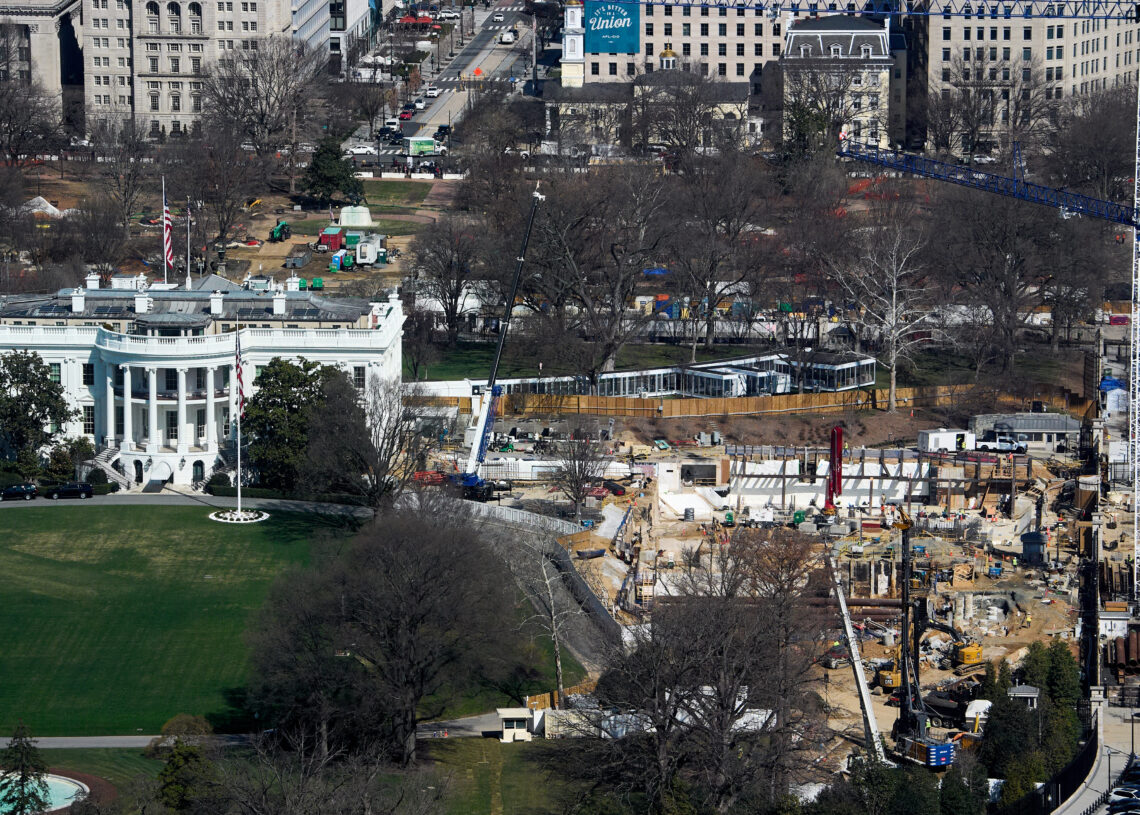
A federal urban planning commission on Thursday approved President Donald Trump’s planned White House ballroom, the final procedural obstacle to building a structure that would dramatically remake one of the most recognized symbols of American power and democracy.
But the project’s future remains uncertain after a federal judge ruled that it requires congressional approval and ordered a halt to construction. Congress also does not appear eager to authorize the project, which is polling poorly and has drawn public complaints.
The National Capital Planning Commission, which Trump has packed with allies, voted 8-1 for the two-story, 90,000-square-foot building — ending the administration’s 13-week push to clear two congressional design-review committees. Two commissioners voted “present.”
The commission’s chair, Will Scharf, who serves as Trump’s White House staff secretary, voted for the project. In lengthy remarks, he said the building will give Trump and future presidents much-needed space to entertain VIP guests without erecting “unsightly” tents that past administrations have put up on the South Lawn for such events.
“The ballroom will be celebrated as a crucial and contributing aspect of the White House complex,” Scharf said.
Other Trump appointees on the panel also delivered remarks explaining why they supported the new ballroom.
Phil Mendelson, who sits on the commission by virtue of his position as D.C. Council chair, was the lone vote against the project. He questioned the size of the building, echoing a frequent critique that it will dwarf the main executive mansion.
“It’s just too large,” Mendelson said. “It’s just too large.”
Trump administration officials have said aboveground construction could begin as early as this month.
But a federal judge made that less likely on Tuesday when he ordered a stop to construction, ruling that Trump lacks the power to fund the estimated $400 million project through private donations. Calling Trump a “steward” of the White House, U.S. District Judge Richard Leon disagreed with the administration’s argument that the president has broad authority to make changes to the property without congressional approval, including projects on the scale of the ballroom.
The White House notified the court it would appeal Leon’s decision, calling it “egregious.” Trump appears to be pinning the ballroom’s fate on the administration’s legal arguments, given that members of Congress are hesitant to support the project.
At the start of the commission’s meeting, Scharf said Leon’s ruling bars construction, with exceptions, not the commission’s review process. “We’ll move past that and continue our consideration of the East Wing modernization project,” he said.
Before voting against the project, Mendelson advocated for delaying Thursday’s vote given Leon’s ruling, which he said would give the commission and the White House a chance to refine the building’s design, making it better. He cited previous White House projects, which were far smaller but took far longer to get through the commission’s review process.
“Because this has been such a rushed process, we have not had the benefit of that iterative work,” he said.
Ballroom supporters on the commission pressed ahead.
Scharf praised the White House project team for making several changes to the building’s design since last month’s meeting, ones that he said reflected much of the commission’s feedback. Those included eliminating a “ceremonial and largely nonfunctional” staircase from the proposed building’s south portico, which would have led down to the South Lawn.
Scharf also criticized “sky-is-falling” pronouncements from those upset by the project. Past additions to the White House — including the Truman Balcony and the north portico that Andrew Jackson completed in 1830 — drew the same vitriol as the ballroom building in their day, he said, but over the decades and centuries have become beloved parts of “the People’s House.”
“I believe that, in time, this ballroom will be considered every bit as much of a national treasure as the other key components of the White House,” Scharf said.
Outside, about 40 people protested the vote, carrying signs that read “Monument to Greed!” “Hands Off the People’s House!” and “Democracy can’t dance in a Billionaire’s Ballroom!” The demonstration, organized by Public Citizen, a liberal advocacy group that frequently opposes Trump, featured a column of six stacked cardboard boxes filled with printouts of the more than 35,000 public comments submitted to the commission about the project. The “vast majority” were in opposition, commission staff said. The Washington Post found that more than 97 percent of them were critical of the president’s project.
The Trump administration originally planned to have the project approved at the commission’s meeting last month, but the agency delayed the vote because of “significant public input,” citing the amount of public testimony.
Marcel Acosta, the commission’s executive director and a career government official, recommended the 12-member committee approve the project. In an 11-page report published in late February, he said the proposed structure would provide presidents with a larger permanent event space while protecting “the historic integrity and cultural landscape of the White House.”
That assessment contrasts sharply with the public response. Dozens of people, including architects, historic preservationists and at least one former commissioner, told the panel they were against the project during a public meeting last month on top of the tens of thousands of comments that had already been submitted.
In February, the Commission of Fine Arts, which Trump also stacked with loyalists, including his 26-year-old executive assistant, voted unanimously to approve the project. Those commissioners universally praised the project with Chair Rodney Mims Cook Jr. calling it “desperately needed” and “a very beautiful structure,” whose design he credited to Trump.
The White House recently remade both commissions reviewing the project. The planning commission is led by Scharf, Trump’s former personal lawyer and current staff secretary, and includes two other White House officials whom critics say are legally unqualified for their seats.
Trump appointees on both commissions have frequently extolled the ballroom.
Edward Forst, the Trump-appointed administrator of the General Services Administration, said Thursday that he would vote for the new ballroom because it would enhance a U.S. president’s power to hold events.
“Our president is also the convener-in-chief of the United States and the most powerful in the world,” said Forst. “Until now, we’ve convened as we can, probably not convened as we should.”
While federal design commissions have traditionally acted as a constraint on government construction projects — often holding extended deliberations that last for years — Thursday’s action underscored how Trump has bent federal processes to quickly push his ballroom to approval as he rushes to finish construction before the end of his second term.
Last year, the president ordered the rapid demolition of the East Wing annex without first seeking authorization from Congress or the committees it has empowered to review federal construction projects. Trump’s plan for a new ballroom that matches the “height and scale” of the main White House has advanced despite objections from a federal judge, architecture experts and historic preservationists, who argue the structure would be too big, dwarfing a centuries-old American symbol.
The administration asked the commission to depart from its normal procedure by approving preliminary and final plans simultaneously, a process that typically unfolds across separate meetings over months. For example, the planning commission approved a White House perimeter fence in four steps over nine months, starting with a conceptual design in May 2016 and ending with final plans in February 2017.
Trump has described the ballroom as a top priority, repeatedly praising the design at public events and arguing that presidents require a dedicated, permanent venue for hosting foreign dignitaries and other VIP guests. He has also defended the project’s $400 million price tag, saying it will be paid for with private donations.
“This ballroom is going to be something that’s so beautiful for the city, so desperately needed by presidents,” he said last week during a Cabinet meeting.
Democrats and government watchdog organizations have raised concerns about the project’s private donors, which include major corporations such as Amazon, Google and Palantir — companies that together have billions of dollars in federal contracts. Critics have questioned whether donors could receive special access or other benefits in return. (Amazon founder Jeff Bezos owns The Washington Post.) Some Democrats say that improvements to the White House complex may be warranted but that the ballroom should be far smaller and subject to congressional oversight — to ensure transparency.
Polls have repeatedly found that most Americans oppose the project. Fifty-six percent of Americans said they disapproved of Trump’s renovations to the White House, according to an Economist/YouGov poll conducted March 27-30, while 28 percent said they supported them.
The post Panel led by Trump allies approves White House ballroom amid legal battle appeared first on Washington Post.