Oil prices rose sharply again Thursday and stock markets fell after President Donald Trump presented no plan to reopen the Strait of Hormuz in his address the evening before, leaving the task to a group of U.S. allies meeting on the energy crisis.
Officials from more than 30 countries convened Thursday to discuss how to reopen the strait, a vital corridor for the world’s oil supply that has been choked off by the U.S.-Israeli war with Iran. The U.S. was not expected to have a representative at the meeting, which was called by Britain.
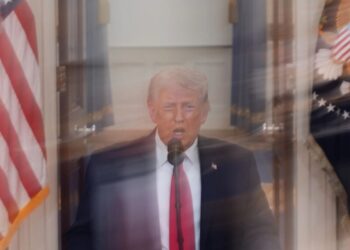
Trump, who has railed against NATO allies for hesitating to get more involved in the war, said in his address to the nation Wednesday night that it was up to other countries to “take the lead in protecting the oil that they so desperately depend on,” suggesting it was not the United States’ problem.
Trump also defended the increasingly unpopular war, while saying the military campaign spreading across the Middle East was “nearing completion.”
Still, Trump’s comments rattled financial markets, sending the price of Brent crude, the global benchmark, up 8 percent to about $109 per barrel on Thursday morning. U.S. stock markets opened lower, with the S&P 500 index losing around 1.5 percent, the Nasdaq composite index sinking around 2 percent and the Dow Jones Industrial Average more than 1 percent lower. In Europe, gas prices rose, while stock markets generally traded around 1 percent lower.
Asian markets also closed lower Thursday, with stocks in South Korea and Japan losing more than 4 percent and 2 percent lower respectively. Markets in Taiwan and Hong Kong fell by about 1 percent.
Since the U.S. and Israel launched an aerial barrage on Iran over a month ago, Tehran’s threats and counterattacks have largely halted traffic in the Strait of Hormuz, which connects the Persian Gulf to the open ocean, sending energy prices soaring.
“The countries of the world that do receive oil through the Hormuz Strait must take care of that passage, they must cherish it. They must grab it and cherish it,” Trump said in his Wednesday speech, adding that the U.S. “will be helpful.”
The president said countries that “refuse to get involved in the decapitation of Iran” should “build up some delayed courage” and secure the waterway. “Should have done it before, should have done it with us, as we asked. Go to the strait and just take it, protect it, use it for yourselves,” he added. “The hard part is done, so it should be easy.”
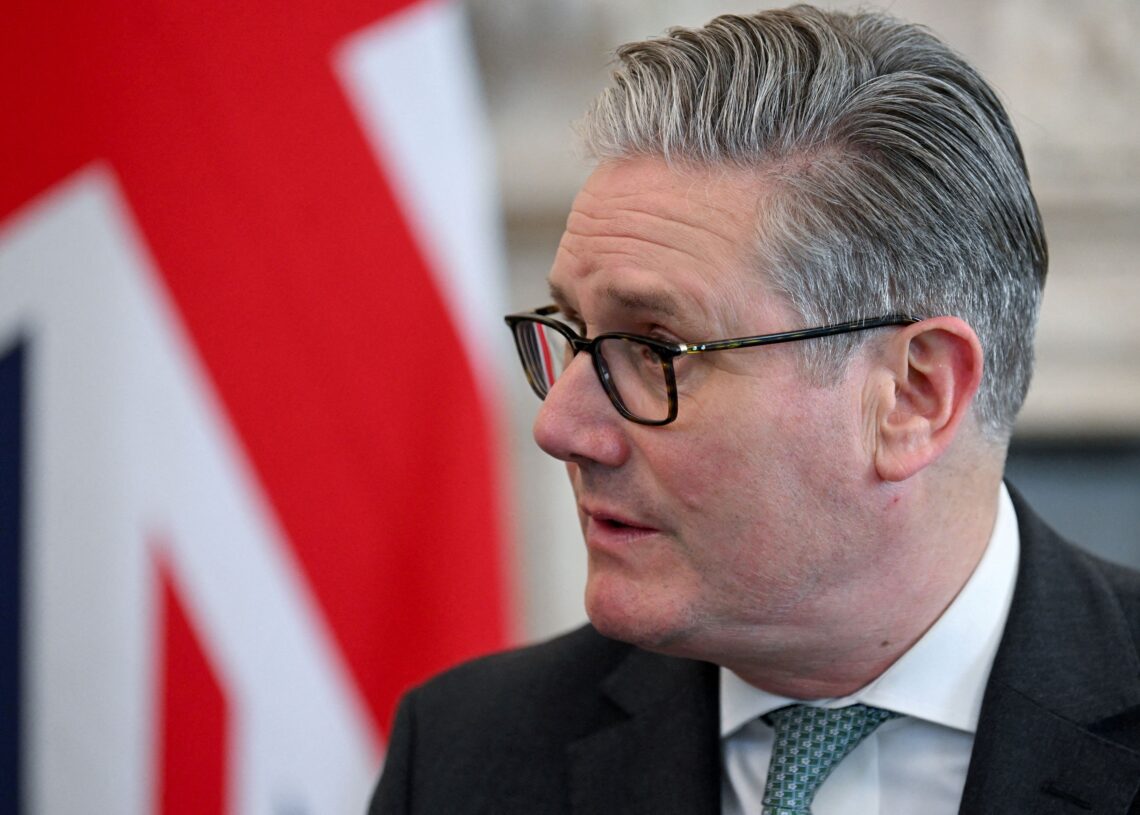
British Prime Minister Keir Starmer, however, said earlier Wednesday in a speech: “I do have to level with people on this; this will not be easy.” He said the meeting is aimed at assessing diplomatic and political ways to make the strait “accessible and safe” after the fighting has ended.
The dispute has widened cracks in the NATO alliance as Trump has chided Europeans for not offering unflinching support for or joining the war more directly. He and his administration have suggested the U.S. could pull support for NATO and weapons for Ukraine in its war against Russia if European leaders do not acquiesce to Trump’s demands. The president said this week he was considering withdrawing from the U.S.-led alliance, which has been a cornerstone of American foreign and military policy in Europe for about eight decades.
French President Emmanuel Macron said a military operation to force open the Strait of Hormuz would not be realistic, calling instead for a “clear framework” to resume the flow through the waterway and for “diplomatic solutions” toward a ceasefire.
“Some people defend the idea of freeing the Strait of Hormuz by force via a military operation, a position sometimes expressed by the United States … although it has varied,” Macron told reporters Thursday during a trip to South Korea. “This was never the option we supported, and we consider it unrealistic,” he added. “It would take indefinite time, and would expose all those who go through the strait to risks.”
Speaking at the start of Thursday’s virtual meeting, British Foreign Secretary Yvette Cooper accused Iran of hijacking an international shipping route “to hold the global economy hostage,” saying maritime traffic through the strait had shrunk from about 150 vessels per day to five, with some 20,000 seafarers trapped on about 2,000 ships.
Starmer said Thursday’s virtual meeting would focus on de-escalation and assessing “all viable diplomatic and political measures we can take to restore freedom of navigation, guarantee the safety of trapped ships and seafarers and to resume the movement of vital commodities.”
The call, chaired by Cooper, will include officials from France, Germany, Italy, Canada, Japan and the United Arab Emirates.
Countries including France and Britain have said their navies would help secure the waterway and escort tankers once the fighting abates, but not while the missiles and drones are flying. Several European allies have also allowed the U.S. to use their airspace and military bases in Europe for the war effort.
European leaders concede they will have to address the Strait of Hormuz crisis as they scramble to curb the fallout of a U.S. war that is buffeting households and businesses across Europe and Asia, in many ways more so than in the United States.
But as they try to calm tensions with the U.S., their most powerful ally, European leaders are also maneuvering to avoid joining a war that is deeply unpopular at home and one that could make them a target of Iran’s retaliation.
Tehran has said the Strait of Hormuz is closed to “enemies of the nation.”
European officials have, in recent days, deliberated with partners in the Persian Gulf and Asia on forming a coalition that could secure and monitor the passage of oil tankers through the strait.
France’s military chief convened officials from over 30 nations last week to strategize on ways to clear the strait “once hostilities have ceased,” and his country, a member of the U.N. Security Council, is also taking part in diplomatic efforts at the United Nations. Even if there is a de-escalation between the U.S., Israel and Iran, securing the waterway will require naval assets for demining and deterrence, officials say.
Nations in the Persian Gulf, where Iran has directed many of its missile and drone attacks, are also pushing to reopen the strait as the conflict triggers some of their worst economic turbulence in decades.
In parallel with talks on building a coalition, some Gulf states led by Bahrain have backed an effort for a U.N. Security Council resolution that could provide legal cover for an international operation to unblock the strait.
The post Oil prices jump after Trump demands others ‘take the lead’ on Strait of Hormuz appeared first on Washington Post.