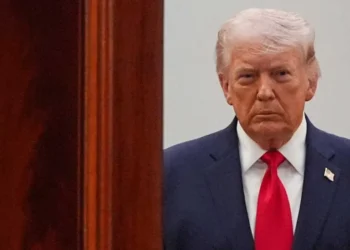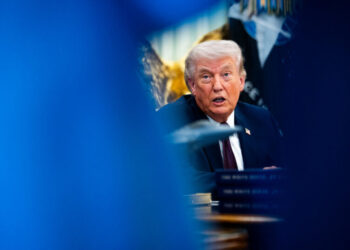
President Trump stood at a lectern on Wednesday night, in his first prime-time address to the nation since the war in Iran began, and declared the monthlong air campaign to be a success.
“We are on track to complete all of America’s military objectives shortly — very shortly,” he said. “We are going to hit them extremely hard over the next two to three weeks. We’re going to bring them back to the Stone Ages, where they belong.”
For all his tough triumphalism, however, the president failed to provide any evidence of a plan to resolve the two crises that now define the war and that have the potential to reshape the balance of power in the Middle East and the world economy for years to come.
The first crisis is the closure of the Strait of Hormuz, through which roughly one-fifth of the world’s oil and liquefied natural gas passed before Iran’s military choked it off last month. The second is the lurking threat of Iran’s estimated 970 pounds of highly enriched uranium, believed to be buried at one or two sites in the country.
Walking away from these problems would leave the world a much more volatile place than it was on Feb. 28, when Mr. Trump joined Prime Minister Benjamin Netanyahu of Israel in attacking Iran. If the president does have a plan to resolve them, he didn’t reveal it. If he doesn’t, he’s leaving to chance their impact on America.
It has been just over a month since Mr. Trump authorized the largest American aerial bombardment mission in a generation. He did so seemingly without preparation for what to do if Tehran blocked off the strait, a danger that advisers have warned presidents about for years. He apparently made little or no attempt to build an international coalition. Our Gulf allies have spent the last month defending against incoming missiles while scrambling to stabilize a spiraling energy market and stave off a humanitarian catastrophe. The fighting has killed thousands of civilians across Iran, Lebanon and the Gulf and displaced millions more across the region.
Oil prices shot up and stock markets tumbled on Thursday after Mr. Trump did not offer any end in sight to the conflict, nor any plan to reopen the Strait of Hormuz. About 20 commercial vessels have been attacked since the war began, and Iran threatens more each day as they wait to pass through. Tehran allows only friendly ships out, reducing commerce through the strait to a trickle.
Iran has now demonstrated de facto control over much of the global economy. Its Parliament is considering whether to formalize the charging of fees for passage, and on Wednesday, an Iranian official warned on social media that the United States would not regain access to the strait.
The other major problem is the nuclear question. After ripping up the 2015 nuclear deal with Iran, Mr. Trump has tried but failed to reach another solution to address the country’s stockpile of highly enriched uranium, the key component for a nuclear weapon. That prompted the president to join Israel in a complex attack on the program in June. The stockpile of uranium — which Mr. Trump called “nuclear dust” in his speech, but is in gaseous form in real life — has been enriched to 60 percent purity, one small step from the 90 percent needed for the most powerful warheads. The president said that the United States intelligence community has the uranium under “intense” satellite surveillance. “If we see them make a move, even a move for it, we’ll hit them with missiles very hard again,” Mr. Trump said.
Translation: Mr. Trump apparently intends to leave Iran in control of enough enriched uranium to make around 10 bombs. It was an astonishing demonstration of indifference that having conducting bombing campaigns against Iran twice primarily to crush its nuclear ambitions, the president is now prepared simply to walk away. Mr. Trump said again on Wednesday that he “will never allow” the regime in Tehran to get the bomb, but the world cannot have confidence in that assurance unless that material is seized, destroyed or made subject to international inspection.
Whatever quick fix Mr. Trump sought when he launched this conflict alongside Israel, he’s now facing the potential to inflict strategic consequences not only on the U.S. economy and its national security but also on its allies. He has publicly voiced displeasure over Europe’s unwillingness to send warships and attack planes to help free up the strait. That scorn for NATO allies wasn’t explicit during the address, but he alluded to it when he urged unnamed countries to “build up some delayed courage” to resolve the energy crisis. “Go to the strait and just take it,” he said, as if it were so easy.
Rose Gottemoeller, an American diplomat who was the NATO deputy secretary general from 2016 to 2019, recently visited Europe. “The allies were and are bereft,” Ms. Gottemoeller said. “Even the tariffs did not have the long reach and impact of this energy crisis, which the United States imposed on them without warning or consultation. The divorce is moving from sadness to an angry split that will be difficult — if not impossible — to repair in the future.”
America’s European allies have thus far determined that it’s not worth the financial and personnel risk to get deeply involved. It’s an uncomfortable feeling to watch an American president, the leader of broad military coalitions since World War II, go it alone. Perhaps the allies’ reaction would have been different if Mr. Trump hadn’t continually upbraided them over their military spending, or repeatedly threatened to take Greenland, or recklessly authorized a sweeping air campaign without alerting them.
“President Trump has done everything he can to isolate the United States from the rest of the world,” said Chuck Hagel, a former defense secretary and Republican senator from Nebraska who is a Vietnam War veteran. “Choosing to go into this conflict alone was self-destructive. He’s about to learn that wars have consequences.”
The conflict also caught many Gulf allies by surprise, placing them in the middle of a war they didn’t choose. The nations hosting U.S. forces — Saudi Arabia, Qatar, Kuwait, Jordan, the United Arab Emirates, Iraq and Bahrain — have all been targeted by Iranian drones and missiles. They’re now forced to question their reliance on the United States and the partnership they formed with Washington in hopes of bringing peace to the region.
The question of whether to go to war with the regime in Tehran has been weighed for over a half-century by eight presidents. It was first posed after the Iranian revolution in 1979 when Americans were taken hostage during the Carter administration. It was later considered in response to the government’s support for militant proxies that threatened Americans and their allies in the region. It was deliberated again as Tehran steadily amassed a sizable missile arsenal alongside an advancing nuclear program. All along, Iran inflicted horrible human rights abuses on its own citizens.
Two key things prompted previous commanders in chief to opt for diplomacy over war: the bloody violence that they were advised was certain to follow and the stranglehold Iran has on the Strait of Hormuz. Iran’s Islamic Revolutionary Guards Corps has spent decades developing weapons and military capabilities aimed at halting commercial traffic in the strait in the time of crisis.
U.S. and Israeli warplanes have conducted an impressive air campaign that has decimated Tehran’s ability to mass-produce weapons and menace neighbors’ capitals. Thousands of troops are headed to the region, which Mr. Trump could soon decide to use inside Iran. But for now the core issues — Iranian control over the strait and its sizable stockpile of nuclear material — remain unresolved.
It’s not hard to understand why the president is tempted to walk away from these intractable problems: There aren’t easy answers to them. As the war enters its second month, it’s becoming increasingly apparent why Mr. Trump didn’t try to get buy-in ahead of time from allies, Congress or the American people for his war in Iran. He sold an unsellable war by not selling it at all — and now he’s belatedly looking for help footing the bill.
The Times is committed to publishing a diversity of letters to the editor. We’d like to hear what you think about this or any of our articles. Here are some tips. And here’s our email: [email protected].
Follow the New York Times Opinion section on Facebook, Instagram, TikTok, Bluesky, WhatsApp and Threads.
The post No Plan. No Allies. No End in Sight. appeared first on New York Times.