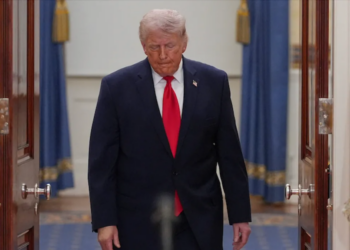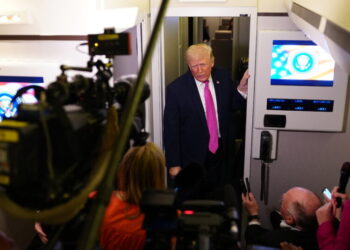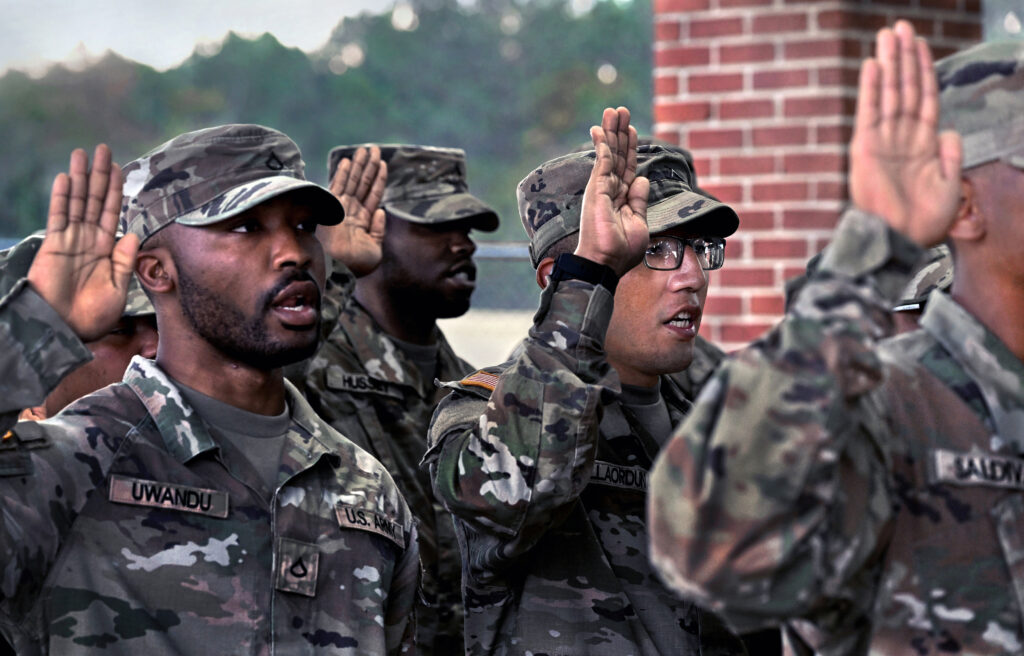
I felt myself tense when President Donald Trump, after three service members were killed in the initial strikes in Iran, said casually: “And sadly, there will likely be more before it ends. That’s the way it is.” When his administration took office, a wave of radical changes arrived at once, reshaping the national conversation about war in ways that felt uncomfortably close to home because my husband was recently deployed.
The beginning of the deployment felt like a smack in the face. First came the shock, then the scramble to find my footing. I tried to avoid the news, until I couldn’t. My husband would text me in the middle of the night when he should have been sleeping, and my heart would jolt before I even opened the message. One night, he told me something was happening, but for safety reasons he couldn’t say what, only that he was okay for now. Later, I found out that bombs were flying over him from the Iran and Israel conflict.
The combination of global tension and personal uncertainty created an anxiety that seeped into every part of my day. No matter how hard I tried, I couldn’t relax. Eventually, I had to admit what felt impossible to say out loud: I needed help.
No one talks about the invisible labor of loving someone deployed, the emotional load of managing fear alone, keeping life stable for your family and pretending to be “fine” so your spouse doesn’t worry. The focus is on the person sent away, not the family left behind to pick up the pieces. Deployment reshapes the entire household.
By the time my husband returned home, I came out with a deep understanding of the true cost of war. Surviving during a crisis is its own kind of hell.
Jennifer Barreto, Ypsilanti, Michigan
Why a U.S. fleet is ‘indispensable’
The March 19 editorial “The beginning of the end of the Jones Act” lauded the Trump administration’s Jones Act waiver as a tool to lower gas prices. But gas prices are sky-high because of the immense costs of moving crude oil through the Strait of Hormuz. Domestic shipping costs are a rounding error by comparison.
The Editorial Board’s praise was more about “the beginning of the end” for the Jones Act. The board argued that because the act hasn’t met all its original goals it should be repealed to let foreign shipbuilders take over.
But surrendering domestic trade to foreign vessels is not the solution. We have already seen the consequences of such dependence. In response to President Donald Trump’s tariff policy, China leveraged its near-monopoly on industrial shipping to halt rare earth exports, kneecapping production on everything from smartphones to fighter jets.
The president even cited the need for U.S.-built, U.S.-flagged vessels in his Maritime Action Plan, calling a U.S. fleet “indispensable.”
I am not comfortable with China undercutting our domestic manufacturers, putting Americans out of work and making us reliant on its vessels, which is why I reintroduced the bipartisan Ships for America Act. With Sens. Mark Kelly (D-Arizona) and Todd Young (R-Indiana), and Rep. Trent Kelly (R-Mississippi), we’ve set a bold target to expand the U.S.-flagged international fleet by 250 ships over the next decade. This legislation delivers the investment needed to modernize shipyards, including California’s Mare Island and Mississippi’s Gulfport, strengthening the workforce, and securing supply chains to sustain a modern Navy.
Repealing the Jones Act is the opposite of “America First.” To maintain our strength, America must rebuild, not retreat.
John Garamendi, Washington
The writer represents California’s 8th Congressional District in the House and is the ranking Democrat on the Armed Services readiness subcommittee.
Don’t set time limits for military operations
It is said that no military plan survives first contact with the enemy. One must adapt to the unanticipated. I thought of this while reading the March 29 front-page article “Pentagon makes ready for weeks of ground operations.” The U.S. officials interviewed presumably were seeking to manage fears of a lengthy, open-ended U.S. operation on dangerous Iranian terrain. But laying out such time limits is dishonest to the American public, given the uncertainties of war. It also tells the Iranians how long an operation the U.S. leadership expects to be able to sustain politically at home. Iran’s leaders, who should not be underestimated, have understood that the military and political dimensions of war cannot be separated, and are watching carefully for indicators of the U.S. will to keep fighting. Publicly setting time limits for military operations, under such circumstances, is serious policy malpractice. Something the president arguably committed in his April 1 speech on Iran.
Eric Terzuolo, Lewes, Delaware
Trump misunderstands NATO
Regarding the April 1 front-page article “Trump again rips NATO over aversion to aid war”:
NATO is a defensive alliance, not an offensive alliance. Article 5 of the North Atlantic Treaty states that an attack on any NATO member “shall be considered an attack against them all.” Therefore, if any NATO member is attacked, the other NATO members have a duty to come to its aid.
Nothing in the treaty says that if a NATO member initiates an attack on another country, the other NATO members have a duty to assist in that attack. President Donald Trump’s statement to Europe on Tuesday that “the U.S.A. won’t be there to help you anymore, just like you weren’t there for us” ignores this fundamental distinction. NATO countries might choose to assist the U.S. in its war efforts in Iran, but they have no duty to do so. The U.S., however, does have a duty to help defend NATO countries if they are attacked.
Jonathan Siegel, Chevy Chase
The post My husband’s deployment taught me the true cost of war appeared first on Washington Post.