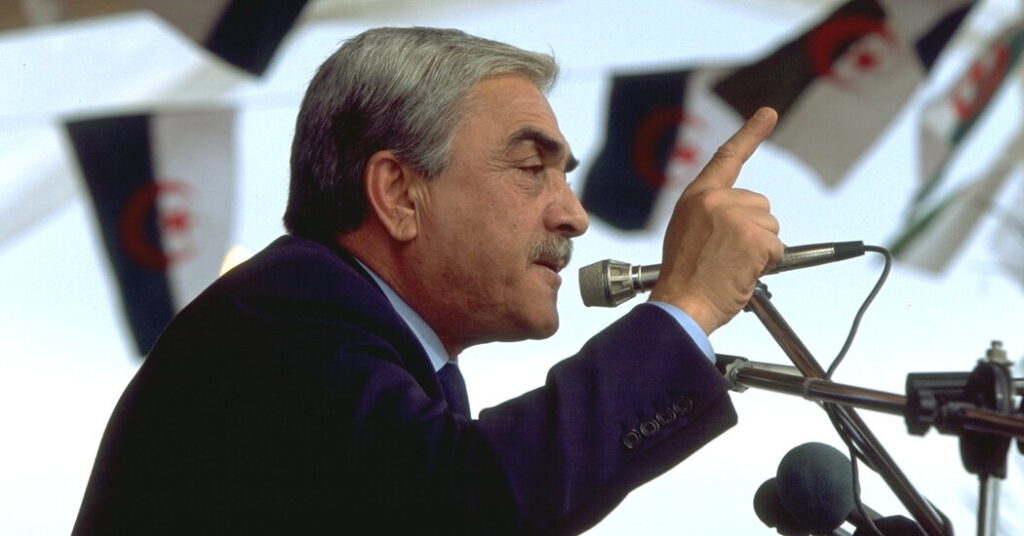
Liamine Zeroual, the president of Algeria during the bloodiest phase of his country’s savage civil war in the 1990s, who unexpectedly cut short his term as violence simmered, died on Saturday in Algiers. He was 84.
His death, in a military hospital in the Algerian capital, was announced by the office of Algeria’s president, which decreed three days of national mourning.
Some 100,000 were killed during Algeria’s “Black Decade,” a grim struggle pitting Islamist insurgents against government forces. Thousands were “disappeared” by the country’s security services and torture by the government was rampant. Much of the violence took place under the rule of Mr. Zeroual, who appeared unable or unwilling to stop it.
One of the conflict’s most brutal episodes occurred on his watch. In September 1997, as many as 400 men, women and children were slaughtered by armed guerrillas, whose identity and motives remain unclear, in the village of Bentalha. The Algerian army was later accused of — at the very least — not intervening to stop the killings.
Shortly after that massacre, Human Rights Watch reported that “the highest levels of authority” gave “sanction” to “wide-scale” disappearances of civilians suspected of being allies with the Islamists.
Worn out by the struggle and, by his own account, having lost the confidence of the generals who pushed him into office, Mr. Zeroual announced to the country’s surprise on Sept. 11, 1998, that he would be stepping down, two years before the end of his mandate. He ended up leaving office in April 1999, after elections had been held.
It was, and remains, perhaps a first: an Algerian leader who left without being forced out or dying in office. “Zeroual didn’t leave power because he was personally discredited, nor swept away by a scandal,” a leading Algerian newspaper, El Watan, wrote after his death.
“You’re sending me to hell,” Mr. Zeroual is reported to have told the cadre of generals who pressed him to run for president in 1995 after having appointed him to the position the year before.
Elections in Algeria rarely have uncertain outcomes, and Mr. Zeroual was duly elected with 61 percent of the vote.
He had been the second choice of the generals who, then as now, were running the country. Their top selection was the man who would eventually succeed Mr. Zeroual: the wily former foreign minister Abdelaziz Bouteflika. But Mr. Bouteflika, recognizing a bad situation certain to get much worse, refused to serve.
The generals — including the country’s master string puller, Khaled Nezzar, Algeria’s de facto ruler — turned to Mr. Zeroual, a stolid former soldier known for making dull speeches, who was then serving as defense minister.
Having canceled national elections in early 1992, after Islamist parties scored an unexpected triumph in the first round of voting, the generals had created a mess. They were hoping Mr. Zeroual would pull them out.
It was a bad bet all around. By the time he got the nod, the country was embroiled in the orgy of throat-slitting, beheading and bombing that was to consume it for the rest of the decade. Mr. Zeroual burst into tears when the generals informed him that he was their choice, according to the magazine Jeune Afrique.
There was initially some hope that Mr. Zeroual might pursue a policy different from that of the so-called Eradicators, the Algerian military hard-liners who simply wanted to slaughter the Islamist factions waging war against the state. In 1993, as defense minister, Mr. Zeroual had visited two captured Islamist leaders, pleading with them to tell their followers to stop the violence.
It didn’t work, and his efforts earned him the permanent distrust of the Eradicators.
By the time he announced he would step down, in 1998, he had failed to squash infighting amid the military’s top echelons and to completely stamp out the violence. In a televised speech announcing his decision, he told his countrymen that Algeria was at the cusp of a new era of “democracy and the rule of law.” Neither emerged.
Liamine Zeroual was born on July 3, 1941, in Batna, in the Aurès region of eastern Algeria, a mountainous district whose fighters helped initiate the rebellion against the French colonizers in 1954. He was a Berber, an ethnic group noted for its toughness in the fight against France.
His father, Ahmed, was a cobbler, and his mother’s name was Halima; Liamine was the youngest of five children who survived infancy. He attended secondary school at the École du Stand in Batna and then went to work for a prominent family of Jewish merchants. One day, when he was 16, he disappeared with a large sum from his employers that he was meant to have deposited at a bank, according to a 1994 profile by Agence France-Presse.
He had joined the Algerian resistance, and the money wound up in its coffers.
Mr. Zeroual’s early service in the cause of Algerian independence, won in 1962, promised him a prestigious career in the new country’s military. He studied at military academies in Moscow and Paris, earning diplomas from both, and in 1981 became commandant of the Algerian military academy at Cherchell.
He was military commander in Algeria’s southern regions and at the Moroccan border, and was made a general in 1988 and then head of the army in 1989. He retired from the army that year, after disagreeing with Mr. Nezzar over a proposed reorganization of the armed forces, only to return to governmental service, at Mr. Nezzar’s urging, in 1993.
He is survived by his wife, Naziha Chérif; two sons, Toufik and Karim; a daughter, Zahia; and two sisters, Safia and Rokia.
Of the premature end of his presidency, Martin Evans and John Phillips wrote in their book “Algeria: Anger of the Dispossessed” (2007): “Zeroual’s departure was not lamented by the populace, who were mostly indifferent. Feelings of indifference and lack of hope were mingled with enduring anger against the regime.”
Still, unlike many officials, he had not grown visibly richer while in office. Because of his reputation for honesty and the selfless quality of his departure, he was encouraged to run for office again at least three times during his retirement in Batna, both by politicians and by ordinary citizens.
But he kept his distance from Algiers and Mr. Bouteflika. After Mr. Bouteflika suffered a stroke in 2013, and some hoped that Mr. Zeroual would get back into politics, he wrote: “I’m sad, sad for Algeria, that you are asking me to return to power after I left it in 1999. My children, I’m 72. With the best will in the world, an aging, ill president would not be capable of performing these duties.”
Adam Nossiter has been bureau chief in Kabul, Paris, West Africa and New Orleans and is now a writer on the Obituaries desk.
The post Liamine Zeroual, Algerian President During Bloody Civil War, Dies at 84 appeared first on New York Times.