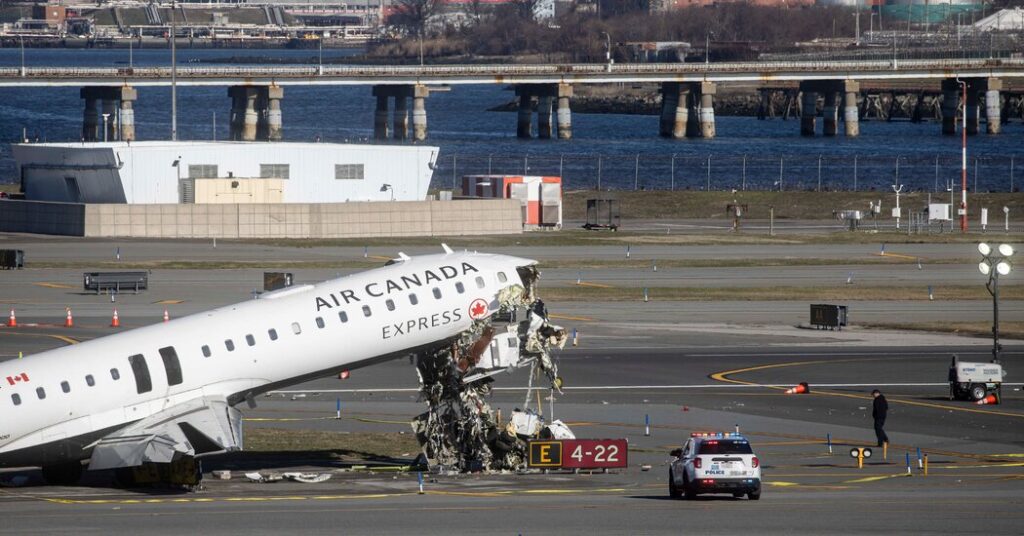
Officials are examining whether an air traffic controller at LaGuardia Airport had to step away to use an emergency telephone before an Air Canada Express jet collided with a fire truck, according to two people familiar with the investigation.
The question is one of several avenues of inquiry the National Transportation Safety Board is pursuing in order to reconstruct what happened late at night on March 22, when the jet collided with a Port Authority truck, killing two pilots. The people familiar with the inquiry asked not to be named because the investigation, which is continuing, is still at a sensitive stage, and no conclusions have been reached.
The question about staffing is only one of the many elements that officials are looking at, according to the people. Other areas of focus, the people added, include the positioning of the lead fire truck near the runway, the communication devices used by the truck drivers, and what role the weather and light pollution might have played that evening.
The two pilots died when the jet collided with the first fire truck in a convoy of six that was heading to an emergency at the other end of the airport. It was LaGuardia’s first deadly accident in more than 30 years. None of the passengers or firefighters were killed.
A spokesman for the N.T.S.B. confirmed that investigators are looking into tower operations as well as the movements and communications of the fire trucks, but declined to comment further. The Federal Aviation Administration declined to comment.
LaGuardia’s standard operating procedure is to have two controllers work the overnight, or “mid,” for midnight, shift, the F.A.A.’s minimum requirement. The N.T.S.B. chairwoman, Jennifer Homendy, has said that there were two controllers in the tower control room at the time of the accident. In addition, a third and fourth controller were located elsewhere in the building at the time, two people familiar with the matter have told The New York Times.
The layout of air-traffic control towers varies across airports, but the emergency landline telephones that are used during a crisis often are a distance from individual work consoles, current and former controllers have said. These phones, known as “crash phones,” are often at a supervisor’s desk and are not always within arm’s reach of air traffic controllers on duty.
In the 10 days since the accident, investigators have been reviewing a variety of data to reconstruct the timeline of events that preceded the deadly collision.
They are interviewing the controllers who were on duty and the firefighters who were driving the lead truck, which collided with the jet. They are analyzing the Air Canada plane’s cockpit voice recorder to construct a fuller picture of what the pilots and the controller were doing during the final seconds before impact. And they will pull the electronic data recorder from the fire truck that collided with the plane, two of the people with knowledge of the investigation said.
The role air traffic controllers played in the accident has been a focus since the crash. Ms. Homendy has said that each person’s responsibilities at the time of the crash are not yet clear.
N.T.S.B. staffers also plan to examine the communications between the fire truck drivers and the operators of five other emergency vehicles grouped behind them. Investigators are trying to determine whether the lead truck failed to pause at a stop line, and whether its operators inadvertently missed instructions from the air traffic control tower — possibly because the truck’s operators pressed a microphone key at the same time the controller instructions were coming in, bleeping out those instructions in the process.
And they are trying to reconstruct the driver’s line of sight to determine whether the firefighter driving the truck — which had to approach the runway at an awkward angle — could have seen the oncoming plane.
The fire truck and the other emergency vehicles following it had been summoned to the area after the pilots of a United Airlines plane radioed the control tower for help, reporting a strange odor on board.
At first, the United pilots only asked the control tower for help securing a gate at the terminal, having failed to reach airport operations personnel.
But less than six minutes before the collision, the United pilots escalated their request, stating that they were in an “emergency” situation — a declaration that prompted the controller to wrangle airport firefighters to meet the plane, in case passengers needed to urgently disembark.
Controller communications with airport operators usually happen on dedicated radio frequencies, according to a government official with knowledge of air traffic operations. But at LaGuardia that night, the need for emergency vehicles might have required using a landline telephone.
If a controller had to step away from his console — even for less than a minute — it could have complicated an already chaotic evening. Rainy conditions had delayed a number of flights, pushing them from the evening shift, during which more controllers were available, into the midnight shift.
In the minute before the fire truck asked for permission to cross the runway, a controller can be heard on audio of the air traffic communications giving instructions to half a dozen other planes. He also pivoted back to managing traffic on a separate runway, only two or three seconds after the fire truck drivers confirmed they had received the controller’s permission to cross the runway where the Air Canada jet was about to land. Seconds later, apparently realizing his mistake, the controller called on the fire truck to stop, according to air-traffic control recordings of the radio communications.
Having to monitor multiple positions at the same time can cause a controller to lose focus, David Riley, a former controller at the Denver International Airport tower, said. “There’s no such thing as multitasking,” he explained.
Kate Kelly covers money, policy and influence for The Times.
The post Investigators Said to Look at Whether LaGuardia Controller Stepped Away appeared first on New York Times.