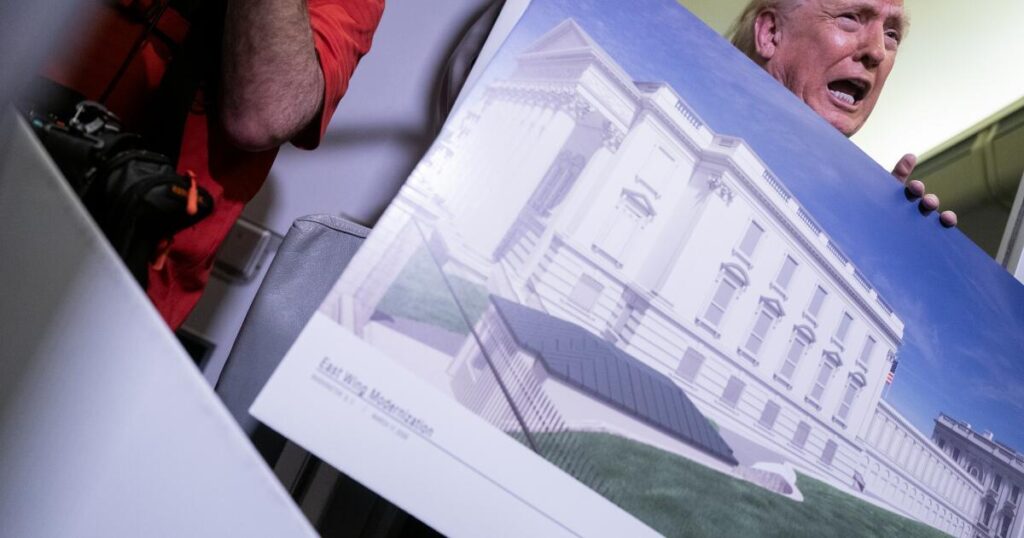
Even if I hadn’t been privileged over the years to enter the White House countless times, always with reverence for its two-century history, I’d have been upset to tears last October by the sudden sight of excavators’ claws ripping the 123-year-old East Wing to shreds. And by the knowledge that President Trump planned a ballroom three times larger in its place.
“The People’s House,” by its simple elegance a symbol of a democratic republic, was to be transformed by the tacky tacking-on of a mad king’s vanity project: a Versailles-like party palace.
For five months since, I’ve stewed as Trump proceeded with his planned desecration. He purged two review boards to stack them with yes-folks predisposed to his garish designs. He expanded those plans so that the ballroom’s price tag doubled to $400 million. Repeatedly he dined with donors and corporate moguls picking up the ballroom tab, each with business before a federal government that he’s turned into a pay-to-play racket. And all without consulting Congress, which since 1790 had been in charge of authorizing and funding construction of and at the White House.
But even as I stewed, I’d chastise myself. The White House is just a building, I’d think. And in the time since Trump’s East Wing tear-down, he’s torn apart the lives of undocumented migrants and citizens alike, sending masked, armed, unqualified agents into American cities, beating and killing protesters and deporting law-abiding longtime residents without due process. He’s torn up both ancient alliances and campaign promises, starting a war that is ravaging the Middle East, costing Americans’ blood and treasure as well as foreigners’.
Against this backdrop, what’s a building?
More than a building, I’ve decided, when we’re talking about the White House.
In a nation founded on ideals, after throwing off a king, the idea of a people’s house that’s not palatial is one worth protecting. Also worth defending is the democratic process by which that house has previously been built and changed, until now. Each time that there were alterations — various repairs, especially after the British torched the White House during the War of 1812; expansions, as with the addition of the East and West Wings in the early 20th century; and modernizations, most extensively after engineers found major structural damage in the Truman years — Congress authorized, funded and oversaw the work, as the law and the Constitution provide.
Sure, Trump’s solicitation of private donations means he doesn’t have to hit up the taxpayers. Yet it adds to the stench of corruption that’s now wafting about. Having covered past administrations, and having attended a state dinner in a tent on the South Lawn, I can attest that presidents probably need a larger ballroom. But not one that’s larger, much larger, than the entire presidential residence.
Also, as a statement of national priorities, Trump’s ballroom obsession is obscene at a time of war and economic pain. On Sunday night aboard Air Force One, he interrupted reporters’ questions about what’s ahead in Iran — will he order troops on the ground? — to regale them for five full minutes on camera about six posterboard drawings he’d just gotten from his architect. “I’m so busy that I don’t have time to do this,” Trump told the reporters. “I’m fighting wars and other things.” But he does it anyway.
When it comes to the ballroom, Trump is not reading the room. (Or, apparently, the polls and public petitions against his pet project.)
And here’s a last reason to oppose, without apology, Trump’s bulldozing his way to a ginormous ballroom: The fight for the symbolic and architectural integrity of the White House is of a piece with the broader fight against the lawless, self-aggrandizing impunity with which Trump approaches everything: war, federal spending, tariffs, immigration crackdowns, voting rights, you name it.
I was still thinking through whether the intensity of my outrage about what’s happening at the White House construction site was justified when, on Tuesday, a Republican-appointed federal judge gave resounding reassurance: “The President of the United States is the steward of the White House for future generations of First Families. He is not, however, the owner!”
That’s how federal District Judge Richard J. Leon opened his 35-page ruling ordering construction to stop while a lawsuit against the project by the National Trust for Historic Preservation proceeds. Just in time: Trump wanted above-ground work to start this month.
The president’s lawyers have said they will appeal, and Leon has suggested the case likely will reach the Supreme Court.
Meanwhile, on Thursday, the second of the two Trump-stacked review boards, the National Capital Planning Commission, is expected to follow the lead of the Commission of Fine Arts in February and bless his ballroom design.
But, as Leon wrote, the president’s sham review process and construction plans fly in the face of three clauses of the Constitution and federal laws giving Congress authority over federal buildings, and specifically those in Washington. In an opinion replete with exclamation marks — reflecting the judge’s oft-expressed frustration with administration lawyers’ absurd arguments over past months — he wrote that “no law comes close” to empowering Trump to raze the East Wing and build a ballroom.
And, contrary to Trump and his toadies’ claims that the president isn’t doing anything that hasn’t been done before, Leon held, “This clearly is not how Congress and former Presidents have managed the White House for centuries, and this Court will not be the first to hold that Congress has ceded its powers in such a significant fashion!” (At a January hearing, he mocked administration lawyers for comparing the East Wing demolition and ballroom plans to President Gerald Ford’s installation of a swimming pool in the White House: “C’mon. Be serious.”)
Such good stuff, Leon gets the last word:
“Congress is the collective voice of the American people in our system of government…. After all, the White House does not belong to any one man — not even a president!”
Bluesky: @jackiecalmes Threads: @jkcalmes X: @jackiekcalmes
The post Given everything in the news, why care about the White House demolition? appeared first on Los Angeles Times.