Senate and House Republican leaders announced on Wednesday an agreement to move forward with legislation to reopen the Department of Homeland Security, resurrecting a bipartisan deal that President Trump and the House G.O.P. had angrily rejected last week.
The plan would fund the department through Sept. 30 but omit money for the agencies carrying out Mr. Trump’s immigration crackdown. G.O.P. leaders hoped to push it through without any debate or formal vote as early as Thursday morning, though hard-right Republicans irate about the deal signaled they might not allow it to move quickly.
Under their plan, Republicans said, Immigration and Customs Enforcement and Border Patrol would continue to be paid for out of funds the G.O.P. pushed through Congress last year over solid Democratic opposition. This year, Democrats have refused to approve spending for those agencies without new restrictions on federal immigration agents’ conduct.
The spending bill does not include any such restrictions, which Democrats began demanding after immigration officers killed two U.S. citizens in Minneapolis.
Senator John Thune of South Dakota, the majority leader, and Speaker Mike Johnson, of Louisiana, announced the deal in a statement on Wednesday afternoon. It followed days of talks behind the scenes with the president and top White House officials on how to break the intraparty stalemate.
“In the coming days, Republicans in the Senate and House will be following through on the president’s directive by fully funding the entire Department of Homeland Security on two parallel tracks: through the appropriations process and through the reconciliation process,” the statement said.
A senior White House official said Mr. Trump, who had blasted the funding deal as “inappropriate” last week, would sign it should it reach his desk.
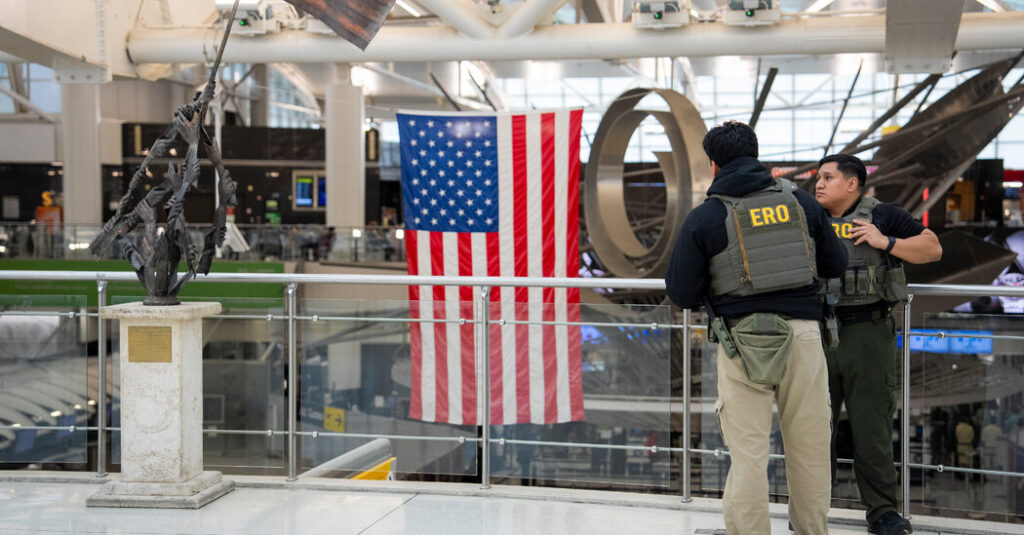
It would end a more than six-week interruption in agency operations that has made history as the longest partial shutdown, left tens of thousands of federal employees furloughed or working without pay and badly snarled airport security operations. Mr. Trump ordered last Friday that Transportation Security Administration workers be paid out of available agency funds.
Both the House and Senate, which have recessed for a two-week spring break, have special ceremonial sessions scheduled for early Thursday morning, when the stalled legislation could be taken up, approved and sent to the president as long as no lawmaker objects.
But ultraconservative Republicans were up in arms about the deal. Congressional officials cautioned Wednesday that plans were still in flux and that some lawmakers might demand an opportunity to vote on the legislation, which could require summoning members back from their recess. Leaders were confident, however, that the measure could ultimately clear both chambers with bipartisan support.
The agreement represents a sharp turnaround by the president and House Republicans, who last week condemned the funding compromise forged in the Senate, which senators had approved early Friday morning by unanimous agreement with no recorded vote. The G.O.P. representatives portrayed it as a surrender to Democratic obstruction and harshly derided it as a “joke,” in Mr. Johnson’s words.
But on Wednesday afternoon, Mr. Trump signaled a retreat was coming when he posted a demand on social media that Republicans deliver to his desk by June 1 a proposal to fund his immigration crackdown through a special budget process that could skirt a Democratic filibuster.
His turnabout appeared to have persuaded Mr. Johnson, who has fashioned his speakership almost exclusively as a vehicle for serving the president’s desires, to back down and accept an idea he had dismissed just days ago as “ridiculousness.”
Senator Chuck Schumer, Democrat of New York and the minority leader, credited his party’s unity in refusing to fund immigration enforcement without limits on agents’ tactics for forcing the Republican compromise.
“Throughout this fight, Senate Democrats never wavered,” Mr. Schumer said in a statement. “We were clear from the start: Fund critical security, protect Americans, and no blank check for reckless ICE and border patrol enforcement.”
Representative Hakeem Jeffries, Democrat of New York and the minority leader, also crowed about the outcome, issuing a statement that said: “Mike Johnson and House Republicans have come to realize that we will never bend the knee.”
Administration officials earlier sought to break off some moderate Democrats who had joined with Republicans to end last fall’s governmentwide shutdown, but they resisted. Republicans eventually concluded that Democrats were not going to back ICE and border control funding without strict new conditions on agent conduct that the White House was not willing to accept, leading to the Friday compromise passed in the early morning hours.
In balking at the legislation, Mr. Johnson and House Republicans made the misleading claim that it eliminated funding for the immigration agencies. In fact, those law enforcement operations were being funded through a $170 billion slush fund that Republicans had provided last year in their major tax cut and domestic policy package. Senators said they had been assured there was sufficient money available through that law to continue paying the agencies’ employees through this year and perhaps longer.
In foreshadowing the agreement, Mr. Trump on Wednesday encouraged Republicans to move quickly to provide another infusion of money for ICE and Border Patrol operations through the rest of his term under the budget process that can be brought to the Senate floor and passed on a straight majority vote, making it immune from a filibuster.
“We are going to work as fast, and as focused, as possible to replenish funding for our Border and ICE Agents, and the Radical Left Democrats won’t be able to stop us,” Mr. Trump wrote on social media.
Republican leaders were hoping that Mr. Trump’s backing would ease the difficulty of pushing the legislation through quickly, but some on the far right were continuing to raise objections.
Representative Scott Perry, a Pennsylvania Republican and a member of the far-right House Freedom Caucus, said that he opposed the newly announced plan to fund the Homeland Security Department.
“Let’s make this simple: caving to Democrats and not paying CBP and ICE is agreeing to defund Law Enforcement and leaving our borders wide open again,” he said in a social media post. “If that’s the vote, I’m a NO.”
After the agreement was disclosed, Senator Lindsey Graham, the South Carolina Republican who chairs the Budget Committee, said he would meet the president’s June 1 deadline.
“To the American people: Help is on the way when it comes to making sure ICE and Border Patrol can do their job without being handcuffed by the desires of the Radical Left,” Mr. Graham wrote on X.
Meeting that goal will not be easy. Reconciliation is complex and time-consuming, and needs to comport with a strict set of legislative rules. In addition, far-right activists and some Republican senators are urging that the central elements of a Republican voter registration and identification bill that is stalled in the Senate be incorporated into the measure, another complication. Lawmakers have various other favored ideas on what should be included in the bill.
Democrats, who would play no role in drafting the legislation, have also been skeptical that Republicans can remain unified enough to pass a party-line bill that addresses funding for ICE and other top G.O.P. priorities, particularly when they are faced with a narrow House majority and approaching midterm elections. Several swing-district lawmakers are carefully navigating immigration politics in an election year.
Some members of both parties have also already raised concerns that funding major agency operations outside the regular appropriations process through the budgetary maneuver sets a risky precedent and further dilutes the congressional power of the purse.
Luke Broadwater contributed reporting.
Carl Hulse is the chief Washington correspondent for The Times, primarily writing about Congress and national political races and issues. He has nearly four decades of experience reporting in the nation’s capital.
The post G.O.P. Leaders Strike Deal to End Homeland Security Shutdown appeared first on New York Times.