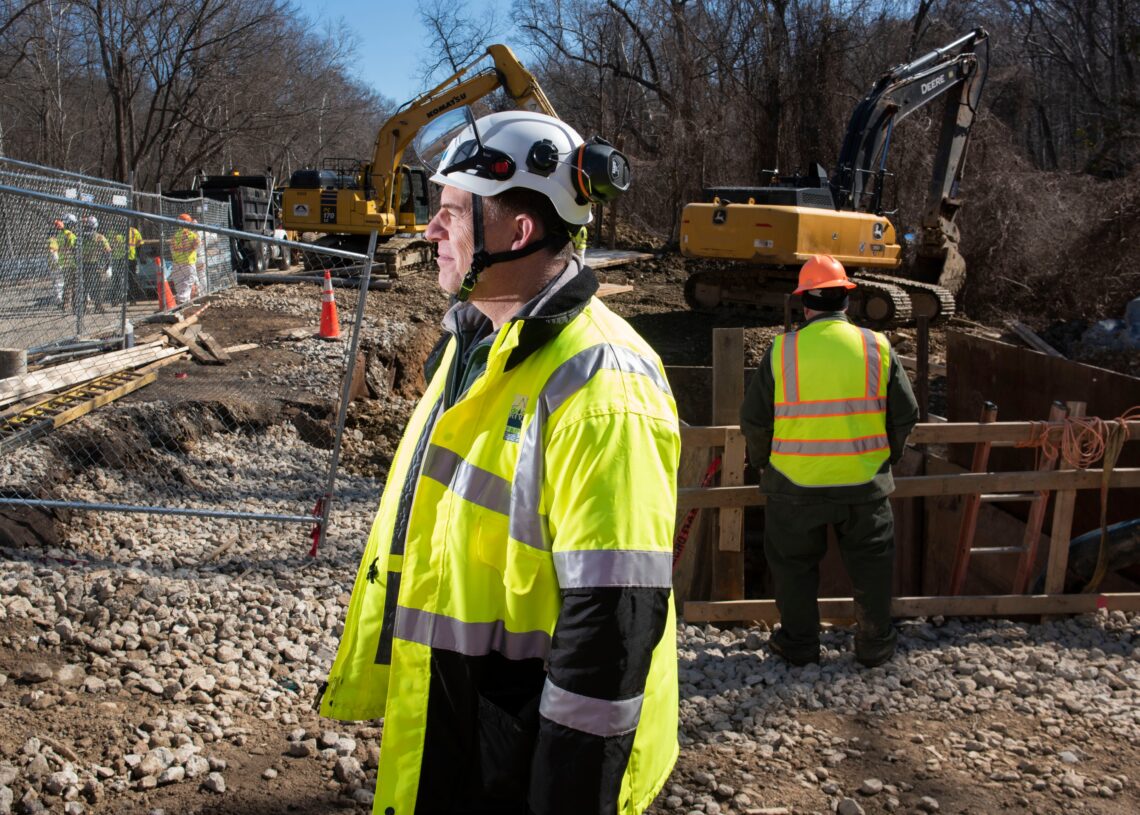
The D.C.-area utility responsible for a massive sewer line that failed catastrophically in January had planned to reinforce the aging section years ago but repeatedly delayed construction as federal officials studied potential environmental impacts, including risks to a blue wildflower and an endangered bat species, a Washington Post investigation found.
D.C. Water asked the National Park Service for permission to fast-track repairs in 2018, after inspectors found widespread corrosion and detached rebar in one area of the six-foot-wide concrete pipe that runs under federal parkland in Maryland, records show. The utility sought to strengthen a three-quarter-mile section that included the point that later ruptured.
Left unaddressed, it warned, the corrosion could “result in a catastrophic failure leading to the release of raw sewage into soil, groundwater, and waterways,” records show.
But the National Park Service’s environmental review dragged on for years and was still not complete when the pipe collapsed — a delay that experts said appeared to flout a 2020 federal rule requiring such examinations be done within one year.
“That’s a process gone wrong,” said Eric Beightel, a former director of the Federal Permitting Improvement Steering Council, a body formed by Congress to streamline approvals for the nation’s largest infrastructure projects.
A review by The Post of more than 2,600 public utility documents reveals how concerns about the removal of trees and vegetation, along with other environmental impacts, postponed repairs to the Potomac Interceptor. The pipe continued to degrade for more than seven years before it failed on Jan. 19 and released one of the largest spills of untreated wastewater in U.S. history. Enough raw sewage to fill 364 Olympic-size swimming pools flushed into the Potomac River north of the nation’s capital, exacting an ecological toll that scientists are still trying to calculate.
National Park Service spokeswoman Christiana Hanson acknowledged the review process was lengthy but blamed D.C. Water for repeatedly proposing changes to its repair plans, which forced the Park Service each time to restart its environmental assessment, or EA.
“The length of the EA process is not a reflection of delays on the part of NPS,” said Hanson, a Park Ranger for the C & O Canal National Historical Park, which controls the Maryland land where the pipe failed. “It’s really showing more that the project scope and design changed over time … and that is set by D.C. Water.”
Records show D.C. Water initially underestimated the number of trees that would be impacted, contributing to the Park Service’s decision in late 2021 not to fast-track the repairs and instead require a more in-depth environmental assessment.
D.C. Water spokesman John Lisle said in a statement that the utility has been working for years to address Park Service concerns. “D.C. Water has been following the EA process prescribed by NPS since 2021,” he wrote.
Three environmental law experts told The Post the Park Service assessment should have been completed one year after the agency determined it was necessary in late 2021, even if there were subsequent design changes.
In response to questions from The Post, the Park Service did not directly address the experts’ assertion.
President Donald Trump blamed “local Democrat leaders” for “gross mismanagement” of the sewer line in a Truth Social post in February, and he singled out Maryland Gov. Wes Moore (D). The documents show the Park Service review started during his first term, stretched through the Biden administration and continued after Trump’s return to office. A White House spokesperson referred questions to the National Park Service.
Repairs finally began last fall on an 800-foot segment of pipe a half-mile upstream from the collapse site. That segment, D.C. Water warned the National Park Service in late 2024, had further degraded and become “a high priority task to prevent collapse,” records show.
The National Park Service had still not authorized repairs on the segment that failed when it ruptured on Jan. 19.
At public meetings since the disaster, D.C. Water chief executive David Gadis has said the utility was aware of corrosion or “thinning” of the concrete pipe at the point of the collapse. But he said the utility had graded the corrosion at that location as “moderate” and had seen no clear indication it was in immediate danger.
D.C. Water’s engineers have said they cannot yet determine if corrosion was a factor in the collapse, but they are investigating whether large boulders used to bury the pipe when it was constructed in 1962 created pressure points that precipitated its failure. The spill was exacerbated, Gadis said, by large rocks that fell into the pipe after it broke apart, blocking the flow of wastewater and forcing it to shoot up through a manhole.
The documents reviewed by The Post — including construction proposals, committee reports, capital improvement plans, and correspondence between D.C. Water and the Park Service — also show the utility has identified corrosion in many other parts of the 54-mile sewer line that runs from Dulles Airport to D.C.’s wastewater treatment plant. Staffers briefed the utility’s executives 18 months ago on the need to complete repairs more efficiently, warning that the “current pipe status jeopardizes ability to deliver suburban flow” to D.C.’s treatment plant.
Critical concerns
Conceived during the Eisenhower administration amid planning for what became Dulles Airport, the interceptor initially carried a modest amount of wastewater from homes and businesses. As the region grew, so did the waste. By 2018, the interceptor was moving about 60 million gallons of untreated sewage each day. Over time, the line began to show signs of serious strain, utility documents show.
D.C. Water conducted video inspections of the pipe in 2017 and 2018, and found corrosion and settled deposits. One of the most troubling spots was buried on the Maryland side of the Potomac, near where the Clara Barton Parkway intersects with the Capital Beltway, a section known on agency maps as LZ09.
In October 2018, during Trump’s first term, a D.C. Water project engineer emailed a 100-page proposal to several counterparts at the National Park Service. It described rebar dangling in the six-foot-wide pipe and proposed relining a roughly 3,700-foot section with polyester resin or spray-on concrete, which the document said would protect the section for another 50 years.
The utility asked the National Park Service to exempt the repair work from an extensive National Environmental Policy Act review, which can sometimes go on for years.
The utility argued that a less intensive and quicker review, known as a “categorical exclusion,” was justified because the repair work would only temporarily disrupt the canal area frequented by joggers and hikers, and the pipe reinforcement was critical for public health. It warned that further deterioration could lead to catastrophic failures.
D.C. Water also said it could limit environmental impacts. It estimated that it would have to cut down just three trees and said it would devise a plan to protect the threatened buttercup scorpionweed, a blue wildflower unique to the Mid-Atlantic that thrives along that stretch of the C & O Canal.
As the Park Service began considering the request for a speedy review, D.C. Water placed the project on its 10-year capital improvement plan. It also allocated initial funding for an engineering study and set 2022 as a target date to complete the repair, which the utility estimated would take six months.
But it soon became clear the Park Service review would take longer than expected. A staff report to D.C. Water’s finance and budget committee almost a year later, on Sept. 26, 2019, listed the project as 255 days behind schedule. It cited the ongoing Park Service evaluation: “Slipped due to extended review by NPS.” At the end of 2019, the Park Service preliminarily approved the project, allowing on-the-ground design work to begin, records show.
The covid pandemic delayed the design work, Lisle said. But the utility completed detailed construction plans by the spring of 2021, records show, and set a new target completion date: Dec. 28, 2024.
Within months, however, that revised goal was under threat.
In September 2021, during President Joe Biden’s first year in office, the utility informed the Park Service that the project would probably require removing not three trees, but about 260. The utility promised to replant hundreds of trees, replacing the diameter of those lost, inch-for-inch.
Park Service officials replied that they had “critical concerns” about the trees, partly because they might serve as a habitat for the endangered northern long-eared bat.
The bat typically lives in caves and mines but can rest in shaggy bark and crevices of trees along the C & O Canal in warmer months.
D.C. Water quickly proposed a fix. It would cut down the trees in the winter, when the bats wouldn’t be active.
But the Park Service raised a bigger problem. Under federal law, it would have to consider the environmental impact of the repairs to LZ09 with those from another stretch the utility had already asked to rehab downstream in D.C. because the two projects shared the same goal.
Evaluating the two sections together compounded the disruption to vegetation, according to documents the two agencies exchanged at the time. On the Maryland side, the pipeline construction zone was expected to impact about 2,000 buttercup scorpionweed plants; on the D.C. side, more than 138,000.
D.C. Water argued the sections should be evaluated separately, saying less than a half-acre of buttercup scorpionweed habitat would be impacted in Maryland and promising to replant the wildflower afterward.
Park Service officials were not persuaded.
“The environmental impact will be too great,” a Park Service official wrote on Sept. 23, 2021, adding that the more extensive review, known as an environmental assessment, would be required.
“Don’t be too alarmed,” the National Park Service staffer wrote, calling the change “a minor lift” that would “save D.C. Water a lot of time down the road.”
A one-year limit
By the end of 2021, D.C. Water continued warning that a combined review could cause critical delays. According to minutes from a virtual meeting in January 2022, water utility staffers told Park Service officials that the pipeline section LZ09 “has serious degradation which continues to get worse.”
D.C. Water staffers worked into the spring to complete a 294-page report required under the more intensive review process.
The Park Service opened a two-week public comment period that summer but never published further updates.
The three environmental law experts told The Post that under a federal rule put in place during Trump’s first term and made into law under Biden, the Park Service should have completed the in-depth environmental review within one year after informing D.C. Water in the fall of 2021 that it was necessary. The experts said the one-year clock should have started on what the law describes as “the date the agency decides to prepare an EA.”
Beightel, who directed the permitting council under Biden and leads federal strategy for the firm Environmental Science Associates, said he sympathized with Park Service officials, but they did not meet their obligation under the law. “They have a slightly more difficult mission because they are approving work for areas that are our most treasured landmarks,” Beightel said. “But an EA [environmental assessment] is supposed to take a year, and no more.”
Jasmine Shanti, a spokeswoman for the Park Service’s national capital region, wrote in an email that the federal agency “determines the start of the environmental assessment timeline based on when a complete and actionable proposal is available for review.” She said NPS had not received such a plan until December of last year.
The documents reviewed by The Post do not fully explain what delayed the environmental assessment after the Park Service sought public comment in 2022. Lisle said meetings between D.C. Water and the Park Service continued monthly, with more issues to work through, including design refinements requested by the Park Service, tribal consultations and “coordinating on archaeological, cultural, and natural resource impacts.”
By late 2024, three years after the Park Service required the more exhaustive review, D.C. Water was still waiting for approval, documents show.
Utility officials by then recognized they needed a broader strategy to rehabilitate other sections of the Potomac Interceptor. At the rate they were progressing, it could take decades to repair the entire aging line, current and former D.C. Water officials said.
On Sept. 26, 2024, D.C. Water’s engineers presented executives a slide showing more than 20 sections of the Potomac Interceptor, scattered across D.C., Maryland and Virginia colored in orange or red — areas where video inspections had identified at least one spot containing “significant” corrosion, according to people familiar with the presentation. It did not indicate which sections already had concrete casings, which would make the internal deterioration less worrisome. But the slide came with a dire warning: along most of the line there were no backup systems should the pipe fail.
After the presentation, D.C. Water began yet another round of video inspections of key areas of the Potomac Interceptor, according to interviews and records. When the cameras passed through section LZ09 in October 2024, engineers learned they had a more serious problem, records show. The rebar seen dangling inside the pipe in prior years had washed away entirely, exposing gaskets that connected sections of pipe.
On Dec. 12, 2024, D.C. Water officials met with Park Service officials to deliver an urgent request, according to a D.C. Water presentation prepared for the meeting. The utility said it needed approval to begin repairs on the most critical 800 feet that appeared to be in imminent danger of failing.
The Potomac Interceptor “needs immediate repair in which the rapid degradation of the pipe has made it a high priority task to prevent collapse,” read the first item on the meeting agenda.
Seven months later, the Park Service agreed. On June 10, 2025, it issued a permit granting D.C. Water the go-ahead to reinforce the 800-foot section — part of the work it had first proposed nearly seven years earlier. In the fall, contractors got to work.
In early January, crews completed the emergency work while the Park Service was in the final phase of the in-depth review to determine how repairs on the rest of the section could proceed. D.C. Water officials hoped to resume work on the next segment this summer.
It was too late. In the dark on Jan. 19, a security camera trained on a manhole over that part of the pipe detected sewage flooding to the surface and toward the Potomac River.
Given the spill and the emergency repairs that followed, Hanson, the Park Service ranger, said D.C. Water would need to revise the environmental review yet again.
“Please note that with the current extenuating circumstances, that draft now needs to change,” Hanson wrote in an email to The Post. “D.C. Water is working on edits.”
Andrew Ba Tran, Dana Hedgpeth and Jenny Gathright contributed to this report.
The post Catastrophic sewage spill followed years of delay on repairs, Post review finds appeared first on Washington Post.