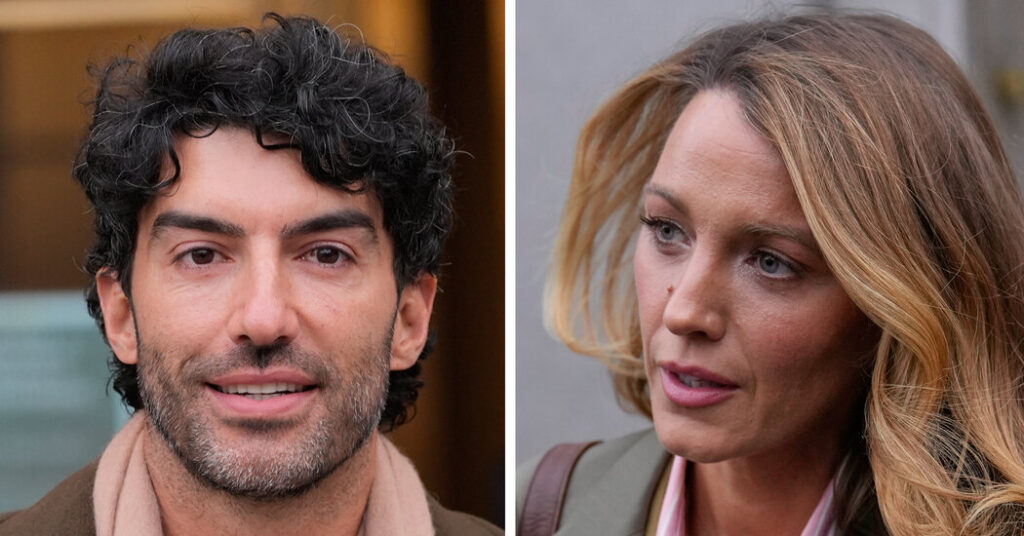
A judge in New York dismissed Blake Lively’s claims of sexual harassment against the actor and director Justin Baldoni on Thursday, narrowing the actress’s lawsuit as the high-profile Hollywood legal battle moves toward trial.
In a 152-page opinion, Judge Lewis J. Liman of Federal District Court in Manhattan allowed Ms. Lively’s claim of retaliation against Mr. Baldoni’s company to be brought in front of a jury. His decision focuses the case primarily on the actress’s allegations that Mr. Baldoni and his colleagues waged a retaliatory campaign on social media and in the press after she made complaints of sexual harassment on the set of the 2024 movie “It Ends With Us.”
The judge determined that while some crisis communication efforts by Mr. Baldoni and his team were acceptable, others may not have been.
“There are limits to the response that the accused can make in response to claims of harassment,” Judge Liman wrote. “There comes a point where the accused stops simply defending him or herself and starts taking action that a reasonable jury could view as retaliation for the fact that the accuser had the temerity to make the accusations.”
Mr. Baldoni, who directed the movie and co-starred opposite Ms. Lively, has vehemently denied her allegations of sexual harassment. His lawyers have said that Ms. Lively used minor grievances to sideline Mr. Baldoni from his own film, and that he hired a crisis management firm to protect his own reputation, not to smear her.
Judge Liman determined that Ms. Lively’s core sexual harassment claims did not meet key legal requirements. But the judge found that some of Ms. Lively’s accusations — which include him commenting in front of crew members that she had never watched pornography — were sufficient to provide a foundation for the retaliation claim.
The split decision means that while the judge will not allow the legal claims of harassment to be considered at trial, he views the events that unfolded after the events Ms. Lively complained about to be worthy of a jury’s scrutiny.
Starting in 2023, what began as a friendly collaboration between Ms. Lively and Mr. Baldoni, whose company was also producing the movie, turned increasingly bitter.
Ms. Lively complained during the course of the production not only about Mr. Baldoni’s behavior but about that of his business partner, Jamey Heath, who is chief executive of the company, Wayfarer Studios. She accuses Mr. Heath in her lawsuit of staring at her bare breasts in the mirror of her makeup trailer, an encounter that his lawyers described as, at most, a “fleeting mishap.”
Tensions escalated further ahead of the movie’s premiere, when Ms. Lively refused to appear alongside Mr. Baldoni to promote the film, which is an adaptation of a Colleen Hoover book about a relationship devastated by domestic violence.
Concerned about potential media coverage of their increasingly apparent discord, Mr. Baldoni hired a crisis communications team.
After the premiere, Ms. Lively was hit with a deluge of negative online commentary. A key question of the trial will be whether that response was organic — a product of existing criticisms of the actress — or heavily influenced by Mr. Baldoni’s communications team.
Ms. Lively’s lawyers assert that through strategic interactions with the news media and manipulation on social media, Mr. Baldoni’s crisis team worked to “disparage Ms. Lively’s character, and discredit any allegations that might arise about Mr. Baldoni’s on-set behavior, by boosting derogatory content about Ms. Lively alongside glowing content about Mr. Baldoni.”
The case has put the inner-workings of Hollywood on display, including infighting over the film’s editing and dueling allegations of both sides disparaging the other to important industry players. The trove of evidence has included communications between Ms. Lively and Taylor Swift, as well as messages the actress and her husband, Ryan Reynolds, sent to Matt Damon and his wife. Film studio executives, actors, agents and publicists have all been deposed.
The trial over Ms. Lively’s remaining claims is scheduled for May.
Julia Jacobs is an arts and culture reporter who often covers legal issues for The Times.
The post Blake Lively’s Retaliation Case Heads to Trial Without Harassment Claims appeared first on New York Times.