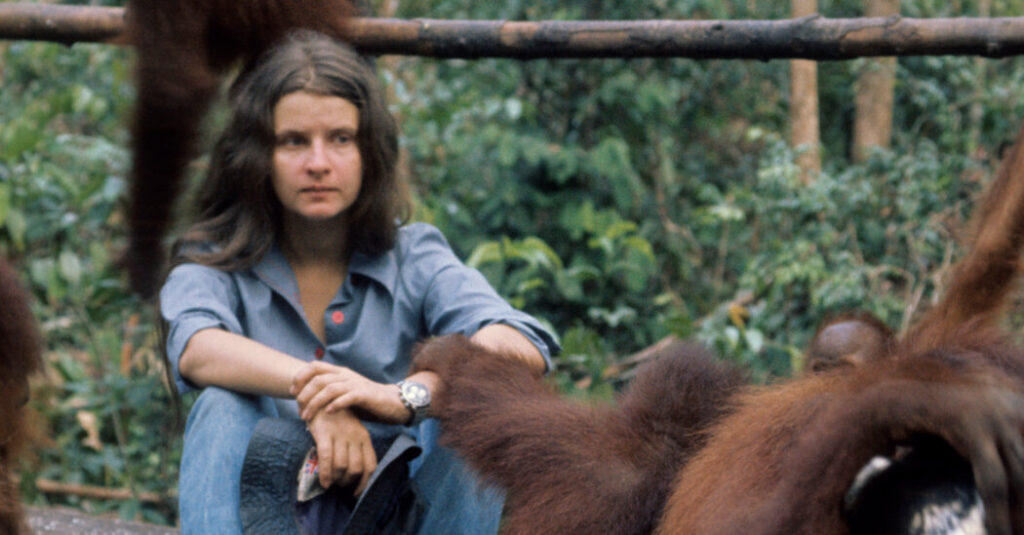
Biruté Galdikas, a primatologist who fulfilled her childhood ambition to study and preserve the lives of wild orangutans in the tropical rainforests of Borneo, where her half-century of research and conservation made her one of the world’s leading experts on that elusive and critically endangered great ape, died on March 24 in Los Angeles. She was 79.
Her death, in a hospital, was caused by lung cancer, according to Orangutan Foundation International, which she started in 1986.
Dr. Galdikas was one of three daring women who revolutionized primatology, following in the tradition of Jane Goodall, who studied chimpanzees in Tanzania, and Dian Fossey, who lived among mountain gorillas in Rwanda.
Like them, Dr. Galdikas (pronounced gal-dee-kuhs) was mentored by Louis Leakey, the British-Kenyan paleoanthropologist whose study of early hominid fossils established the origins of mankind in Africa. The three women were like daughters to Dr. Leakey, and sisters to one another.
“Like true siblings, we did not choose each other, but were fated to be tied together, often referred to as the ‘trimates,’” Dr. Galdikas wrote in her memoir, “Reflections of Eden: My Years With the Orangutans of Borneo” (1995).
She arrived in the Southeast Asian island of Borneo in 1971, accompanied by her first husband, Rod Brindamour, a photographer. They set up a research base — naming it for Dr. Leakey — in what is now Tanjung Puting National Park, a habitat covering 1,174 square miles of swampy terrain. Orangutans are exclusive to Borneo and Sumatra.
“Nobody knew anybody who had been there,” Dr. Galdikas told the CBC, Canada’s public broadcaster, in 2021.
It was remote territory, almost inaccessible to researchers, without transportation and communication services but with plenty of leeches, malarial mosquitoes, wild pigs, pythons and king cobras. (The real threats came from people opposed to her work; she was once kidnapped and beaten before being released overnight, said her son Frederick Galdikas, a member of the Orangutan Foundation board.)
Dr. Galdikas attracted a new level of attention to orangutans in 1975 with an article she wrote for National Geographic magazine. The cover photograph, by her husband, showed her carrying an orphaned orangutan in her left arm and holding hands with another. Her second cover story for the magazine, in 1980, featured a photo of Binti, her toddler son with Mr. Brindamour, sharing a bath with an orphaned orangutan.
In the 1975 article, Dr. Galdikas described a standoff with a male orangutan:
“He was just ambling along, head down, oblivious to my presence,” she wrote. “Then he stopped dead in his tracks less than 12 feet away. For long seconds, he stared and stared. I guess he was evaluating the bizarre sight in front of him: a pale-faced primatologist with large black sunglasses clutching an enormous bag full of dirty laundry.”
She added: “But, strangely, I felt no fear. I simply marveled at how magnificent he looked with his coat blazing orange in the full sunlight. Abruptly, he whirled around and was gone. There was nothing but the sound of his feet padding off along the path.”
In a profile of Dr. Galdikas in The New York Times Magazine in 1992, Mark Starowicz, a CBC producer who had made a documentary film about her, wrote: “For years, her daily routine hardly varied. Rising before dawn and returning to the spot where the orangutan she was trailing had nested the night before, she would closely monitor its movements and behavior. After the orangutan nested, she would head home or sleep in a hammock in the forest.”
Dr. Galdikas documented the orangutans’ solitary nature; their foraging habits and diet of more than 400 types of food; their young suckling their mothers for six to seven years; the unusually long interval between births for female orangutans — nearly 8 years; and the species’ declining population.
Luisa Arnedo, a senior program officer at the National Geographic Society, which funded some of Dr. Galdikas’s research, said in an interview: “The thing with primatology is, when you’re dealing with behavior and life history, you have to spend a lot of time there. You can’t collect data for a year and leave. You need decades of observing. The 7.7 years between births — she had to be there.”
Dr. Galdikas’s honors included the 1997 Tyler Prize for Environmental Achievement, a prestigious award from the University of Southern California. She was cited for conducting “one of the longest, continuous studies by one principal investigator of any mammal in the world.”
Biruté Mary Galdikas was born on May 10, 1946, in Wiesbaden, Germany, to Lithuanian parents, Antanas and Filomena (Slapsis) Galdikas, who were fleeing Soviet control of their homeland. Her father settled first in Quebec, where he worked in gold and cooper mines. The family, which later grew with three more children, later moved to Toronto and then to Los Angeles, where her mother was a nurse and her father a painting contractor.
Inspired by her parents’ stories about the forests of Lithuania — and reading, at age 6, “Curious George,” the first in a series of classic children’s books about a monkey by Margret and H.A. Rey — young Biruté dreamed of life as an explorer. Within a few years, her focus had narrowed.
“I was born to study orangutans,” she wrote in “Reflections of Eden,” “because they, like me, were of the forest.”
At the University of California, Los Angeles, she earned a bachelor’s degree in psychology in 1966. Three years later, shortly before receiving a master’s degree in anthropology from U.C.L.A., she attended a lecture there by Dr. Leakey.
“When Leakey began talking about primate studies,” she wrote in her memoir, “I felt as if he had read my mind and knew I was there. Immediately after the lecture, I rushed up to him and told him that I wanted to study orangutans.”
Dr. Leakey encouraged her and helped her secure funding to start her research in Borneo. She worked with Mr. Brindamour until they divorced in 1979. He got custody of Binti; both parents had agreed that the child needed human friends, not the orangutan playmates whose behavior he was emulating.
Dr. Galdikas received her Ph.D. in anthropology from U.C.L.A. in 1978 and soon married Pak Bohap, an elder in the Dayak tribe of Indigeneous Borneans. Mr. Bohap, who died in 2022, had worked as a tracker on her staff and was a founder of Orangutan Foundation International, which aims to raise awareness of the orangutans’ diminishing populations. In addition to their son Fred, they had a daughter, Jane, who was named for Ms. Goodall.
Early in her time in Borneo, the Indonesian Forestry Service asked Dr. Galdikas to rehabilitate captive young orangutans that it had confiscated from people who had kept them illegally as pets; she would later reintroduced them to the wild.
Sugito, a year-old infant orangutan, she wrote, “decided I was his mother” and clung desperately to her.
“Changing clothes became a major undertaking, with Sugito screeching and clutching at whatever was coming off,” she recalled in her 1975 National Geographic article. “He slept curled up next to me and would not abandon me even when I bathed in the river.”
Dr. Galdikas and her staff eventually returned more than 500 orangutans to the wild, a mission she had not anticipated when she went to Borneo. But she made it a priority to save the great ape from threats to its existence, like the commercial pet trade, illegal logging and deforestation.
Her conservation efforts included successfully pushing for national park status in the wildlife reserve where her research center is based, ensuring government protection of the orangutan habitat; encouraging eco-tourism; and working with local partners to buy forest land outside the park to expand the orangutans’ perimeter of protection, Fred Galdikas said.
In addition to him, Dr. Galdikas is survived by her son Binti; her daughter, Jane Galdikas; a sister, Aldona Galdikas-Franz; and seven grandchildren.
Her foundation was her vehicle for championing orangutans and raising awareness of their diminishing populations.
“I feel like I’m viewing an animal holocaust, and holocaust is not a word I use lightly,” she told The Times in 2000. “The destruction of the tropical rain forest in Borneo is accelerating daily. The consequences of this destruction for the orangutans will be final. And if orangutans go extinct in the wild, paradise is gone.”
Richard Sandomir, an obituaries reporter, has been writing for The Times for more than three decades.
The post Biruté Galdikas, 79, Who Worked to Save Wild Orangutans in Borneo, Dies appeared first on New York Times.