The war in the Persian Gulf has already been bad for the markets and the global economy. There’s no question about that.
But from a purely financial standpoint, another issue looms: By the time all the fighting ends — whenever it ends — how big will its impact be? The best anyone can do at this stage is make educated guesses.
President Trump’s from-the-gut decision-making, combined with Iran’s resilient ability to close shipping lanes and wreak damage on Gulf energy production, means that the range of possibilities for this war is still staggeringly broad.
New forecasts come out continuously. Most scenarios go from bad to very bad — and much worse. It’s difficult to rule anything out.
The markets so far have embraced the merely bad predictions — which, under the current circumstances, amount to a positive outlook. Over the last month, Mr. Trump’s intermittent comments suggesting the war was almost over have set off rallies in the markets, only to be followed by setbacks.
In a speech from the White House on Wednesday, Mr. Trump said, “Over the next two to three weeks, we’re going to bring them back to the Stone Ages, where they belong. In the meantime, discussions are ongoing.”
He also said he would leave it to other countries to try to reopen the Strait of Hormuz, which Iran controls and through which one-fifth of the world’s oil and natural gas usually flows.
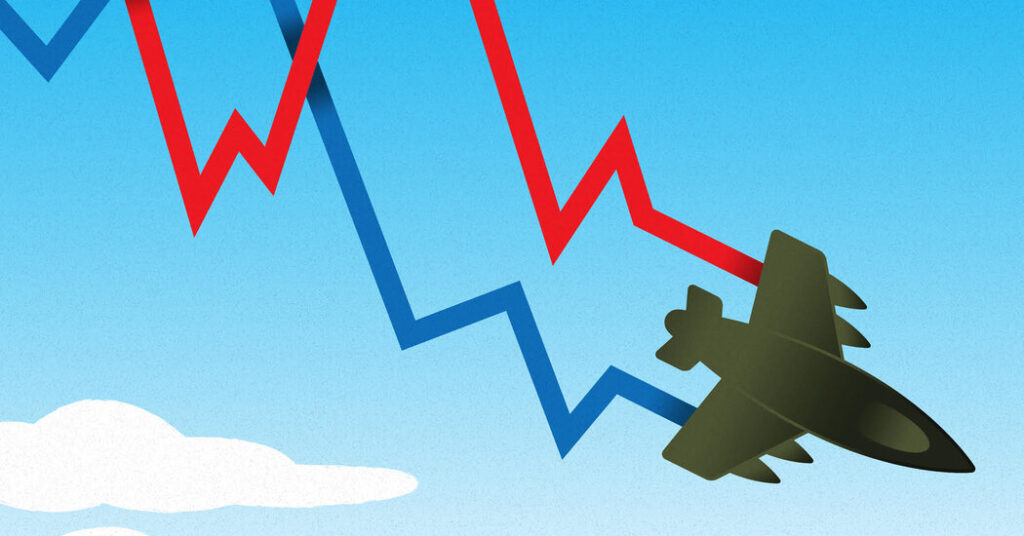
Energy prices are painfully high, and stocks and bonds are down since the war’s start. Even after a late rally, the S&P 500 was down 7.3 percent for the first quarter of the year, which ended on Tuesday, and it dropped almost 8 percent in the month since the United States and Israel attacked Iran on Feb. 28. These moves have stung.
The markets sank after the president’s speech. Still, they would be in much worse shape if a consensus of investors believed the war would wreak profound, long-term harm on the global economy.
Because oil, natural gas and fertilizer are such important ingredients for so many things in daily life, the cuts in supply that have occurred so far are already dangerous. A protracted war would be far more perilous and could even set off a global recession.
The Situation So Far
In the United States, the average price of a gallon of gas crossed the $4 threshold this week.
That level has previously signaled to many Americans that inflation was a serious problem, endangering the political prospects of incumbents, though the correlation between the price at the pump and presidential approval ratings appears to have weakened over the last 15 years. In June 2022, average gas prices exceeded $5 a gallon, which caused serious problems for the Biden administration.
Gas prices in the United States have already become uncomfortably high — and prices are certain to keep rising because of the delayed effects in refining and distributing oil. If consumers respond by cutting back sharply on spending, economic growth could slow or conceivably lurch into reverse.
That has put the Federal Reserve in a bind. At its last meeting, in mid-March, the Fed said it would not lower interest rates, as Mr. Trump has demanded, until the inflationary effects of the war were clear. It would have to cut rates if job losses mounted because of the war. And the possibility of a rate increase, to curb inflation, has risen sharply since the start of the war, though the odds in futures markets dropped this week after Jerome H. Powell, the Fed chair, spoke in terms that many people took as dovish.
“We feel like our policy is in a good place for us to wait and see how that turns out,” he told students at a Harvard economics course on Monday. So for now, it seems the Fed is holding steady.
The United States is buffered from some of the effects of higher energy prices because it is a net exporter of oil and liquefied natural gas.
The situation is much worse now in countries without those resources, particularly in Asia, like Pakistan, the Philippines, Vietnam, Thailand and Sri Lanka, where the shortfall in energy from the Gulf is felt acutely. And most of Europe faces greater energy problems than the United States does, with the oil shock set off by Russia’s war in Ukraine still hurting the continental economy and current shortages worsening the situation considerably.
Educated Guesses
Even if Mr. Trump decides in a few weeks that the United States really has done enough fighting, the energy shock set off by the war couldn’t be resolved by a single person or nation. Iran certainly has a say in the matter.
It has proved that it can throttle the strait, and there are other important energy choke points, too. For example, the Houthis, an Iranian-backed militia in Yemen, have threatened to block shipping lanes in the Red Sea, which they have attacked before. And significant damage to production capacity in the Middle East has already been done. It wouldn’t take much to keep energy prices high — or to send them higher.
Even so, most oil producers and consumers desperately want the conflict to end soon. Perhaps simply because this outcome seems so sensible, the consensus wisdom is that it will happen.
For example, in its “base line scenario,” Capital Economics, an independent research firm based in London, projected in late March that there would be a swift end to the war and a return to normal oil flows. It assigned a two-thirds probability to this outcome, Jennifer McKeown, the firm’s chief global economist, said.
Under this relatively benign outcome, the United States would probably fare best, while regions more dependent on energy imports would face setbacks of varying degrees because of price increases and energy shortages that are already underway. Under its “adverse scenario,” in which the war continues, Capital Economics said, the United States again outperforms most other regions, which would fall close to or fully into recessions.
The International Monetary Fund, in a blog post this week, said there were too many possibilities to be able to project forward accurately. But no matter how you look at it, it said, “all roads lead to higher prices and slower growth.” Some outcomes would be particularly painful, especially for vulnerable regions, with the worst off being poor energy-importing countries in Africa, Asia and Latin America.
“Low-income countries are especially at risk of food insecurity,” the I.M.F. said.
Merely Bad
It’s difficult to sugarcoat the war’s effects on the U.S. stock market. Most portfolios fell, unless you cherry-picked the right stocks and sectors. Investments in fossil fuel and select military companies have paid off. When the quarter ended on Tuesday, Exxon Mobil was up more than 40 percent for the calendar year; Lockheed Martin was up 25 percent. But the overall U.S. stock market was down, bond funds have declined as interest rates have risen, and many international markets were far more badly hit.
Even so, the latest rally provides an important reminder: Most wars in recent decades have had scant effects on financial markets a year after the fighting has ended. It’s possible that this one will be similar.
Corporate earnings, the underpinning of stock prices, are still strong, and if the economy keeps expanding, the stock market could resume a rise propelled by spending on artificial intelligence.
But there are heightened risks coming from several directions. The A.I. boom could falter, and the Trump tariffs could derail the economy. The war, at the moment, is still the biggest threat.
If you’re lucky enough to be an investor and have the stomach for a roller-coaster ride, stick with the markets, by all means. Cash held in safe, interest-bearing accounts can be a balm when markets crash, as they periodically do. It’s difficult to plan sensibly in a world like this, but it is the world we live in.
Jeff Sommer writes Strategies, a weekly column on markets, finance and the economy.
The post Bad, Very Bad and Much Worse: Pick a Forecast for the War and Economy appeared first on New York Times.