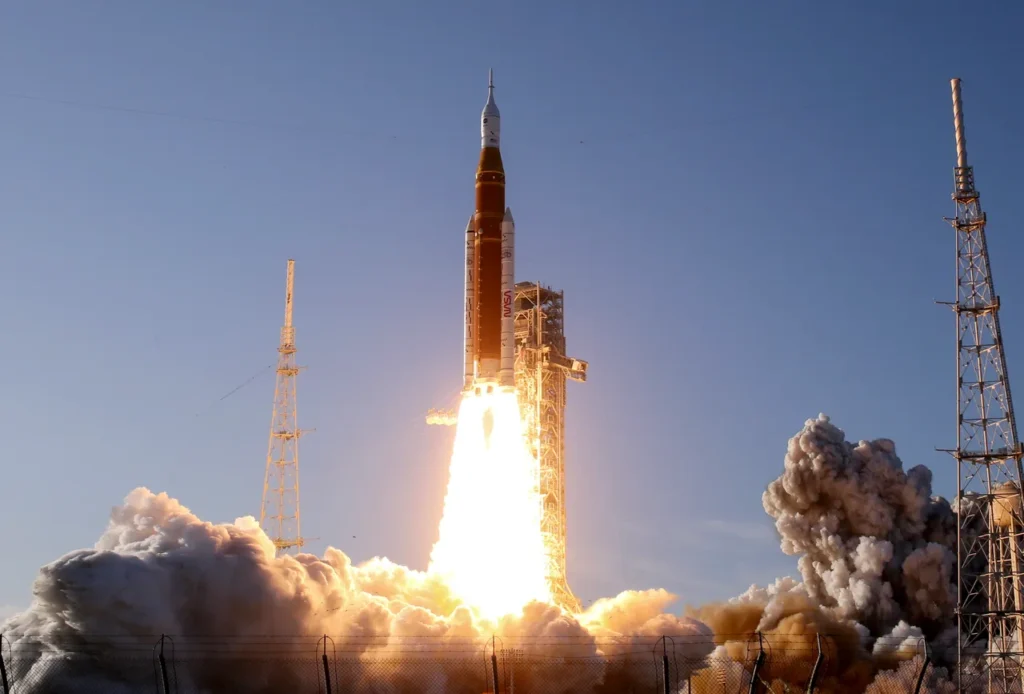
At 6:36 pm Cape Canaveral time, NASA’s SLS rocket lifted off without incident with the four members of the Artemis II spacecraft aboard. During the first few hours, Orion will complete its journey into Earth orbit and, throughout the first day, will conduct critical navigation and systems tests. Around the third or fourth day, the spacecraft will begin its trajectory toward the moon and cross its gravitational sphere of influence. In total, the mission will last approximately 10 days.
The mission includes the first woman and the first Black person on a crewed mission to lunar orbit. The launch comes 53 years after Apollo 17, the last crewed mission to the Moon.
The Artemis II crew will not land on the moon (that will happen on Artemis IV ). Instead, their capsule will fly at altitudes between 6,000 and 9,000 kilometers above the surface of the far side of the moon, circle it, and begin the return journey to Earth. The mission’s main objective is to demonstrate that the space agency has the technological capability to send people to the Moon safely and without incident.
Once they achieve this, NASA will begin preparations for new moon landings in the following years, which will aim to establish the first lunar bases in history and, with them, the sustained and sustainable presence of humans on the satellite.
The launch was successful and occurred on schedule. The launch window opened on Wednesday, April 1, at 6:24 pm Eastern Time (EDT) and could have been extended for two hours, if necessary. NASA would have had five more days to attempt another launch.
Mission Details
The astronauts took off on a NASA SLS rocket and are traveling inside the Orion capsule, described as a spacecraft about the size of a large van. They will orbit Earth for at least two days to test the onboard instruments. Then they will align the spacecraft to begin its journey to the moon. By the fifth or sixth day of flight, the capsule is expected to enter the moon’s sphere of influence, where the satellite’s gravity is stronger than Earth’s, and dock with its orbit.
When the spacecraft passes “behind” the moon, the most dangerous phase will begin. The crew will be out of contact with Earth for about 50 minutes due to interference from the moon itself. During this crucial moment, the crew must capture images and data from the moon, taking advantage of the far-more-advanced technology they carry than was available during the Apollo era.
After completing the return, the capsule will head home, taking advantage of the Earth-moon gravity field to save fuel. According to NASA estimates, by the 10th day of flight the crew will be close to reaching the planet.
Artemis II has five priorities: It must sustain the crew safely throughout the flight; operate essential systems for a manned lunar campaign, from ground infrastructure to space hardware; retrieve flight data and use it in future missions; activate an effective emergency system in case of a critical scenario; and verify subsystems and validate emerging data.
Secondary Goal: Beat China
As in the Apollo era, the United States is fighting a space competition with another technological power. However, instead of Russia, the rival now is China, which is rapidly advancing its program to put its own taikonauts on the surface of the moon. By way of context, in the next two years alone, the Chinese space agency plans to send two more Chang’e robots, as well as a lunar lander before 2030.
For the current NASA administration, maintaining space leadership is a stated goal. Although the agency operates on a much smaller budget than during the Cold War, geopolitical pressure has pushed its partners, including SpaceX and Blue Origin, to prioritize technologies that will accelerate the US return to the lunar surface.
The first lunar settlement is key to the future of space geopolitics. While the moon’s territory “belongs to no one” and is governed under the rules of the Outer Space Treaty, the first arrivals will establish operational safety zones, or perimeters where no one else can approach. The first lunar bases will have the best positions over potential vital resource deposits, located in the permanently dark craters of the South Pole, and no one else will be able to take their position away from them.
What’s Next?
Once the mission is over, NASA will rewrite its road map. Artemis III, once billed as the first lunar landing mission, will now focus on testing critical systems, such as the suits and the transport module, all in low Earth orbit. The first manned landing will be moved to a future mission, probably Artemis IV, still without a firm date, and will have to operate without the Gateway station, whose recent cancellation forces a redesign of the program’s logistical architecture.
Mastering lunar descent with new technology is key to the new lunar base construction plan, divided into three phases, dozens of missions, and an investment of close to $10 billion.
This story originally appeared on WIRED en Español and has been translated from Spanish.
The post Artemis II Mission Launches Successfully appeared first on Wired.