Russia, China and France on Thursday effectively stymied a push by Arab countries to get the United Nations Security Council to authorize military action against Iran to reopen the Strait of Hormuz, saying they opposed any language authorizing force, according to a diplomat and a senior U.N. official.
The actual vote on the resolution, which was drafted by Bahrain with the support of the Arab countries in the Persian Gulf, is expected to be scheduled for Friday. But it remained unclear whether extra hours of diplomacy would bring the three veto-holding countries on board.
Russia, China and France are among the five permanent members of the council with veto power. There were also divisions over the resolution among the 10 nonpermanent members, according to diplomats.
The current draft resolution is in its fourth revision after weeks of closed-door negotiations. The part of the text that has generated an impasse states that the Security Council “authorizes member States, acting nationally or through voluntary multinational naval partnerships, with advance notifications to the Security Council,” to use all necessary means “to secure transit passage and to deter attempts to close, obstruct or otherwise interfere with international navigation through the Strait of Hormuz.”
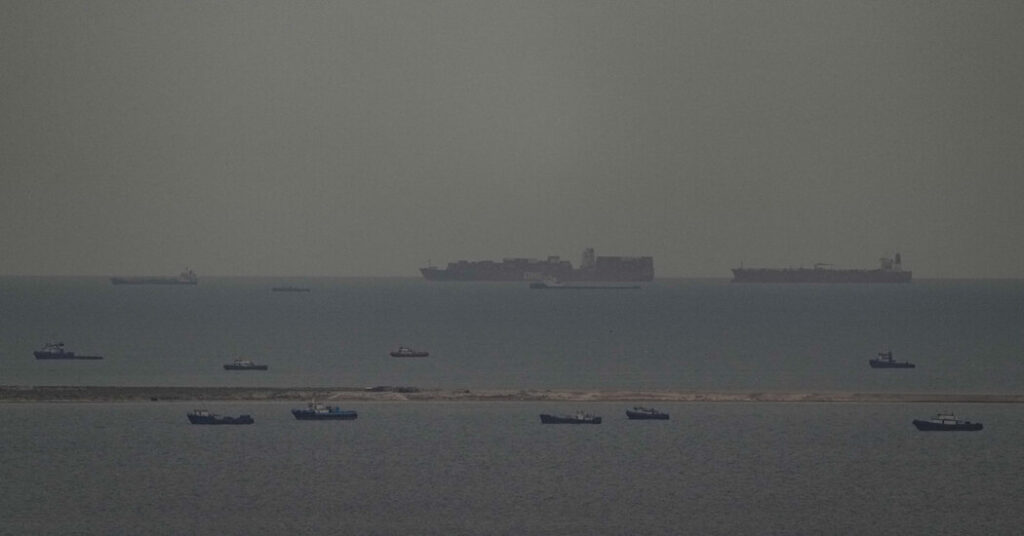
Iran closed the Strait of Hormuz, a strategic choke point where a fifth of the world’s oil and gas normally travels, shortly after the United States and Israel launched a war against it on Feb. 28. The closure has caused global energy disruption, hurt financial markets and increased the costs of oil, shipping and insurance. Iran has also launched thousands of retaliatory attacks on the Arab nations in the Persian Gulf — which host major American bases — killing at least 18 civilians and severely damaging military and energy infrastructure.
Bahrain’s foreign minister, Abdullatif bin Rashid Al Zayani, told a session of the Security Council on Thursday that “Iran’s aggressive intentions,” toward its Arab neighbors were “treacherous” and “preplanned,” and violated international law. He said Iran had targeted civilian structures such as airports, water stations, seaports and hotels.
Iran signaled on Thursday that it intended to continue to oversee shipping traffic through the critical Strait of Hormuz, even after the war.
For Iran, its Arab neighbors uniting against it at the Security Council represented a serious, perhaps irreparable, deterioration of relations. For years, Iran cultivated closer ties with its neighbors, only to blow them up during the past month of war.
Analysts say the Bahraini-led efforts at the Council are more symbolic than pragmatic; the militaries of most of the Persian Gulf countries are relatively small, and heavily dependent on U.S. support. They have minimal experience combating a military the size of Iran’s.
And France’s president, Emanuel Macron, said on Thursday that President Trump’s comments urging countries that rely on the strait to forcefully open it were unrealistic.
“It is unrealistic because it would take an inordinate amount of time and would expose anyone crossing the strait to coastal threats from the Revolutionary Guards, who possess significant resources, as well as ballistic missiles, a host of other risks,” Mr. Macron said.
Abdulaziz Sager, the chairman of the Gulf Research Center, a think tank based in Saudi Arabia, said any cease-fire agreement must also address Iran’s capability to attack Gulf countries and control maritime traffic through the Strait of Hormuz. “We will not forget what they have done to us, and they will not forget that the U.S. had a lot of facilities here in the Gulf,” he said.
The blocking of the strait has cut off the main export route for the Arab countries, where economies and government budgets depend heavily on fossil fuel revenue. Qatar, one of the world’s largest exporters of natural gas, has been forced to shut down production entirely and declare force majeure, breaking contracts with buyers.
The Qatari government said it expects a $20 billion loss in annual revenue. Most of the Gulf countries had maintained cordial ties with Iran before the war, including Saudi Arabia, which re-established diplomatic relations with Iran in a China-brokered pact in 2023.
Saudi and Emirati officials in particular had come to believe that the best way to manage the threat posed to them by Iran was through nurturing diplomacy and shared economic interests, analysts say.
Bahrain was an exception. An island nation where a Sunni monarchy rules over a Shiite-majority citizenry, Bahrain has long had an antagonistic relationship with Iran, accusing it of meddling in its internal affairs and stirring up dissent.
But in the wake of the war, even countries like Qatar and Oman — which often served as a mediators between the United States and Iran — have indicated that their relationships with the Islamic republic are probably irreparably damaged. They have handed the mediator role to Pakistan, Turkey and Egypt.
Ali Vaez, the Iran director at the International Crisis Group, said the resolution by Bahrain was flawed and risked escalating tensions in the region, pointing out that the closure of the strait is a result of the war and it was open before the strikes. “It treats a political crisis as if it can be solved at gunpoint.”
Farnaz Fassihi is the United Nations bureau chief for The Times, leading coverage of the organization. She also covers Iran and has written about conflict in the Middle East for 15 years.
The post Arab Countries Want the U.N. to Authorize Force to Open the Strait of Hormuz. The Idea Hit Roadblocks. appeared first on New York Times.