What do you get when a Senegalese artist born in 1928 spends his formative years soaking in the work of European painters like Poussin, Rembrandt, Goya and Degas while studying classic African sculpture?
The result is “Between Latitude and Longitude,” a small but magnificent exhibition at the Metropolitan Museum of Art’s newly reopened Michael C. Rockefeller wing focused on Iba Ndiaye, an enigmatic and little-known artist.
In 1981, Lowery Sims, then an associate curator at the Met, presented “Iba Ndiaye: Evolution of a Style” at New York’s African-American Institute. She wrote: “While it is hoped that the full range of Iba Ndiaye’s achievement as a figural artist may be the subject of an exhibition of his large-scale works in the future, the current offering does afford us an overview of Ndiaye the incessant experimenter.”
In 1992, Ndiaye’s work was central in “Africa Explores: 20th Century African Art,” curated by Susan Vogel at what was then the Center for African Art in New York. However, the show at the Met traces not just the artist’s work but also how the artist came to make the work. Paintings and drawings by the artist are accompanied by photographs taken by his wife, Francine Ndiaye (a museum curator in Paris), as well as by work from people who influenced him. It positions Ndiaye, who died in 2008 at 80, as an important figure in modern art history, who straddled African and Western art traditions.
He lived all his life crisscrossing cultures: He was born in Senegal, but in Saint-Louis, a French settlement on the Senegal River from which France administered all of West Africa from 1895 to 1902. His father was Muslim, and his mother was Catholic. He had an elite education that further exposed him to diverse cultures at a time when that was rare for most Africans: He studied at the Lycée Faidherbe in Saint-Louis, enrolled to study architecture at the Ecole des Beaux-Arts in Montpellier, France, before pivoting to join the art world of the Parisian crowd, where he first studied at École Nationale Supérieure des Beaux-Arts. In 1955, he joined the Académie de la Grande Chaumière in Montparnasse, whose alumni include Calder, Giacometti, Modigliani, Balthus, Miró and Bourgeois.
The colonial grasp on many African countries began to fall apart in the 1950s, giving way to nations wanting to forge their own identities. A significant number of the first leaders of these countries were invested heavily in the arts — especially because many of them were writers, poets and philosophers themselves: Julius Nyerere of Tanzania translated Shakespeare’s “Julius Caesar” and “The Merchant of Venice” into Swahili. Agostinho Neto of Angola was a doctor who also published poetry, including a collection, “Sacred Hope,” in 1974.
The most famous of these leaders was Léopold Sédar Senghor, Senegal’s first president, who aside from being a world-renowned poet was a primary theorist of the Negritude movement (a movement for Black consciousness and aesthetics that rejected European colonialism, assimilation and racism). He invited Ndiaye back to Senegal in 1959 to establish the National School of Fine Arts in Dakar.
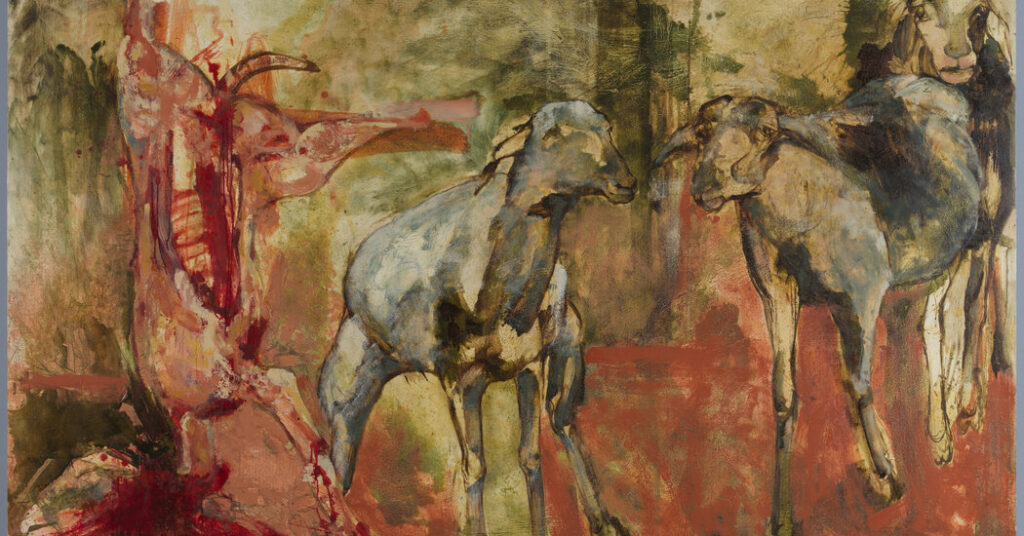
Perhaps signs were always there that Ndiaye would not last long in a world where fellow teachers were invested in a sharp break from Western methods. His unusual pedagogy, for example, might ask a student to make a plaster cast of Andrea del Verrocchio’s “David,” before immediately focusing on a Yoruba mask. Ndiaye’s painting “Tabaski III,” from 1970 and the centerpiece of the new exhibition, is the culmination of this mixture of cultures. It represents the fine blend of a mind formulating new artistic directions in a world of absolutes.
The painting is named after the Wolof word for Eid al-Adha, one of the biggest Muslim holidays in Senegal, where more than 90 percent of the population practices the religion. A slaughtered ram — the source of the red in the image — dominates the left part of the painting. Three rams, still alive, their eyes sullen, fill the rest of the frame.
Every element evokes the moment of Tabaski, especially for anyone who has experienced it: the slashed ram head at the bottom left; the painting’s yellowish background representing the scatter of dust that tinges the air; the muddy, bloody earth; the tiredness of the rams, which are sometimes set in a head-butting competition; the aggressive dabs of dark paint mimicking the blurry but energetic wave of a season where everything is drowning in guttural animal cries.
Two Met curators, Alisa LaGamma (the Ceil and Michael E. Pulitzer Curator of the Department of the Arts of Africa, Oceania and the Americas) and David Pullins (the Jayne Wrightsman Curator of European paintings) organized the show. They are from totally different departments, which may in part be why the exhibition emanates carefully interwoven scholarship, presented in a harmonious body of work.
“Ndiaye traveled a lot,” Pullins said in a video interview with both curators. “He jumped across artistic traditions, from Spain to India to Japan. He had no sense of hierarchy.”
During one of those sojourns, to Mali in 1971, he studied the effects of the harmattan (northeasterly winds that blow downward from the Sahara from November to March). “Sahel, Sandstorm,” painted just seven years before his death, is a stunning rendition of measured chaos. The red, muddy earth returns, this time as a thick mass that forms a solid base at the bottom of the frame. Above it, sand twirls and scatters, like an explosion, with dust rising into the surprisingly blue sky.
LaGamma said that unlike the places where most of Ndiaye’s contemporaries grew up, Saint-Louis “did not have the tradition of figurative works that we so much attribute to Africa.” The artist, she added, “discovered African art in museums in the same context where he saw European art.” Was this why it was natural for Ndiaye to look at both cultures as he fashioned his visual language?
Emancipation from the dominance of what were considered colonial influences was a common problem for artists in newly independent African countries. In 1958, a group of students (including Uche Okeke, Bruce Onobrakpeya, Demas Nwoko, Yusuf Grillo, Simon Okeke, Jimoh Akolo, Oseloka Osadebe, Ogbonnaya Nwagbara and Emmanuel Okechukwu Odita) nicknamed the “Zaria Rebels” at the Nigerian College of Arts, Science and Technology in Zaria formed “Natural Synthesis” in response to Western influence, hoping to mix lessons from their British lecturers with more Indigenous sources. Ndiaye’s approach, too, was a kind of synthesis, although with a different intention.
“Voyage au Mali,” a 1983 painting by the Senegalese artist Souleymane Keita, helps trace Ndiaye’s legacy to the next generation. Keita, who died in 2014, was Ndiaye’s student, and his influences were a Mandinka heritage and American abstract painting, which he was exposed to during a five-year residency in the United States and via his friendship with Black American abstract artists like Melvin Edwards, Ed Clark and Bill Hutson. The colors of “Voyage au Mali” — the dark reddish base, the oranges, the yellows that rise and dissipate like dust — are similar to Ndiaye’s “Sahel, Sandstorm,” suggesting a clear exchange of ideas between student and teacher.
“Originality goes beyond original provenance, thanks to the acquisition from and contact with others,” Ndiaye said in a 1977 conversation with the French art historian Jean Laude. “The mixing is a universal part of being human.” The show at the Met is a much-needed recovery of an almost disappeared narrative, one that proves that non-Western artists also want to — and already do — function as full members of the world.
Iba Ndiaye: Between Latitude and Longitude
Through May 31. The Metropolitan Museum of Art, 1000 Fifth Avenue; 212-535-7710, metmuseum.org.
The post A Senegalese Artist Who Crossed Boundaries Others Didn’t Dare appeared first on New York Times.