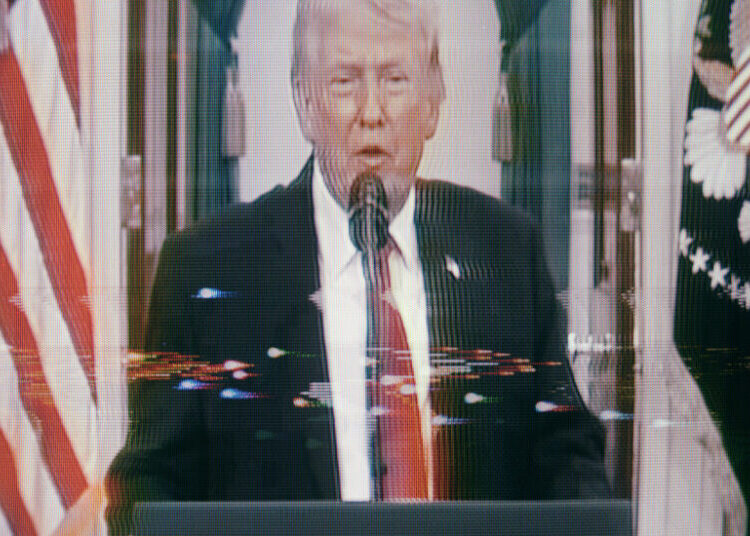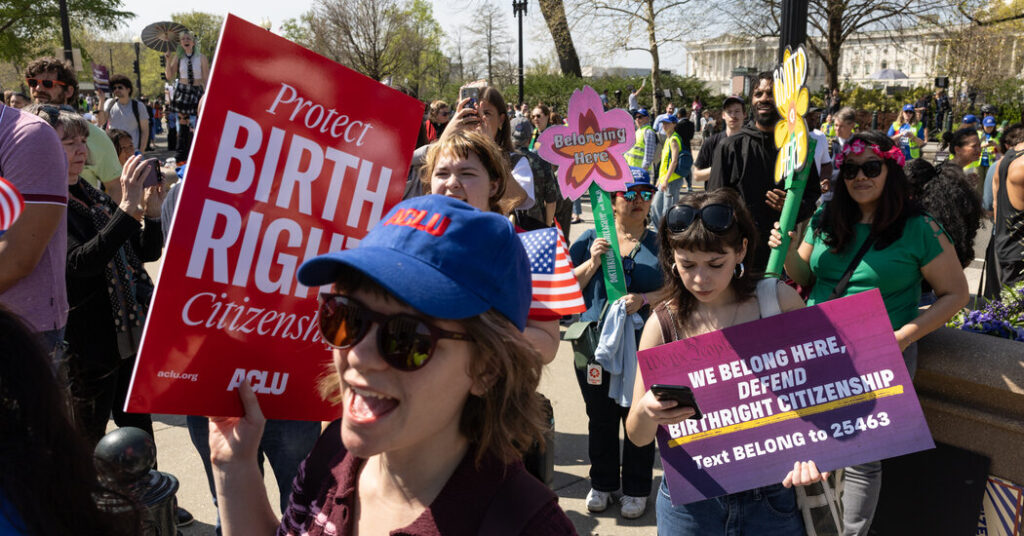
Hello! This has been a big week at the Supreme Court, where the justices heard arguments on Wednesday in one of the most consequential cases of the term, over President Trump’s plan to limit birthright citizenship.
The relationship between the president and the court has been frosty since a six-member majority rejected Trump’s tariffs program in February, prompting him to call the justices who had ruled against him “fools and lap dogs.”
Judging by the justices’ questions on Wednesday, the relationship between the two branches is unlikely to improve anytime soon.
Trump attended much of the argument, a first for a sitting president. Despite his presence, things did not go well for the administration. It is never a good sign, for instance, when the first question from the chief justice calls your key argument “very quirky.”
Trump left not long after a lawyer for the American Civil Liberties Union began her argument. The group is representing expectant parents and children challenging the constitutionality of Trump’s order, which would end the promise of U.S. citizenship for nearly all babies born in the country. Instead, children born to undocumented immigrants and temporary residents would not be citizens.
He later posted on social media that the United States is the “only Country in the World STUPID enough to allow ‘Birthright’ Citizenship!” The statement was false.
During the argument, the two sides reversed what might be considered their usual legal approaches.
Solicitor General D. John Sauer supplemented the usual conservative approach of relying on text and history with appeals to contemporary policy considerations like “birth tourism.” That’s a phenomenon the administration has decried in which wealthy foreigners are said to visit the United States just to give birth and have their children become citizens.
“We’re in a new world now,” Sauer said, adding that “eight billion people are one plane ride away from having a child who’s a U.S. citizen.”
Chief Justice Roberts had a tart response. “Well, it’s a new world,” he said. “It’s the same Constitution.”
By contrast, Cecillia Wang of the A.C.L.U. hewed closely to the conservative touchstones of text, history and tradition, arguing that the words of the Constitution, statements of those involved in debates at the time and key precedents all support a guarantee of birthright citizenship.
The two lawyers differed about the meaning of a key phrase in the 14th Amendment, which says that “all persons born or naturalized in the United States, and subject to the jurisdiction thereof, are citizens of the United States.” Sauer said “jurisdiction” encompasses the concepts of domicile and allegiance. Wang said the phrase means what it ordinarily does: to be subject to the authority of the government.
For a long stretch, starting with the 2024 decision that gave Trump substantial immunity from prosecution and continuing through a score of emergency orders provisionally greenlighting an array of his second-term initiatives, Trump had an extraordinarily successful run before the Supreme Court.
That started to change in December, when the court refused to let Trump deploy National Guard troops in Illinois. The tariffs decision followed in February.
The birthright citizenship case may deal the administration another blow, from a court Trump once assumed would be a reliable ally.
Today, I wrote an analysis floating the idea that things could have gone worse for Trump. The Times has covered the case intensely and from many angles — I invite you to check out some of that work.
Mailbag
Are Executive Orders Law?
What, exactly, is the legal status of an executive order? — Fredric Schnabel, Freiburg, Germany
Executive orders are instructions from the president to his subordinates in the executive branch about how to do their jobs. Those directives are not law in the usual sense. Instead, they must, in theory at least, be based on authority granted by the Constitution or Congress.
Disputes about whether the claimed authority actually exists are common and often give rise to litigation. Wednesday’s argument over the validity of Trump’s executive order telling federal officials not to issue or accept documents recognizing the citizenship of some children born in the United States is an example of such a dispute. Trump said the 14th Amendment and a federal law authorized his executive order. The justices will decide whether he was right.
I’d love to hear your questions on the law, the courts or whatever is on your mind. Send them my way at [email protected].
What I’m Reading
-
“Robert Jackson’s ‘The Federal Prosecutor’ Revisited,” an anguished reflection by Michael Dreeben in The Harvard Law Review Forum. Dreeben, who worked in the solicitor general’s office for more than 30 years, argued more than 100 cases in the Supreme Court and represented the federal government in the 2024 Supreme Court case granting Trump substantial immunity. He wrote that the majority in that case effectively destroyed the independence and impartiality of the Justice Department.
-
Justice Sonia Sotomayor, dissenting on Monday from the Supreme Court’s refusal to hear an appeal from James Skinner, who is serving a life sentence in Louisiana, wrote that the court had betrayed the phrase engraved on the front of its courthouse: “equal justice under law.”
-
Judge Richard J. Leon’s opinion halting Trump’s proposed White House ballroom contained 19 exclamation points, exhausting the judicial branch’s annual allotment of that punctuation mark.
Closing Argument
Supreme Court Bingo
When Chief Justice Roberts is in the majority, which he very often is, he gets to assign which justice will write the majority opinion. In his 2015 study of the chief justice’s practices and strategies in such assignments, Richard Lazarus, a law professor at Harvard, found that Chief Justice Roberts “has clearly sought to achieve parity in the number of opinions each justice writes for the court.”
The justices hear arguments in seven two-week sittings between October and April. If the court hears nine arguments in one of those sittings, the chief justice will generally try to make sure that each justice gets to write one majority opinion.
That practice sometimes allows for educated guessing about which justice is likely to write the opinion in which case.
For instance, there were 10 arguments last October. The only case yet to be decided is a major one on the Voting Rights Act from Louisiana. Seven justices have written one majority opinion each, and Justice Jackson has written two.
That leaves Justice Alito, who has, so far, written none.
Justice Alito wrote the majority opinion in a 2021 decision giving states new latitude to impose restrictions on voting. The math suggests there is reason to think he is at work on a sequel, one that is likely to rule that a key provision of the law is unconstitutional or to severely limit its effectiveness.
Adam Liptak is the chief legal affairs correspondent of The Times and the host of The Docket, a newsletter on legal developments. A graduate of Yale Law School, he practiced law for 14 years before joining The Times in 2002.
The post A President, the Supreme Court and a Landmark Citizenship Order Collide appeared first on New York Times.