Joseph Martinez entered the New Rochelle Diner and scanned the room for a woman sitting alone. She waved, and he approached and took a seat in her booth. She introduced herself as Lisa; they’d texted but never met in person.
She said she had heard good things about the astronomy lessons he gave in the Bronx, where he was known as “Jupiter Joe,” hauling out his big telescope to look at the stars. Lisa wanted to hire him to tutor her 11-year-old daughter. He gave her the Jupiter Joe origin story, how he’d been fascinated by stars and planets since he was a boy and how he now shared his interest with his daughters.
A waiter brought water and sodas, but they didn’t eat. He and Lisa chatted, and after about an hour, she thanked him, promised she’d be in touch and left. Mr. Martinez ordered himself a grilled cheese with bacon, sipped his drinks — he had two — and after he finished, he walked out.
When the diner’s door shut behind him, an unassuming man at a table nearby rose, pulled on latex gloves and carefully picked up Jupiter Joe’s used straws, dropping each in its own plastic bag.
It was January 2021, and the diner was the latest stop in a decades-spanning hunt for a killer. The trail had long ago grown cold. The time had come to get creative.
Twenty-two years earlier, on a cold day in February 1999, a maintenance man was working his weekend shift at a strip mall in Co-Op City in the Bronx. He noticed a big garbage bag in a dumpster out back and got curious — it was not unusual to find discarded DVDs from the video rental store there.
He tore the bag open and recoiled in shock.
Word raced through the police ranks that Sunday morning. A detective’s beeper went off while he was attending Mass in the Bronx. It was a call from his squad, with “911” at the end — urgent. He ducked out of the church.
There was a child’s body inside that bag in the dumpster. A girl.
The first hours in a homicide are crucial, and this one would draw as much manpower as could be spared. Many detectives in the Bronx were called to the scene, among them Malcolm Reiman.
“When there is a child homicide, basically, society is horrified, and the public is horrified, the Police Department is also horrified,” he later testified. “So you get something that’s called an ‘all out’ situation.”
The account of the discovery of the body, the police response that day and other details about the case came from court transcripts and interviews with people involved.
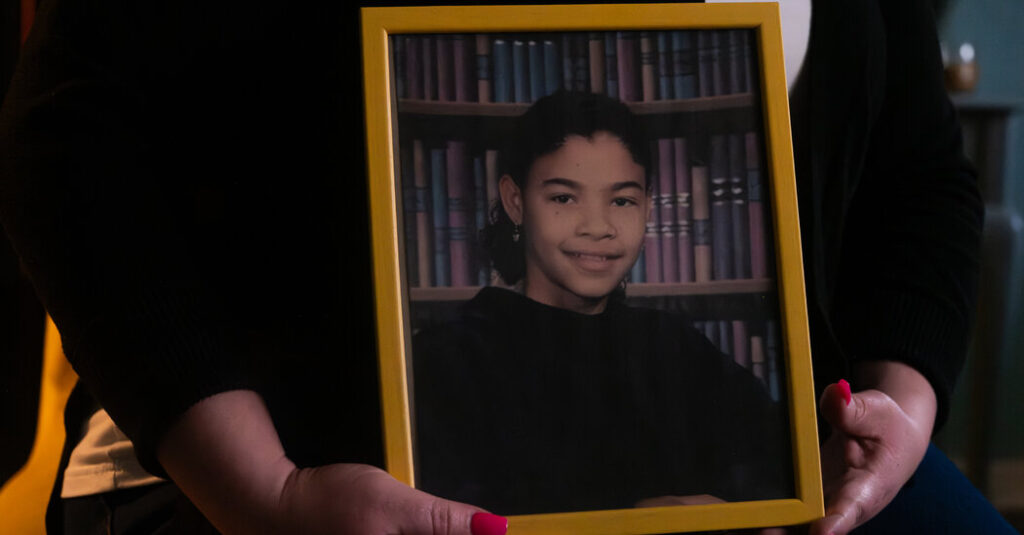
The investigation started promisingly. The girl was quickly identified as Minerliz Soriano, a 13-year-old seventh grader who lived with her family in an apartment building on Pelham Parkway South, two miles away. She had disappeared after school four days earlier, and missing fliers quickly went up in the area.
Detectives visited the apartment building and her middle school. They retraced her route home. They interviewed neighbors, who remembered how she sold candy and Christmas ornaments door to door in the building with her little sister. There were many leads, several persons of interest.
Minerliz was fully clothed and had been strangled. One appalling and vital clue emerged from the forensics team: Two small stains on her sweatshirt were determined to be semen.
Lab analysts with the Office of Chief Medical Examiner performed various tests on the stains and revealed an individual DNA profile. But the profile matched no one in the state’s criminal justice system. Whoever left the stains on the sweatshirt had not had his DNA taken by law enforcement before, and his identity remained unknown.
‘You Wait.’
Minerliz was a bright student at the Frank D. Whalen Middle School, cheerful and out of fashion at the same time, in her baggy sweatshirts and jeans, her old sneakers. She liked Britney Spears and ’N Sync and doing double Dutch outside the school. She bit her fingernails.
At an after-school program when she was 12, she met Kimberly Ortiz, a grade ahead of her, and they quickly became best friends. Kimberly was the more worldly of the two, interested in boys. Minerliz was driven by a sense of wonder. She told her friend she wanted to be an astronaut.
“I told her, ‘We’re from the Bronx,’” Ms. Ortiz recalled years later. “‘We’re not going to be no astronauts.’”
“You wait,” Minerliz replied.
Sometimes the girls cut out from the after-school program — to hang out at a library a few blocks away. They looked at websites, still a novelty at the time. Astronomy, comets, movies, French lessons — Minerliz ranked her interests with a star system in a notebook.
The blocks between school and home were quiet enough that two girls walking there after classes felt safe, with plenty of friendly and familiar faces along the way.
These hours after school were Minerliz’s escape. Kimberly came to believe that her friend’s home life was dominated by chores and caring for her little sister. She lived with her mother and stepfather, and in the six months that she had known her, Kimberly had never met them.
On Feb. 24, 1999, Minerliz asked Kimberly to skip after-school to hit the library. But the school had called Kimberly’s mother and told her about the times she’d skipped, so she had to go.
That Wednesday afternoon was the last time they ever spoke. Four days later, the phone in Kimberly’s apartment rang, and her mother answered and listened to the caller.
“Oh, my God,” the girl heard her say.
Tactics Old and New
In spite of the promising early leads, the case began to grow cold. Members of Minerliz’s family were ruled out as suspects — none matched the DNA sample from the girl’s sweatshirt. Months passed after the murder with no new information. There were plenty of other crimes in the late 1990s Bronx.
“We had sometimes three homicides a day,” Detective Reiman recalled. “Homicides the day before. And the weeks before. All these things are going on.”
Then years passed. Still, detectives returned to the Minerliz Soriano case over the years, picking it up, finding no new leads, putting it back down. The DNA still did not match anyone in the databanks. Nor did it match DNA from any other crime scene.
By 2011, Detective Reiman specialized in cold cases, and he returned in earnest to this investigation. He started tracking down boxes of notes, scattered in records rooms all over the city, from detectives in 1999 and pored over statements given at the time by neighbors. He paid particular attention to what the men said.
“Perhaps somebody took an interest in her,” he said in a television report. “An unhealthy interest.”
He and fellow detectives eventually developed a list of 43 men who lived at the Pelham Parkway South building at the time of the killing. By this time, more than 10 years later, some had moved and some had stayed. Some had been jailed for other crimes.
All they really had to go on was the anonymous crime scene DNA. So he decided to visit each of the men and obtain a DNA sample.
He could either request a cheek swab and risk spooking the killer, who might flee, or get it surreptitiously, by picking up something the man in question discarded — a water bottle, a cigarette butt — and testing that. These objects were known as abandonment samples.
He did not get through his list before he decided to retire after 31 years on the job. He would hand the case off to other detectives.
“At a certain point you realize that this job is going to kill you,” he’d say later. “There is always one more case, you know. You have to draw the line somewhere and leave or you just stay forever.”
By then, investigators also had another idea. Something brand-new.
The Five Sons
By 2019, advances in testing had led to a new method to help law enforcement put a name to an anonymous DNA sample — by identifying a relative of whoever left the sample. It was a somewhat controversial practice called a familial DNA search, and the Bronx district attorney’s office sought it as an avenue of investigation in the Minerliz Soriano case. It had never been used before in New York City.
This new test on the sample from the sweatshirt might identify a blood relative of the person who left the stain. That could narrow the field of potential suspects from countless to just a handful.
It is a law enforcement tool that is meant to be treated as a last resort, when other avenues of investigation have been exhausted. Critics have warned that relying on a partial match of DNA could draw police surveillance of innocent people who had nothing to do with a relative’s actions.
The stain on Minerliz’s sweatshirt was tested again, and in 2020, for the first time, there was a result. The DNA on the sweatshirt belonged to a relative of a man who had been arrested on charges of petit larceny in New York years earlier. He had since died, but he was survived by five sons.
Detectives collected information on the sons. The youngest two were quickly ruled out — they were just boys in 1999, ages 5 and 10. That left three potential sources of the sweatshirt stain.
Detectives didn’t want to approach them directly for a DNA sample. That could potentially tip off the killer that they were getting close. So they needed abandonment samples.
Two of the older sons lived in the Bronx, the third in Florida. The police contacted their counterparts in Orlando, who followed that son, waiting for him to throw something away — in the end, a Covid mask — that they could use.
The older Bronx son, Joseph Martinez, was 27 at the time of the killing. He had a spotless record — no arrests before or after 1999. He had worked in computer support in the World Trade Center in the late 1990s, and now, in 2021, worked at an insurance company.
More recently, he had taken his deep interest in astronomy and turned it into something of a side gig. He bought a powerful telescope and organized watch parties in and around the Bronx. He visited the U.S.S. Intrepid in the Hudson River for events, and often brought his two young daughters along.
On these outings, he went by a nickname: Jupiter Joe.
He seemed an unlikely killer. Then the police made a startling discovery: In 1999, he lived in the same building as Minerliz Soriano. Detectives dug up the statement he’d given officers immediately after the murder. Sure, I’d seen the girl around the building, he’d said. But I didn’t know her.
Now they needed a DNA sample.
The Diner Meeting
Over the years, a detective named James Menton had built a reputation for his creative approach to obtaining abandonment samples. He once posed as a busboy in a busy Chinese restaurant to grab the fork of a man he was investigating. And when the driver of a truck he was tailing over the Manhattan Bridge leaned out and spit onto the roadway, Detective Menton stopped traffic to collect a sample with his cotton swab.
So when he needed DNA from Mr. Martinez, he looked him up on Google to figure out his routines. He latched onto the astronomy angle.
Detective Menton, pretending to be a mother named Lisa, texted Mr. Martinez. By way of introduction, Lisa wrote that her daughter’s best friend attended one of the regular sidewalk shows that Jupiter Joe would hold. “We were wondering if you do any private student tutoring.”
That could work, he said. They could discuss it in person or virtually.
“Would you feel comfortable meeting for coffee or lunch to talk more about it?” the detective texted. “My treat, of course.”
Yes, Mr. Martinez replied. They agreed to meet at the New Rochelle Diner, about a 15-minute drive from the Bronx.
Detective Menton, who worked alongside F.B.I. agents on a task force, asked a female agent to pose at the diner as Lisa. He sat at a nearby table, alone, and watched Jupiter Joe enter, greet the agent and drink his two drinks.
When Mr. Martinez left, Detective Menton bagged the two straws and took them straight to a lab for analysis.
The results came back. There was no doubt. The DNA on the straws was an exact match to the stains on Minerliz’s sweatshirt.
In November 2021, detectives contacted Mr. Martinez and asked him to come to the police precinct to answer routine questions about the case — what Minerliz was like in the building, whether anyone seemed suspicious, that sort of thing.
An hour or so into the videotaped conversation in an interview room — “the box,” in detective circles — Detective Dominic Robinson got to the point.
“Did you and Minerliz ever have sex?” Detective Robinson asked.
“No,” Mr. Martinez replied.
“We have evidence that your DNA was on top of her,” the detective said. “Give me any sort of an explanation of how that’s feasible, how that’s possible, how that could happen. I’m willing to walk down any road with you.”
“I would like to contact my lawyer,” Mr. Martinez replied. He was arrested, and the interview was concluded.
The Saliva Theory
At the trial in September, Mr. Martinez’s lawyer, Troy Smith, did not dispute that his client’s DNA was found on Minerliz’s sweatshirt.
But he argued that it wasn’t semen.
The tests conducted on the stains in 1999 have evolved and improved over the years, and what appeared in tests then to be semen, based on the levels of a specific protein, may in fact have been saliva, Mr. Smith argued.
Thus, the stains could have gotten on the sweatshirt any number of ways, he said.
“If I coughed into my hand — I wouldn’t do this to you — and shook your hand,” he asked a witness from the medical examiner’s office, “my DNA could be transferred to your hand, correct?”
“Correct.”
“If you then touch your shirt, my DNA could be on your shirt?”
“Correct.”
“If after I shook your hand and then you shook the hand of another person, my DNA could be on that other person?”
“Yes.”
Mr. Martinez’s family and supporters seized on this idea as they defended him.
“When you’re around somebody day in and day out, you will pick up something,” said a former girlfriend, Denise Matos, 50, who spent eight years with Mr. Martinez until shortly before Minerliz was killed. She pointed out that Mr. Martinez had no criminal record at all.
“You get a predator,” she added, “they’re not going to be a one-and-done.”
The prosecutor, John Miras, walked the jurors through the lab results in his closing arguments, noting that the high levels of protein in the stain were typical of semen, whereas those levels are minuscule in saliva.
“You can’t get around the science,” he argued. “There is no evidence that he walked by her one day in the elevator and sneezed.”
In November, after a weekslong trial, the jurors returned their verdict: guilty.
An Old Friend’s Return
Kimberly Ortiz was devastated when Minerliz was killed. Her mother forbade her from attending the funeral. But Kimberly went anyway. It was far from their neighborhood, and she took several trains to get there.
She was 13; she turns 40 this year. She now lives in Jacksonville, Fla., where she works for Humana Medicare, and she flew to New York to testify at Mr. Martinez’s trial, the final witness for the prosecution. Her testimony added no new facts about her friend’s killer — she hadn’t seen it happen, after all.
But she brought her best friend into sharp focus for a little while in court, describing her giggling, her shyness around boys and her geeky interests.
“I was the street-smart person and she was more naïve,” she testified. “She was innocent, goofy and just overall just funny.”
Kimberly bought her a ring once that said “Best Friend.” Prosecutors showed her a picture of Minerliz’s hand after her body was found. Yes, she said. That’s the ring.
Last week, Ms. Ortiz returned to the Bronx courthouse one last time, for Mr. Martinez’s sentencing.
Judge Audrey Stone listened to the prosecutor dismiss Mr. Martinez’s reputation in the community as a charade — “three decades of putting on a face that deceived the world.” She listened as the defendant himself spoke: “From the start of this trial, I have maintained my innocence.”
The judge sentenced him to 25 years to life in prison.
Some of the detectives who worked on the case, now retired or on to new jobs, sat quietly in the rear of the courtroom. Among them were Malcolm Reiman, who was called in that day in 1999 when the girl’s body was found, and James Menton, who grabbed the straws at the diner.
The Soriano family and their relatives stepped outside before news cameras, and Ms. Ortiz joined them to remember Minerliz together. When the girls used to cut their after-school program to hang out at the library, they would make “vision boards,” cutouts from magazines that displayed the futures they imagined for themselves.
One was going to be an actress. And the other, the first female astronaut from the Bronx.
Michael Wilson, who covers New York City, has been a Times reporter for more than two decades.
The post Who Murdered Minerliz? How a Diner Meet-up Cracked the Case. appeared first on New York Times.