President Trump declared on Tuesday that he had already achieved one of the primary objectives of his attack on Iran, the elimination of its ability to build a nuclear weapon. But there is no evidence that the United States or Israel has removed or destroyed the country’s stockpile of near-bomb-grade fuel.
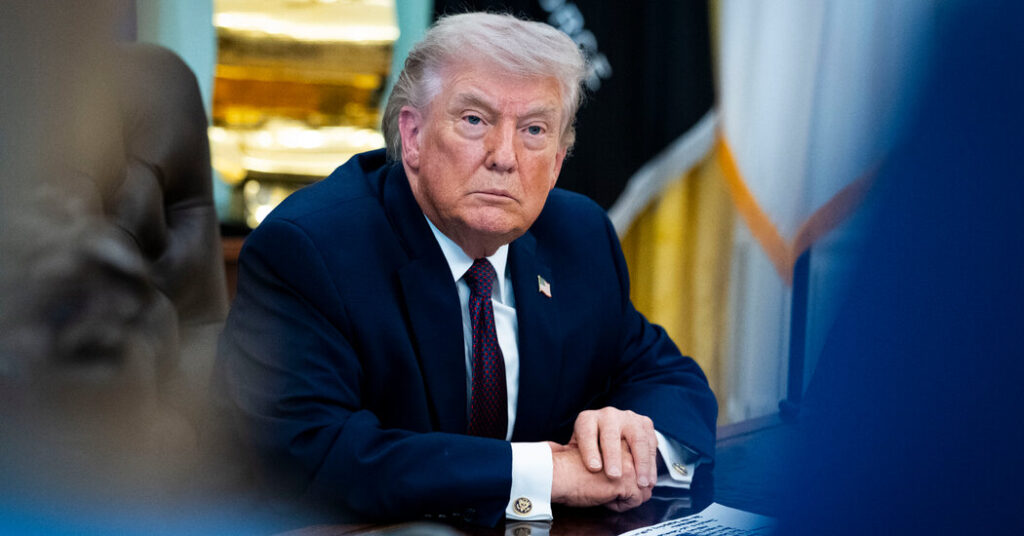
“I had one goal,” Mr. Trump said in the Oval Office late in the afternoon. “They will have no nuclear weapon, and that goal has been attained.”
Several of Mr. Trump’s top aides, including Secretary of State Marco Rubio and Defense Secretary Pete Hegseth, have joined him in narrowing the war objectives in recent days, presumably to give the president space to declare victory and pull back from the conflict. When Mr. Rubio this week sketched out four major objectives — telling an interviewer to “write them down” — he made no mention at all of halting Iran’s nuclear program. (The State Department on Tuesday issued a video in which Mr. Rubio celebrated the smashing of the “shield” of missiles and drones that had protected the country’s nuclear infrastructure.)
But the country’s nuclear ambitions were the central argument for going to war when Mr. Trump announced the commencement of the military operation on Feb 28. In a speech to the nation that morning, Mr. Trump said he initiated “major combat operations” in part because Iran had “attempted to rebuild their nuclear program and to continue developing long-range missiles that can now threaten our very good friends and allies in Europe, our troops stationed overseas, and could soon reach the American homeland.”
Dropping the elimination of the nuclear program from the administration’s list of strategic goals, or declaring the problem solved when Iran retains control over its nuclear fuel, now poses a factual, political and rhetorical challenge.
Unless something changes over the next two weeks — the target Mr. Trump set to begin withdrawing from the conflict — he will have left the Iranians with 970 pounds of highly enriched uranium, enough for 10 to a dozen bombs. The country will retain control over an even larger inventory of medium-enriched uranium that, with further enrichment, could be turned into bomb fuel, if the Iranians can rebuild that capacity after a month of steady bombing.
Mr. Trump’s statement to reporters on Tuesday could of course be strategic deception. The United States and Israel have both been planning and rehearsing raids on Iranian sites at Isfahan and Natanz, the two locations where most of Iran’s near-bomb-grade stockpiles are believed to be buried. They were both hit in U.S. air attacks last June. And while there is evidence that the Iranians regained access to the Isfahan site, where international inspectors believed the vast majority of the fuel to be stored, there is no indication that any of it has been removed.
“We have seen no evidence” that the material left the site before or after the June attack, Rafael Grossi, the director general of the International Atomic Energy Agency, said during a visit to Washington two weeks ago. Mr. Grossi visited the Isfahan site in 2024, but has not been able to inspect it since the June bombing.
“One cannot deny that this has really rolled back the program significantly,” he told CBS News in an interview broadcast earlier this month. “But my impression is that once the military effort comes to an end, we will still inherit a number of major issues that have been at the center of all this.”
Mr. Grossi added that while some nuclear sites had been struck in the latest wave of attacks, they had been “relatively marginal” to the overall Israeli and U.S. effort.
Just a few weeks ago, the administration was actively debating sending in Special Operations forces to seize the material, stored in 30 to 50 canisters. But the operation would be among the riskiest of commando raids. Isfahan is hundreds of miles inland, and presumed to be guarded by the Islamic Revolutionary Guards Corps, or I.R.G.C., which runs Iran’s covert nuclear efforts.
While officials said last week that the president had still made no decision about the operation, they acknowledged that the risk of many U.S. and Israeli casualties had caused officials to reconsider their earlier enthusiasm for seizing the material or seeking to destroy it.
And, if real negotiations begin, the United States may convince Iran to give up the material. That is what happened in 2015, when the Obama administration negotiated a deal in which Iran shipped about 97 percent of its nuclear stockpile to Russia. That left the country with so little material that intelligence estimates concluded Iran would require at least a year to make the fuel for a weapon, and months or years longer for the device itself.
Mr. Trump exited that accord in 2018, calling it one of the worst in history. But if he leaves Iran without getting the uranium out of the country, he will open himself to the criticism that he accomplished less than Mr. Obama did.
Mr. Trump’s statement on Tuesday afternoon suggested, for the first time, that he was ready to live with the status quo, and leave it to one of his successors to deal with.
“In a fairly short period of time we’ll be finished,” he said. “They will not be able to do a nuclear weapon for years, and when they are ready, maybe in a long time from now, able to do a nuclear weapon, you’ll have a president that will be like me, and that he will go there and he’ll knock the hell out of them again.”
It was the latest example of how Mr. Trump dials up and dials down the nuclear threat to fit his immediate agenda. A few weeks ago, he overstated how quickly the material stored underground could be turned into a weapon, telling reporters that Iran had been “within one month” of being able to make a nuclear weapon before he ordered the bombing last June. (Experts note that while Iran could have enriched that fuel to bomb grade within a month, it would have taken months, maybe a year, to make a crude weapon.)
In fact, before the war broke out on Feb. 28 with the combined U.S. and Israeli attack, most intelligence officials said they saw little imminent risk that Iran could race for a bomb. Now, Mr. Trump seems to be saying that they are years away, and that it will be another president’s problem.
David E. Sanger covers the Trump administration and a range of national security issues. He has been a Times journalist for more than four decades and has written four books on foreign policy and national security challenges.
The post Trump Says He Halted Nuclear Threat From Iran, Despite Evidence to the Contrary appeared first on New York Times.