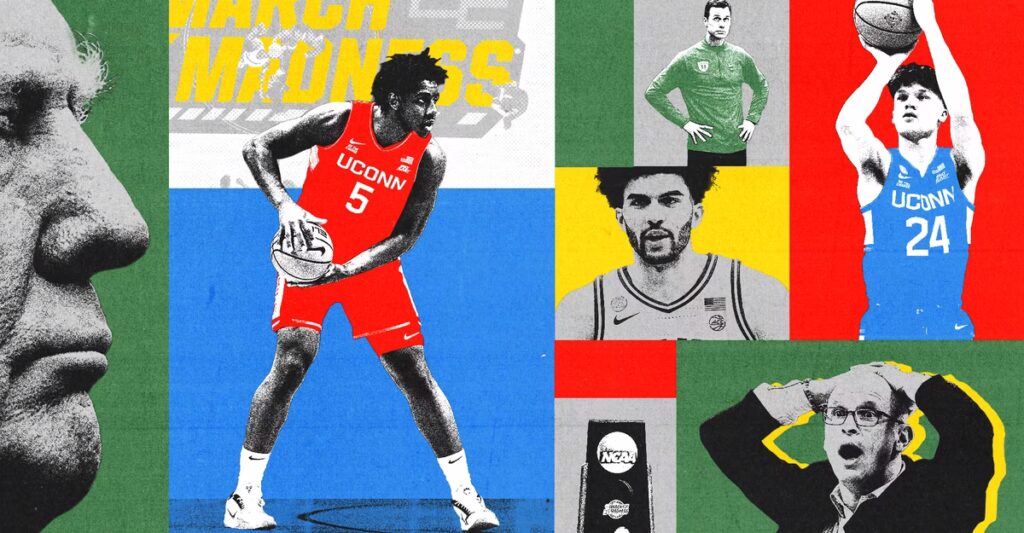
There was lightning in the shot that the University of Connecticut freshman Braylon Mullins made from near mid-court to send his team to the NCAA basketball championship’s Final Four. There was true, loyal sorrow in the tears that trickled from the welted eye of Duke’s Cameron Boozer, swollen nearly shut, after his team’s stunning loss on Mullins’s buzzer beater. The action in this March Madness tournament has put the lie to complaints by nostalgists that cash has killed college athletics.
In the new collegiate economy, players command a small fortune for the use of their name, image, and likeness, and can transfer schools at will. Recruiting has become transactional, and coaches must remake their team yearly. But what, really, is so wrong with that? For all the fears about pay corrupting players’ motives and destroying tradition, one of the things on display in this honey of a tournament is that coin doesn’t kill caring. It doesn’t kill quality. It doesn’t kill the thrill. “Obviously that’s an epic,” the UConn coach Dan Hurley said, after his team’s 73–72 victory proved that iconic games still happen.
The charm of March Madness has always lain in its high-emotion clash of cultures, playing styles, and campus philosophies. The open-player market so bemoaned by purists has actually enhanced the varieties on display, as schools have been forced to abandon their old recruiting certainties and experiment. The teams that reached the Sweet 16 were built with very different methods. Seeing if one approach prevails over another is a fascinating subtext, almost a game within the game.
[Read: How to fix the mess of college sports]
The University of Illinois, that 159-year-old midwestern land-grant institution, avoided the million-dollar American recruiting wars and reached the Final Four with a roster so heavy with foreign-born players, it’s nicknamed the “Balkan Bloc.” Duke went a more traditional route: It put highly recruited blue-chip freshmen on the floor, including Cam and Cayden Boozer, the twin sons of the alumnus Carlos Boozer, who together are reported to be worth about $3 million in endorsements and whose Samsung and State Farm commercials were on loop on CBS during the tournament.
The 71-year-old Michigan State coach Tom Izzo’s philosophy was what he called not old-school but “right-school”: He had five seniors on his roster, and all of his starters in the Sweet 16 had begun their college career with him. Hurley, in contrast, had built his UConn like a hybrid car: Mullins had been one of the most sought-after freshman recruits in the country, but he shared the floor with veteran transfers such as Tarris Reed Jr., a senior who’d come from Michigan in 2024, and Silas Demary Jr., a junior who’d arrived from Georgia after the basketball season ended last spring.
What all of these teams have in common is that their coaches are great teachers and their players quick studies. In this way, the new system has its virtues. With rosters changing every year and the influx of transfers, a coach had better be an expert instructor and a master at fostering organizational chemistry. The system, strangely, rewards learning. It exposes the bad teachers and false promisers, and highlights the sincere ones. “You remember the teachers and coaches that pushed you to your maximum, pushed you beyond your comfort level to get the most out of you,” Hurley told the press last week. He added, “I think the same thing applies to coaching. Feel like I got a responsibility.”
Virtuoso teaching was especially visible at the East Regional Sweet 16 round, starring UConn, St. John’s, Michigan State, and Duke. If any team could be said to represent the supposedly corrupted, talent-hoarding transactional era, it was St. John’s. Coach Rick Pitino, who has worked at seven different schools, fashioned this year’s roster almost entirely out of well-paid transfers. He brought in nine new players to place around the veteran Zuby Ejiofor, a 2023 transfer from Kansas. Yet the Johnnies were one of the most startlingly well-bonded outfits in the country; in their Sweet 16 thriller, they pushed the top-ranked Duke all the way through, to the final 10 seconds, before losing, 80–75. “One of the most unique teams I’ve had in 52 years,” the 73-year-old Pitino said, white-faced and eyes red-rimmed afterward. “They were just the greatest kids in the world.” Ejiofor had reportedly left $2 million on the table in name, image, and likeness deals offered by other schools to return to St. John’s.
The current system is not without its faults. The main thing that needs to be worked out is the too-liberal transfer rule. In April 2024, under pressure from legal challenges on antitrust grounds, the NCAA granted athletes the ability to change schools an unlimited number of times as long as they retained academic eligibility. Combined with NIL rights, this created market mayhem, with some athletes changing schools four or five times, seeking playing time or endorsement-related paychecks. UConn’s Dwayne Koroma, a senior, is playing for his fifth school. The University of Arkansas coach John Calipari joked last week that some teams have players who are “25, 26, 27, beards, kids in the stands, on their second wife.”
[Read: The shame of college sports]
To President Trump, this acquisition of market leverage by athletes is cause for hysteria. In a speech last week at a fundraising dinner, Trump pronounced college sports a “disaster” and a “mess like you’ve never seen before.” The “millions” commanded by athletes, he claimed, would “bankrupt” universities. He has called for rolling back the antitrust legal decisions that enabled it.
But commonsense fixes are available—solutions to make the system more practical without unfairly imposing on athletes’ rights and making them akin to indentured servants again. Most coaches who spoke during the NCAA tournament supported their players’ right to earn off their talents. What they seek to curb is the opportunism of unsavory agents who inflate their clients’ worth and, with false promises of gain, encourage them to transfer like skipping stones. “I’m not going to be extorted,” Calipari said at a pregame press conference last week. Izzo, of Michigan State, told reporters, “I’m not going to be afraid to coach a guy because he can transfer this week.”
Calipari has campaigned for a rule shift that would allow players to transfer once without penalty but would require them to sit out one season if they move a second time. In a speech last summer, he said, “If we cure the transfer rule, 70 percent of our problems go away. We can deal with all the other stuff.” It’s a sensible proposal. Growing evidence suggests that the wide-open transfer policy may harm players’ economic and education prospects. About 2,700 men’s-basketball players entered the transfer system after last season, according to an ESPN database. A study, by the analytics consultant group Timark, found that 65 percent of players who sought a move either transferred to a lesser institution or did not find a new school. Transfers cost students credits and can delay or even derail graduation, which is a significant, understated risk, given that fewer than 2 percent of college players make it to the NBA.
The NCAA would need limited antitrust protection from Congress to make this change to the transfer system, but that appears to be obtainable. Senator Tommy Tuberville of Alabama, a former Auburn football coach, proposed just such a bill last week. It’s a simple piece of legislation, the substance of which is about three pages long, unlike previous NCAA-reform bills, such as the terminally stalled SCORE Act, which runs 86 pages. Tuberville may even win over opponents such as Senator Chris Murphy of Connecticut, who has been a dogged advocate for player rights but who has also acknowledged that unlimited movement is problematic and not necessarily a player benefit. “It is better for the athletes than the old system, but it’s also not working,” Murphy said in a hearing last week.
Fix the transfer issue, and it will be clearer that player income is not a college crisis. Cam Boozer’s net worth didn’t prevent him from playing the entire game with his eye at half-mast. “We gave a lot,” Boozer said in his tearful press conference. “It took a lot of heart, a lot of balls, to do that.”
Despite the powerful undertows, allegiance and commitment are still present in the top tier of the college game. A roster search of the Sweet 16 teams by the Associated Press showed that 11 had at least three starters who’d played at their school and nowhere else. Five teams had at least four starters who’d played multiple seasons for their coach.
On Hurley’s UConn team, four players have spent three years or more under him, and five were returners for a second season. “When you’re with a group of people that care so much about each other and what you’re trying to accomplish, it’s an addictive feeling,” Hurley said last week. His veterans, he said, were a “a bunch of players that let us coach them, let us coach them hard,” and they were a difference-maker in reaching the Final Four.
Hurley coaxed his team back from a 15-point halftime deficit against Duke, whose freshmen could not handle the pressure when the game got tight. As the final shot fell in, Hurley’s suit coat was nearly torn off his shoulders in the explosive joy on his bench. At the Final Four this weekend, in Indianapolis, he will be trying to coach his team to a third national title in four seasons. Nostalgists should note: That’s a feat that has not been accomplished since UCLA in the 1970s. For all of the economic evolutions in the NCAA, the qualities of a championship team haven’t changed.
*Source Images: Zach Bolinger / Icon Sportswire / Getty; Emilee Chinn / Getty; Patrick Smith / Getty; Jonathan Brady / AFP / Getty.
The post The Lesson of a Thrilling March Madness appeared first on The Atlantic.