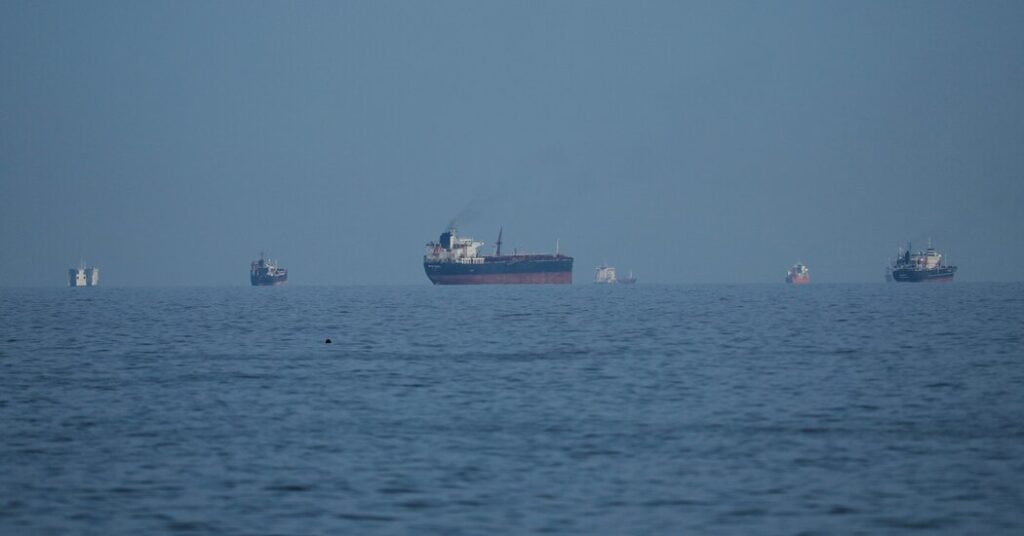
The gas tanker had been marooned in the Persian Gulf for more than two weeks when its crew saw missiles rain down on a target only a dozen or so nautical miles away.
It was the Iranian attack last month on the Ras Laffan terminal in Qatar, the world’s largest liquefied natural gas facility. The night sky lit up with explosions and the tanker’s crew braced for debris.
“The first thing that came to my mind was my family, what would happen to them if something happened to me, since I am the breadwinner,” said K.R., a sailor who saw the strikes from the deck of the tanker and spoke over the Messenger app from his ship. He asked to be identified only by his initials, and that his employer and vessel not be named, for fear of losing his job.
He is one of almost 20,000 seafarers stranded in the Persian Gulf, according to the International Maritime Organization, as Iran has effectively blocked the exit through the Strait of Hormuz. Nearly 7,300 of those are Filipino, the Philippine government said last month, a sign of how the nation supplies a substantial portion of the world’s cargo ships, and how reliant it is on citizens working overseas and sending money back home.
K.R. spends his days painting and chipping rust on the outer hull of the tanker he is on. He said he is in daily contact on Messenger with his parents and younger sister. His ship was scheduled to sail through the Strait of Hormuz on Feb. 28 — the day the United States and Israel launched attacks on Iran — but got stuck in the waters of the Gulf instead. The crew has enough food supplies to last through April, and has no indication of when they will be able to sail to safer waters.
“The fear doesn’t go away. I worry about my family,” K.R. said. “In my mind, I just surrender to God whatever happens to me or to us here.”
About 20 commercial vessels have been attacked in the region since the war began, according to the I.M.O., a United Nations agency. Ten seafarers and one shipyard worker were killed, at least 10 were injured and four remain missing. One of them, George Miranda, 46, a Filipino motorman, has not been accounted for since the Mussafah 2, a tug sailing under the flag of the United Arab Emirates, was hit by two missiles on March 6 while assisting a vessel in the strait that had been hit by a missile.
The five Filipino seafarers The Times interviewed did not want to talk on the record for fear of running afoul of their employers, particularly those operating in the Gulf, as well as fear of getting arrested. Last month, three Filipinos in the U.A.E. were detained for posting videos of missile attacks on social media.
One Filipino sailor said that a couple of weeks ago, he saw from his vessel what appeared to be a drone attack on a port in the Gulf. There were multiple explosions and the crew was ordered to go below deck.
He said that his vessel made it out of the strait, which Iran has effectively blockaded. But then it had to sail through the Red Sea, where he was concerned about pirates. (The waterway has also become potentially more dangerous since the Houthis, an Iran-backed group in Yemen, have started attacking Israel and could disrupt maritime routes.)
Some sailors, he said, have stopped sleeping in their cabins, believing the lodgings are more likely to be targeted. They have moved into workshops and other locations on the ship that they consider more safe.
Simon Grainge, the chief executive of the London-based International Seafarers’ Welfare and Assistance Network, said sailors reaching out through its 24-hour helpline are afraid, distressed and anxious. Some are even expressing thoughts of self-harm.
“Seafarers are finding themselves in a conflict zone, potentially under attack, with no clear way out,” he said. “They are completely at the mercy of events.”
Hans Cacdac, the secretary of the Philippines’ Department of Migrant Workers, said seafarers have the right to refuse sailing in conflict zones, including through the Strait of Hormuz, and that those who do are entitled to two months’ worth of wages and free repatriation. But it remains unclear whether those protections can apply to the sailors stranded at sea.
At a shelter and counseling center in Manila run by Stella Maris, a Catholic seafarers’ mission, the Rev. Paulo Prigol said that the war was hurting livelihoods in the Philippines.
For most Filipinos, a job on a merchant marine ship is a ticket out of poverty.
The priest said that he had spoken to a young Filipino cadet whose first deployment lasted only days before routes were disrupted because of the new conflict. “The dream was gone in eight days,” he said.
“This war will have an impact on the decision-making process of a seafarer,” he added. “Those with family and kids, I think they will consider the decision twice.”
But for some seafarers, being penniless at home is riskier.
One sailor, who attended a service led by Father Prigol on Saturday, said he had been a motorman on a cargo ship that was struck by a drone near the Suez Canal in 2023. But he said sailing was the only way he knows how to make a living.
On the outskirts of Davao City, Nigel Nimes, 19, learned that his father was in waters close to the Iran war the way many families did — through the news.
His father, a cargo ship captain on a freight route near Turkey, had not even heard about the war. The internet on board was unstable, and all he knew was that they had been rerouted. Since then, the younger Mr. Nimes said, he checks on his father every chance he gets.
“It’s quite close” to the Iran war, he said of his father’s ship. He said he worries the vessel will be hit by a missile intended for another target.
The family wants him home. But if that happens, Mr. Nimes said that there may not be money to pay for his studies.
The post ‘The Fear Doesn’t Go Away’: The Merchant Seamen Stuck in the Persian Gulf appeared first on New York Times.