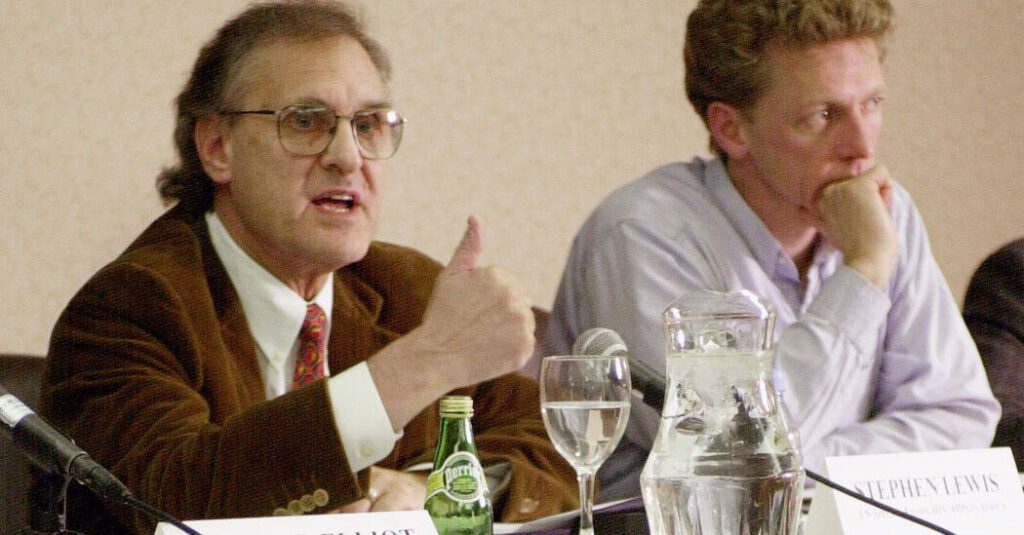
Stephen Lewis, a Canadian leftist political leader and diplomat who turned to fighting the AIDS epidemic in Africa after steering Ontario’s New Democratic Party in the 1970s, died on Tuesday in Toronto. He was 88.
His death, in a hospice facility, was from cancer, his family said in a statement.
Mr. Lewis was part of a progressive political dynasty. His father, David Lewis, led the federal New Democrats, Canada’s longtime main leftist party, in the 1970s, overlapping with the period when Stephen Lewis was piloting the party in Ontario. Two of the younger Mr. Lewis’s siblings also served in leadership roles in the provincial party in the 1980s and ’90s.
On Sunday, two days before Mr. Lewis died, his son, the broadcast journalist, filmmaker and politician Avi Lewis, was chosen to lead the New Democrats nationwide, as they seek to rebuild after a crushing defeat in last year’s federal election.
After leaving party politics in 1978, Mr. Lewis, an impassioned orator, became a commentator on radio and television. In the 1980s, he was Canada’s ambassador to the United Nations. He later advised the U.N. on African affairs. From 1995 to 1999, he served as the deputy director of UNICEF, and by the early 2000s, he had devoted himself to promoting awareness of the vast destruction wrought by AIDS in Africa.
Mr. Lewis’s commitment to the issue was a bright spot during the dark days of AIDS denialism on that continent, said Vuyiseka Dubula, an official with the Stephen Lewis Foundation, an advocacy organization that Mr. Lewis founded in 2003.
Mr. Lewis, she said, had been both an inspiration and a confidante to other activists.
“Many of us would go to him when we were struggling with some difficult moments and crossroads in our political lives,” she said. “He has given us so much hope.”
Prime Minister Mark Carney of Canada, a Liberal, said in a statement that Mr. Lewis had been “a pillar of compassionate leadership in Canadian democracy and a renowned global champion for human rights and multilateralism.”
Stephen Henry Lewis was born in Ottawa on Nov. 11, 1937, the eldest of four children of David and Sophie (Carson) Lewis. His paternal grandfather, Moishe Lewis, was a Jewish labor activist from Poland who fled to Canada in the 1920s, anglicizing his last name from Losz.
Stephen’s family moved to Toronto in 1950. In 1956, he entered the University of Toronto, then transferred to the University of British Columbia before returning to the Toronto school.
But he left without completing his final examinations and took a job with the Socialist International, which led him to a weeklong conference in Ghana, his first experience in Africa.
In the early 1960s, Mr. Lewis started law school at the University of Toronto. During his second year, he debated John F. Kennedy, then a U.S. senator from Massachusetts, at a university event centered on the question of whether the United States had failed in its responsibilities as a world leader.
Kennedy was stiff and read from his remarks without looking up much, according to an account by the Canadian author John Boyko in a book he wrote about Kennedy.
By contrast, Mr. Boyko wrote, for a 19-year-old student debater, Mr. Lewis was nimble and confident, quipping that the United States had asserted itself as the “policeman, babysitter and bank to the world.”
Mr. Lewis left law school without getting a degree.
After working intermittently with the New Democrats, Mr. Lewis was persuaded by the powerful leftist leader Tommy Douglas, who had ushered in Canada’s universal health care program, to get into politics. In 1963, Mr. Lewis, at 25, was elected to represent a district in east Toronto as a member of Ontario’s provincial Parliament.
He was selected to lead the provincial party in 1970, when he was 33. By 1974, he had built it up to form Ontario’s official opposition party. He won popular support focusing on classic leftist issues like affordable living and workers’ rights. His strategy was so effective that the Conservative premier of Ontario at the time acceded to progressive rent-control reforms and a new occupational health and safety law.
With Mr. Lewis at the helm, the New Democrats chipped away at the Conservatives’s majority until they won enough seats in 1975 to form a minority government in a power-sharing arrangement with them.
It was the Ontario party’s best performance in its history, but the jubilation was short-lived. It soon began losing supporters to the Liberals, the mainstream progressive party.
Mr. Lewis was appointed Canada’s ambassador to the United Nations by Prime Minister Brian Mulroney, a Conservative, in 1984 and served in that post until 1988.
He was appointed a U.N. special envoy for H.I.V./AIDS in Africa in 2001, a role in which he was sharply critical of both the U.N. and Western governments for their failure to supply medications in Africa for H.I.V., the virus that can lead to AIDS. His outspokenness eventually alienated the institutions with which he was supposed to work.
“I am personally persuaded that the toll on society from AIDS, the threat to the very underpinnings of African survival, is so intense that the normal, diplomatic properties must be abandoned,” Mr. Lewis said in a 2005 lecture. “I would argue that it’s morally irresponsible to embrace silence when there’s so much at stake.”
He founded the Stephen Lewis Foundation after leaving the U.N. It has raised $200 million for African H.I.V. and AIDS organizations, with a particular focus on assistance to grandmothers raising orphaned children.
In addition to his son, Avi, who is married to the author Naomi Klein, Mr. Lewis is survived by his wife, Michelle Landsberg, a journalist; two daughters, Jenny Lewis and Ilana Landsberg-Lewis; and four grandchildren.
On Sunday, Avi Lewis told a crowd of supporters that even on his deathbed, his father had been asking about the New Democrats.
“Ever the political fanatic,” Mr. Lewis said, “Dad has demanded daily updates about our organizing delivered to his hospital bed, a veritable IV drip of campaign data. At age 88, he is more passionate about the promise of democratic socialism than he has ever been.”
Vjosa Isai is a reporter for The Times based in Toronto, where she covers news from across Canada.
The post Stephen Lewis, Leftist Canadian Politician and AIDS Activist, Dies at 88 appeared first on New York Times.