THIS LAND IS YOUR LAND: A Road Trip Through U.S. History, by Beverly Gage
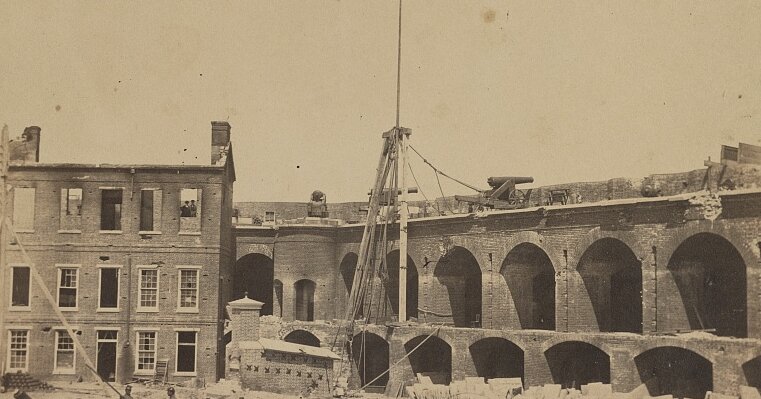
The American flag has typically signified confidence, whether connected to Olympic pride or MAGA rage. But it’s worth remembering a time when the Stars and Stripes suggested something more fragile. In 1861, when the Confederacy fired on the federal garrison at Fort Sumter, S.C., and ignited the Civil War, the American flag that flew there indicated what the historian Beverly Gage calls “the shaky presence of federal authority.” Consequently, it was pulled down and replaced with a Confederate flag. At a moment of profound upheaval, nobody knew when, or if, the United States flag would go back up.
In “This Land Is Your Land,” her companionable tour through 13 places and events in America’s past, Gage recounts a visit she made to the fort, where the flag is raised every morning. A park ranger guided about 20 volunteers, Gage included, to unroll the enormous flag, attach it to some clips and hoist it up the pole.
As she watched the flag fluttering in the wind while everyone cheered, she felt unexpectedly moved. In 1865, after the Confederacy surrendered at Appomattox and the American flag was once again raised at Fort Sumter, it was received by the crowd that gathered there as a potent symbol of both anguish and liberation. The ceremony she witnessed in 2023 “managed to evoke that sense of bygone purpose.”
In one obvious respect, “This Land Is Your Land” is perfectly timed. Gage says she was inspired to write the book by the upcoming Semiquincentennial, the 250th anniversary of the Declaration of Independence. As a historian at Yale whose previous book was a Pulitzer Prize-winning biography of the F.B.I. director J. Edgar Hoover, Gage wanted to experience history as a lot of Americans experience it, on road trips to museums, souvenir shops and battlefield re-enactments, instead of holed up in the archives. She spent part of 2023 and 2024 visiting approximately 300 historic sites.
But in another way, Gage’s road trips might as well have taken place in a different era. Within the last year, the Trump administration has demanded that the National Park Service remove or cover up any displays that might “disparage Americans.” As Gage was finishing her book, she noticed that instead of encouraging curiosity in the country’s history, the government seemed determined to thwart it: “Apparently the nation intends to mark its 250th anniversary by chastising and defunding the very programs and institutions — the National Park Service, the National Archives, the National Endowment for the Humanities and many others — that make its history accessible.”
Then again, setbacks and reversals have always been part of the American story. Gage says she wanted her book to steer clear of both “veneration” and “damnation” — the unmodulated opining that characterizes a lot of our historical dialogue and casts the country as either a hero or a villain. What comes through in her book is how complicated and just plain weird a lot of American history is.
Sometimes the irony is thicker than the “providential fog” that supposedly saved George Washington’s troops from British detection in August 1776. At Philadelphia’s Museum of the American Revolution, an elaborate exhibit centered on Washington’s field tent gives Gage an opportunity to reflect on how his wife’s great-granddaughter was married to Robert E. Lee — the Confederate general “who did as much as any man to tear apart the national fabric Washington had tried to weave.” When the Civil War ended, Lee’s daughter, who by then had possession of Washington’s tent, sold it to raise money for Confederate widows.
The places that Gage visits are often marked by contradiction, which she highlights to powerful effect. Before the Civil War, Beaufort, S.C., was a “hotbed of secession”; now it’s the headquarters for the Reconstruction Era National Historical Park. Visitors can learn the remarkable story of Robert Smalls, who was born into slavery in Beaufort and enlisted by the Confederacy as the pilot on a transport ship. In 1862, Smalls and the other enslaved men on board steered the ship to the Union side. He later helped South Carolina draw up a new state constitution and served five terms in the U.S. House of Representatives.
Given the difficulty of identifying a single arc or through line, Gage decided to structure her book chronologically, beginning with the Revolutionary experience in her home state of Pennsylvania and ending in contemporary California, with visits to the Ronald Reagan Presidential Library and Museum and, inevitably, Disneyland.
As unsparing as she is about the country’s history, she is uneasy with the despair on offer at the Legacy Museum in Montgomery, Ala. The museum gets the facts right: “The American past really was this blood-soaked.” But she takes issue with the museum’s declaration that “slavery didn’t end. It evolved.” Gage suggests that such bleak fatalism is the mirror image of a sunny triumphalism. “A neat progress tale doesn’t capture the depth of resistance” to abolitionist efforts, she writes. “But I’m not sure what’s gained by suggesting that they didn’t make much difference.”
Gage worries about some of the likely celebrations for the country’s 250th birthday, “since the powers that be in Washington seem as interested in suppressing history as in understanding it.” She might be a shade too generous; you could argue that they are much more interested in suppressing history than in understanding it.
But a book like this, clearly intended for a broad audience, cannot have the author saying anything that sounds harsh or, perish the thought, divisive. After all, Gage’s subtitle is “A Road Trip Through U.S. History.” As a guide, she is necessarily inviting; as a historian, she knows that none of the attempts to fulfill the Declaration’s promise of freedom and equality has ever come easily. “Much of the task of celebrating the 250th will fall to the rest of us,” she writes, “ordinary citizens who will have to do what we can with what we’ve got where we are.”
THIS LAND IS YOUR LAND: A Road Trip Through U.S. History | By Beverly Gage | Simon & Schuster | 324 pp. | $30
Jennifer Szalai is the nonfiction book critic for The Times.
The post Road-Tripping With a Historian Through America’s Past appeared first on New York Times.