In 1976, Chris Espinosa rode his Puch moped a mile and a half every Wednesday afternoon, parked it and went to work. Just 14 years old, he still had to go to school and didn’t have a driver’s license. But his employer, Apple Computer, had customers who wanted to try its earliest computer, and Mr. Espinosa was responsible for demonstrating it.
Mr. Espinosa’s job has changed many times in the 50 years since. But he still works for Apple.
Mr. Espinosa, 64, is one among an increasingly rare breed in today’s economy: people who have spent all of their lives working for one company. It is even harder to find somebody like him in Silicon Valley, where companies start up and shut down overnight and software engineers, product managers and others switch jobs every couple of years.
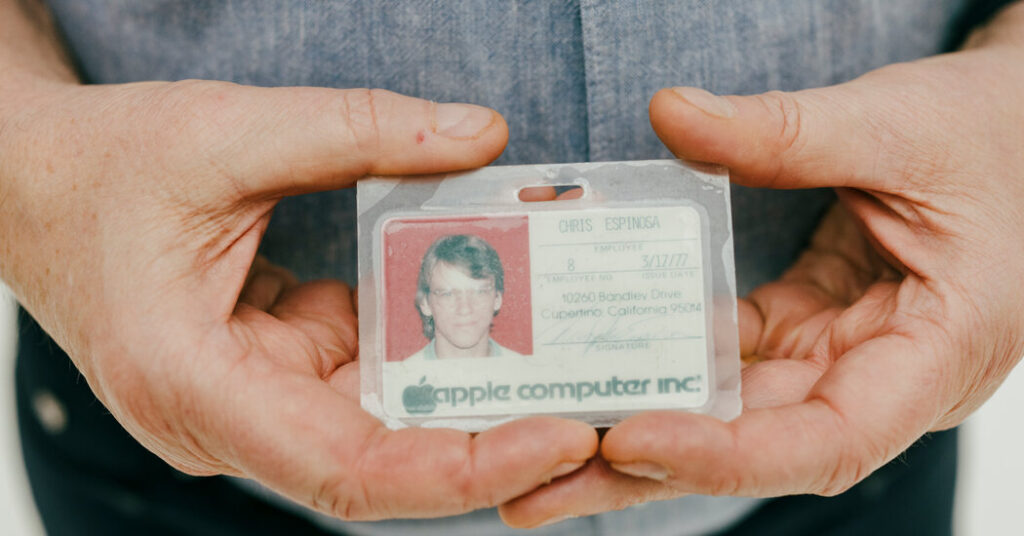
On Wednesday, Apple turned 50. Few have witnessed its transformation as closely as Mr. Espinosa, its longest-tenured employee. When Steve Jobs and Steve Wozniak signed the documents to start Apple in 1976, Silicon Valley’s fruit orchards hadn’t yet been taken over by office parks. Mr. Espinosa became employee No. 8 at the scrappy start-up that assembled computers by hand in Mr. Jobs’s childhood home.
“It was a time of both great promise and great trepidation,” Mr. Espinosa said. “The ability to have a great idea, start a company and then either not find your customers and go out of business or not manage growth and go out of business — that was just the rule.”
In half a century, Apple has risen, fallen and risen again. A mythology has developed around the company as it has become one of the most valuable outfits in the world. Mr. Jobs, who died in 2011, has become so idolized that he was the subject of at least two movies, one of which was nominated for two Oscars.
Apple is now worth roughly $4 trillion, makes more than $100 billion in profit every year and has 2.5 billion of its phones, tablets, computers, earphones and smart watches in use around the world. Those devices have shaped the industries of computing and entertainment. Between its supply chain and its retail business, Apple has come to define how to be a global technology company.
But Apple, which dropped “Computer” from its name in 2007, faces questions that dog mature companies. It is a political player that must reckon with tariff whiplash, antitrust scrutiny and geopolitical turmoil. The iPhone is nearly two decades old, leading to expectations that its maker will introduce new products. And like other technology giants, Apple is under pressure to seize on artificial intelligence.
But before it became an industry juggernaut, Apple germinated among the electronics hobbyists of Silicon Valley. Mr. Jobs, Mr. Wozniak, Mr. Espinosa and other early employees attended Homestead High School in Cupertino, Calif. They found kindred spirits to tinker and talk computers with at the Homebrew Computer Club, a group that met in Menlo Park, Calif.
Mr. Espinosa met Mr. Jobs at the Byte Shop, a computer store that had locations in Mountain View, Calif., and surrounding Bay Area towns. There, Mr. Jobs recruited Mr. Espinosa to write computer programs for the Apple II, which would become one of the first popular personal computers, in BASIC, a now out-of-fashion programming language.
“It was really, really fun, because that was the time when people were starting the entire industry from scratch,” Mr. Espinosa said. Whether computer stores or commercial software, he added, “all of these things had to be invented.”
In 1978, Mr. Espinosa took his only hiatus from Apple, for a stint at the University of California, Berkeley. Even then, he worked part time for the company and burned the midnight oil writing the user’s manual, more than 200 pages long, for the Apple II. In 1981, Mr. Jobs persuaded Mr. Espinosa to drop out and return full time to Apple.
Four years later, though, Mr. Jobs had left Apple after a power struggle with its chief executive at the time, John Sculley. Over the next decade or so, the company found itself rudderless and in a financial free fall.
“There were a lot of through lines for Apple that ran — still this desire to do great things, values driven,” said Greg Joswiak, Apple’s head of marketing, who joined in 1986 and has the longest tenure among its leadership team. “But there were also a lot of ways that we lost our way.”
As that happened, Apple laid off staff “again and again and again,” Mr. Espinosa said. His manager told him that he had been spared because he had worked for the company for so long that his severance package would be too expensive.
“I was wondering what I was going to do because I had no college degree and I had only worked at one company,” Mr. Espinosa said. Then he figured: “I was here when we turned the lights on. I might as well stick around until we turn the lights off.”
Then came what Mr. Espinosa called “a cusp” for Apple: the return of Mr. Jobs in 1997. The company’s first 20 years had been an era of “arrogance,” Mr. Espinosa said. But the 30 years after, with the introductions of the iPod and the iPhone, are what define consumer electronics today.
“The idea of having a computer in your home or one that you carried around with you all the time or one you strapped to your wrist — those were not only unthinkable but probably scary and weird” in the 1970s, Mr. Espinosa said.
Mr. Espinosa now works on the operating system for Apple TV, the company’s streaming device. The 2,000 shares that Mr. Wozniak gave him shortly after Apple went public in 1980, as part of the “Woz Plan” to offer his shares to early employees, would now be worth nearly $57,000 each — a combined $114 million.
As much as Apple has changed over the past 50 years, Silicon Valley has, too. Many of the companies that have come and gone, Mr. Espinosa said, “have been designed by a hustler who thinks he’s Steve Jobs, who wants to find his Steve Wozniak, get venture capital, fund an unprofitable, unsuccessful company.”
“The model out there isn’t built for stability, isn’t built for doing things in the customer interest,” he said. “So much of tech is now just seeking the next bubble and getting out before it pops, and that’s not what we do here.”
Kalley Huang is a Times reporter in San Francisco, covering Apple and the technology industry.
The post One of Apple’s First Employees Looks Back at 50 Years appeared first on New York Times.